

Stereochemical considerations in the E2 reactions The E2 follows a
concerted mechanism, where removal of the proton and formation of the
double bond occur at the same time. The partial p bond in the transition state
requires the parallel alignment or coplanar arrangement of the p orbitals.
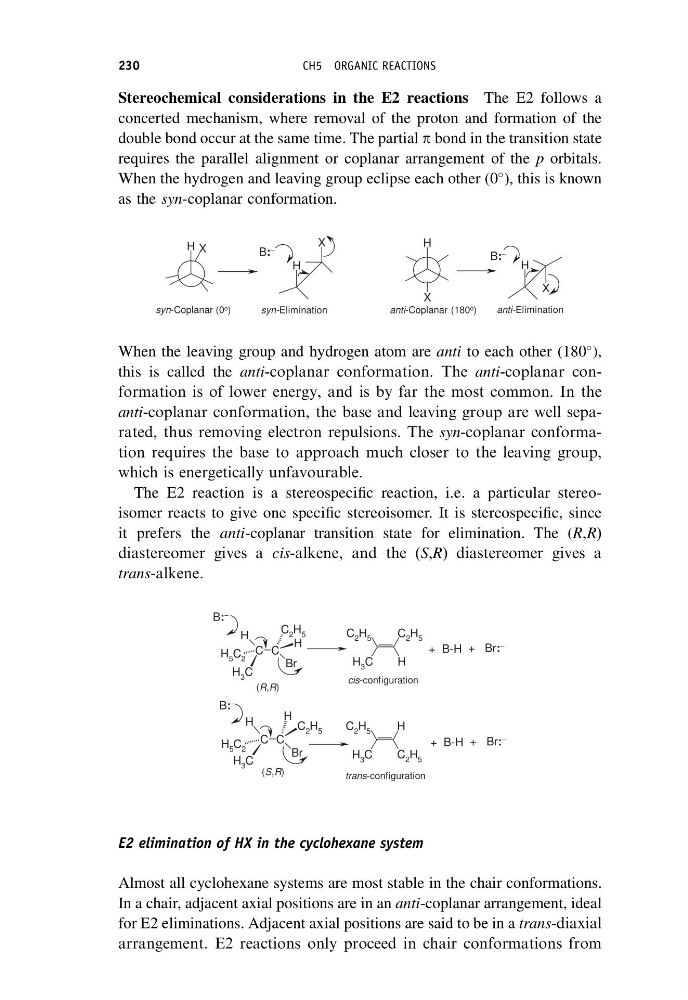
When the hydrogen and leaving group eclipse each other (0
), this is known
as the syn-coplanar conformation.
H
X
H
X
H X
H
X
syn-Elimination
anti-Elimination
B: −
syn-Coplanar (0 o )
anti-Coplanar (180 o )
B: −
When the leaving group and hydrogen atom are anti to each other (180
),
this is called the anti-coplanar conformation. The anti-coplanar conformation is of lower energy, and is by far the most common. In the
anti-coplanar conformation, the base and leaving group are well separated, thus removing electron repulsions. The syn-coplanar conformation requires the base to approach much closer to the leaving group,
which is energetically unfavourable.
The E2 reaction is a stereospecific reaction, i.e. a particular stereoisomer reacts to give one specific stereoisomer. It is stereospecific, since
it prefers the anti-coplanar transition state for elimination. The (R,R)
diastereomer gives a cis-alkene, and the (S,R) diastereomer gives a
trans-alkene.
H
C C
Br
C
H 3
C 2 H 5
H 5 C 2
H
H
C C
Br
C
H 3
H
H 5 C 2
C 2 H 5
C 2 H 5
C 2 H 5
C
H 3
H
C 2 H 5
H
C
H 3
C 2 H 5
(S,R)
trans-configuration
(R,R)
cis-configuration
+ B-H
+ B-H
B: −
B: −
+ Br: −
+ Br: −
E2 elimination of HX in the cyclohexane system
Almost all cyclohexane systems are most stable in the chair conformations.
In a chair, adjacent axial positions are in an anti-coplanar arrangement, ideal
for E2 eliminations. Adjacent axial positions are said to be in a trans-diaxial
arrangement. E2 reactions only proceed in chair conformations from
230
CH5 ORGANIC REACTIONS
concerted mechanism, where removal of the proton and formation of the
double bond occur at the same time. The partial p bond in the transition state
requires the parallel alignment or coplanar arrangement of the p orbitals.
When the hydrogen and leaving group eclipse each other (0
), this is known
as the syn-coplanar conformation.
H
X
H
X
H X
H
X
syn-Elimination
anti-Elimination
B: −
syn-Coplanar (0 o )
anti-Coplanar (180 o )
B: −
When the leaving group and hydrogen atom are anti to each other (180
),
this is called the anti-coplanar conformation. The anti-coplanar conformation is of lower energy, and is by far the most common. In the
anti-coplanar conformation, the base and leaving group are well separated, thus removing electron repulsions. The syn-coplanar conformation requires the base to approach much closer to the leaving group,
which is energetically unfavourable.
The E2 reaction is a stereospecific reaction, i.e. a particular stereoisomer reacts to give one specific stereoisomer. It is stereospecific, since
it prefers the anti-coplanar transition state for elimination. The (R,R)
diastereomer gives a cis-alkene, and the (S,R) diastereomer gives a
trans-alkene.
H
C C
Br
C
H 3
C 2 H 5
H 5 C 2
H
H
C C
Br
C
H 3
H
H 5 C 2
C 2 H 5
C 2 H 5
C 2 H 5
C
H 3
H
C 2 H 5
H
C
H 3
C 2 H 5
(S,R)
trans-configuration
(R,R)
cis-configuration
+ B-H
+ B-H
B: −
B: −
+ Br: −
+ Br: −
E2 elimination of HX in the cyclohexane system
Almost all cyclohexane systems are most stable in the chair conformations.
In a chair, adjacent axial positions are in an anti-coplanar arrangement, ideal
for E2 eliminations. Adjacent axial positions are said to be in a trans-diaxial
arrangement. E2 reactions only proceed in chair conformations from
230
CH5 ORGANIC REACTIONS