

N
CH(CH 3 ) 2
(H 3 C) 2 HC
H
N
C O
Potassium-t-butoxide
Diisopropylamine
2,6-dimethylpyridine
K +
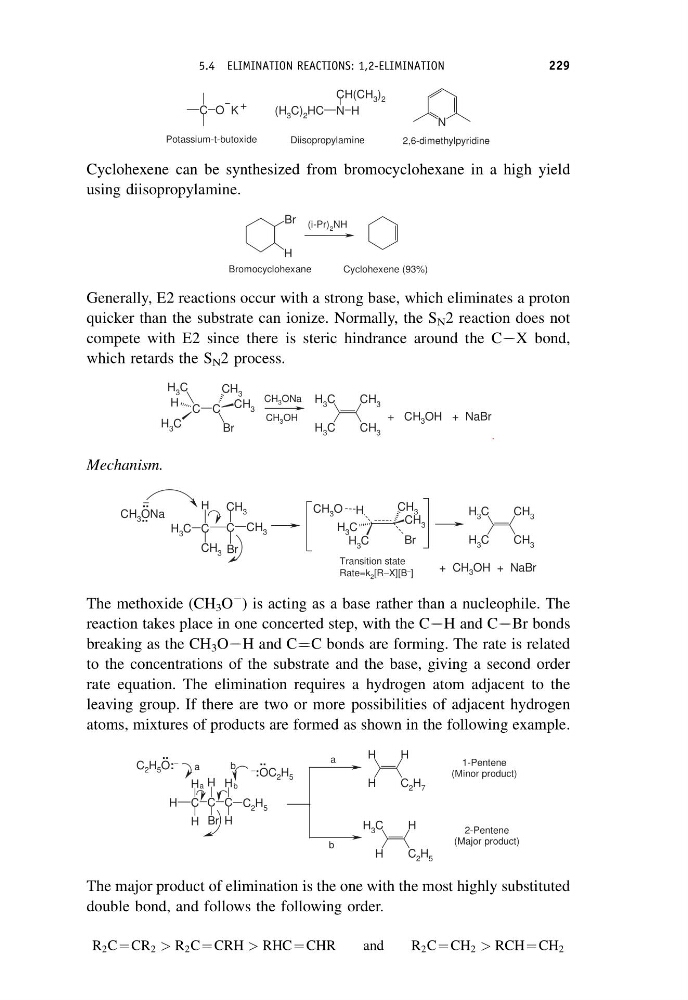
Cyclohexene can be synthesized from bromocyclohexane in a high yield
using diisopropylamine.
Br
H
(i-Pr) 2 NH
Bromocyclohexane
Cyclohexene (93%)
Generally, E2 reactions occur with a strong base, which eliminates a proton
quicker than the substrate can ionize. Normally, the S N 2 reaction does not
compete with E2 since there is steric hindrance around the CÀ ÀX bond,
which retards the S N 2 process.
C C
C
H 3
CH 3
Br
CH 3
H
C
H 3
C
H 3
CH 3
C
H 3
CH 3
+ CH 3 OH + NaBr
CH 3 ONa
CH 3 OH
.
Mechanism.
C
H 3
C
H
CH 3
C
CH 3
Br
CH 3
C
H 3
C
H 3
H
CH 3 O
CH 3
Br
CH 3
CH 3 ONa
C
H 3
CH 3
C
H 3
CH 3
Transition state
Rate=k 2 [R−X][B − ]
_
..
..
+ CH 3 OH + NaBr
The methoxide (CH 3 O
À ) is acting as a base rather than a nucleophile. The
reaction takes place in one concerted step, with the CÀ ÀH and CÀ ÀBr bonds
breaking as the CH 3 OÀ ÀH and C À À
À À C bonds are forming. The rate is related
to the concentrations of the substrate and the base, giving a second order
rate equation. The elimination requires a hydrogen atom adjacent to the
leaving group. If there are two or more possibilities of adjacent hydrogen
atoms, mixtures of products are formed as shown in the following example.
H C C
H
H H
Br
C
H
H
C 2 H 5
H
H
H
C 2 H 7
C
H 3
H
H
C 2 H 5
b
a
1-Pentene
(Minor product)
2-Pentene
(Major product)
a
b
C 2 H 5 O: −
..
a
b
..
− :OC 2 H 5
The major product of elimination is the one with the most highly substituted
double bond, and follows the following order.
R 2 C ¼ CR 2 > R 2 C ¼ CRH > RHC ¼ CHR
and
R 2 C ¼ CH 2 > RCH ¼ CH 2
5.4 ELIMINATION REACTIONS: 1,2-ELIMINATION
229
CH(CH 3 ) 2
(H 3 C) 2 HC
H
N
C O
Potassium-t-butoxide
Diisopropylamine
2,6-dimethylpyridine
K +
Cyclohexene can be synthesized from bromocyclohexane in a high yield
using diisopropylamine.
Br
H
(i-Pr) 2 NH
Bromocyclohexane
Cyclohexene (93%)
Generally, E2 reactions occur with a strong base, which eliminates a proton
quicker than the substrate can ionize. Normally, the S N 2 reaction does not
compete with E2 since there is steric hindrance around the CÀ ÀX bond,
which retards the S N 2 process.
C C
C
H 3
CH 3
Br
CH 3
H
C
H 3
C
H 3
CH 3
C
H 3
CH 3
+ CH 3 OH + NaBr
CH 3 ONa
CH 3 OH
.
Mechanism.
C
H 3
C
H
CH 3
C
CH 3
Br
CH 3
C
H 3
C
H 3
H
CH 3 O
CH 3
Br
CH 3
CH 3 ONa
C
H 3
CH 3
C
H 3
CH 3
Transition state
Rate=k 2 [R−X][B − ]
_
..
..
+ CH 3 OH + NaBr
The methoxide (CH 3 O
À ) is acting as a base rather than a nucleophile. The
reaction takes place in one concerted step, with the CÀ ÀH and CÀ ÀBr bonds
breaking as the CH 3 OÀ ÀH and C À À
À À C bonds are forming. The rate is related
to the concentrations of the substrate and the base, giving a second order
rate equation. The elimination requires a hydrogen atom adjacent to the
leaving group. If there are two or more possibilities of adjacent hydrogen
atoms, mixtures of products are formed as shown in the following example.
H C C
H
H H
Br
C
H
H
C 2 H 5
H
H
H
C 2 H 7
C
H 3
H
H
C 2 H 5
b
a
1-Pentene
(Minor product)
2-Pentene
(Major product)
a
b
C 2 H 5 O: −
..
a
b
..
− :OC 2 H 5
The major product of elimination is the one with the most highly substituted
double bond, and follows the following order.
R 2 C ¼ CR 2 > R 2 C ¼ CRH > RHC ¼ CHR
and
R 2 C ¼ CH 2 > RCH ¼ CH 2
5.4 ELIMINATION REACTIONS: 1,2-ELIMINATION
229