

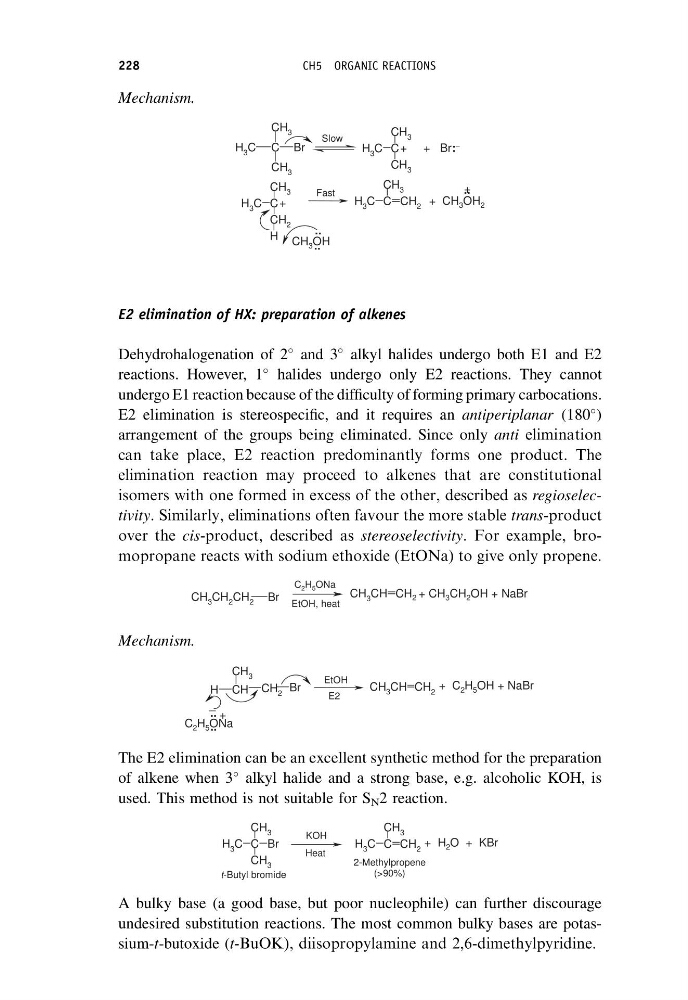
Mechanism.
C Br
C
H 3
CH 3
CH 3
C
CH 3
C
H 3
CH 3
C CH 2
CH 3
C
H 3
C
CH 2
C
H 3
CH 3
H
Fast
+ CH 3 OH 2
CH 3 OH
+
Slow
..
..
+
+
..
+ Br: −
E2 elimination of HX: preparation of alkenes
Dehydrohalogenation of 2
and 3
alkyl halides undergo both E1 and E2
reactions. However, 1
halides undergo only E2 reactions. They cannot
undergo E1 reaction because of the difficulty of forming primary carbocations.
E2 elimination is stereospecific, and it requires an antiperiplanar (180
)
arrangement of the groups being eliminated. Since only anti elimination
can take place, E2 reaction predominantly forms one product. The
elimination reaction may proceed to alkenes that are constitutional
isomers with one formed in excess of the other, described as regioselectivity. Similarly, eliminations often favour the more stable trans-product
over the cis-product, described as stereoselectivity. For example, bromopropane reacts with sodium ethoxide (EtONa) to give only propene.
CH 3 CH 2 CH 2 Br
CH 3 CH CH 2 + CH 3 CH 2 OH + NaBr
EtOH, heat
C 2 H 5 ONa
Mechanism.
CH
CH 3
H
CH 3 CH CH 2
Br
CH 2
EtOH
+ C 2 H 5 OH + NaBr
C 2 H 5 ONa
_
+
..
..
E2
The E2 elimination can be an excellent synthetic method for the preparation
of alkene when 3
alkyl halide and a strong base, e.g. alcoholic KOH, is
used. This method is not suitable for S N 2 reaction.
CH 3
C
C
H 3
CH 3
Br
CH 2
C
C
H 3
CH 3
KOH
t-Butyl bromide
+ H 2 O + KBr
2-Methylpropene
(>90%)
Heat
A bulky base (a good base, but poor nucleophile) can further discourage
undesired substitution reactions. The most common bulky bases are potassium-t-butoxide (t-BuOK), diisopropylamine and 2,6-dimethylpyridine.
228
CH5 ORGANIC REACTIONS
C Br
C
H 3
CH 3
CH 3
C
CH 3
C
H 3
CH 3
C CH 2
CH 3
C
H 3
C
CH 2
C
H 3
CH 3
H
Fast
+ CH 3 OH 2
CH 3 OH
+
Slow
..
..
+
+
..
+ Br: −
E2 elimination of HX: preparation of alkenes
Dehydrohalogenation of 2
and 3
alkyl halides undergo both E1 and E2
reactions. However, 1
halides undergo only E2 reactions. They cannot
undergo E1 reaction because of the difficulty of forming primary carbocations.
E2 elimination is stereospecific, and it requires an antiperiplanar (180
)
arrangement of the groups being eliminated. Since only anti elimination
can take place, E2 reaction predominantly forms one product. The
elimination reaction may proceed to alkenes that are constitutional
isomers with one formed in excess of the other, described as regioselectivity. Similarly, eliminations often favour the more stable trans-product
over the cis-product, described as stereoselectivity. For example, bromopropane reacts with sodium ethoxide (EtONa) to give only propene.
CH 3 CH 2 CH 2 Br
CH 3 CH CH 2 + CH 3 CH 2 OH + NaBr
EtOH, heat
C 2 H 5 ONa
Mechanism.
CH
CH 3
H
CH 3 CH CH 2
Br
CH 2
EtOH
+ C 2 H 5 OH + NaBr
C 2 H 5 ONa
_
+
..
..
E2
The E2 elimination can be an excellent synthetic method for the preparation
of alkene when 3
alkyl halide and a strong base, e.g. alcoholic KOH, is
used. This method is not suitable for S N 2 reaction.
CH 3
C
C
H 3
CH 3
Br
CH 2
C
C
H 3
CH 3
KOH
t-Butyl bromide
+ H 2 O + KBr
2-Methylpropene
(>90%)
Heat
A bulky base (a good base, but poor nucleophile) can further discourage
undesired substitution reactions. The most common bulky bases are potassium-t-butoxide (t-BuOK), diisopropylamine and 2,6-dimethylpyridine.
228
CH5 ORGANIC REACTIONS