

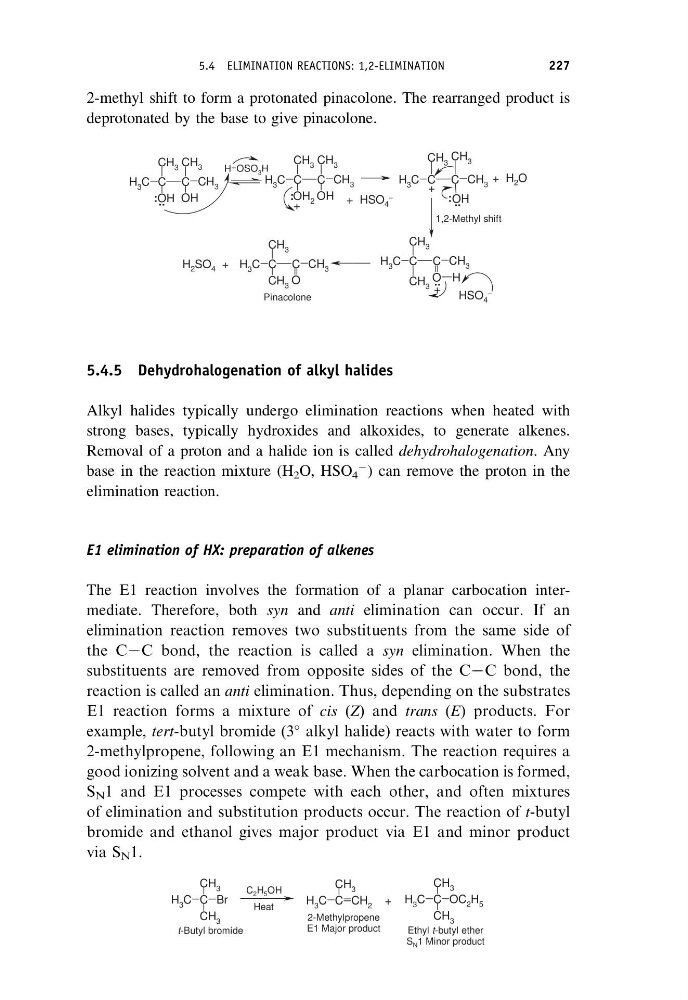
2-methyl shift to form a protonated pinacolone. The rearranged product is
deprotonated by the base to give pinacolone.
C
OH
C
OH
CH 3
CH 3
C
H 3
CH 3
C
OH 2
C
OH
CH 3
CH 3
C
H 3
CH 3
C C
OH
CH 3
CH 3
C
H 3
CH 3
C C
O
CH 3
C
H 3
CH 3
CH 3
H
C
CH 3
C
O
CH 3
C
H 3
CH 3
H OSO 3 H
1,2-Methyl shift
Pinacolone
+
+ H 2 O
+
: ..
:
+
: ..
..
H 2 SO 4 +
HSO 4
−
+ HSO 4
−
5.4.5 Dehydrohalogenation of alkyl halides
Alkyl halides typically undergo elimination reactions when heated with
strong bases, typically hydroxides and alkoxides, to generate alkenes.
Removal of a proton and a halide ion is called dehydrohalogenation. Any
base in the reaction mixture (H 2 O, HSO 4
À ) can remove the proton in the
elimination reaction.
E1 elimination of HX: preparation of alkenes
The E1 reaction involves the formation of a planar carbocation intermediate. Therefore, both syn and anti elimination can occur. If an
elimination reaction removes two substituents from the same side of
the CÀ ÀC bond, the reaction is called a syn elimination. When the
substituents are removed from opposite sides of the CÀ ÀC bond, the
reaction is called an anti elimination. Thus, depending on the substrates
E1 reaction forms a mixture of cis (Z) and trans (E) products. For
example, tert-butyl bromide (3
alkyl halide) reacts with water to form
2-methylpropene, following an E1 mechanism. The reaction requires a
good ionizing solvent and a weak base. When the carbocation is formed,
S N 1 and E1 processes compete with each other, and often mixtures
of elimination and substitution products occur. The reaction of t-butyl
bromide and ethanol gives major product via E1 and minor product
via S N 1.
CH 3
C
C
H 3
CH 3
Br
CH 3
C
C
H 3
CH 3
OC 2 H 5
CH 2
C
CH 3
C
H 3
2-Methylpropene
E1 Major product
Ethyl t-butyl ether
S N 1 Minor product
t-Butyl bromide
Heat
+
C 2 H 5 OH
5.4 ELIMINATION REACTIONS: 1,2-ELIMINATION
227
deprotonated by the base to give pinacolone.
C
OH
C
OH
CH 3
CH 3
C
H 3
CH 3
C
OH 2
C
OH
CH 3
CH 3
C
H 3
CH 3
C C
OH
CH 3
CH 3
C
H 3
CH 3
C C
O
CH 3
C
H 3
CH 3
CH 3
H
C
CH 3
C
O
CH 3
C
H 3
CH 3
H OSO 3 H
1,2-Methyl shift
Pinacolone
+
+ H 2 O
+
: ..
:
+
: ..
..
H 2 SO 4 +
HSO 4
−
+ HSO 4
−
5.4.5 Dehydrohalogenation of alkyl halides
Alkyl halides typically undergo elimination reactions when heated with
strong bases, typically hydroxides and alkoxides, to generate alkenes.
Removal of a proton and a halide ion is called dehydrohalogenation. Any
base in the reaction mixture (H 2 O, HSO 4
À ) can remove the proton in the
elimination reaction.
E1 elimination of HX: preparation of alkenes
The E1 reaction involves the formation of a planar carbocation intermediate. Therefore, both syn and anti elimination can occur. If an
elimination reaction removes two substituents from the same side of
the CÀ ÀC bond, the reaction is called a syn elimination. When the
substituents are removed from opposite sides of the CÀ ÀC bond, the
reaction is called an anti elimination. Thus, depending on the substrates
E1 reaction forms a mixture of cis (Z) and trans (E) products. For
example, tert-butyl bromide (3
alkyl halide) reacts with water to form
2-methylpropene, following an E1 mechanism. The reaction requires a
good ionizing solvent and a weak base. When the carbocation is formed,
S N 1 and E1 processes compete with each other, and often mixtures
of elimination and substitution products occur. The reaction of t-butyl
bromide and ethanol gives major product via E1 and minor product
via S N 1.
CH 3
C
C
H 3
CH 3
Br
CH 3
C
C
H 3
CH 3
OC 2 H 5
CH 2
C
CH 3
C
H 3
2-Methylpropene
E1 Major product
Ethyl t-butyl ether
S N 1 Minor product
t-Butyl bromide
Heat
+
C 2 H 5 OH
5.4 ELIMINATION REACTIONS: 1,2-ELIMINATION
227