

formation of a carbocation intermediate, but formation of a primary
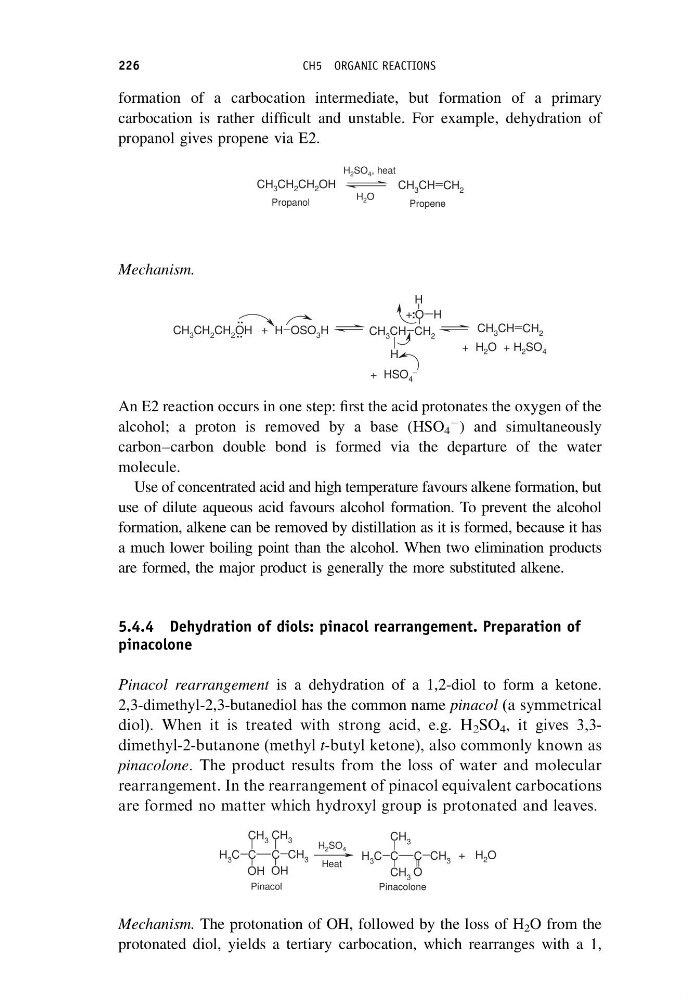
carbocation is rather difficult and unstable. For example, dehydration of
propanol gives propene via E2.
CH 3 CH CH 2
CH 3 CH 2 CH 2 OH
Propanol
H 2 SO 4 , heat
H 2 O
Propene
Mechanism.
CH 3 CH 2 CH 2 OH
H OSO 3 H
CH 3 CH CH 2
CH 3 CH CH 2
H
O H
H
+
+ H 2 O + H 2 SO 4
..
+
..
+ HSO 4
−
:
An E2 reaction occurs in one step: first the acid protonates the oxygen of the
alcohol; a proton is removed by a base (HSO 4
À ) and simultaneously
carbon–carbon double bond is formed via the departure of the water
molecule.
Use of concentrated acid and high temperature favours alkene formation, but
use of dilute aqueous acid favours alcohol formation. To prevent the alcohol
formation, alkene can be removed by distillation as it is formed, because it has
a much lower boiling point than the alcohol. When two elimination products
are formed, the major product is generally the more substituted alkene.
5.4.4 Dehydration of diols: pinacol rearrangement. Preparation of
pinacolone
Pinacol rearrangement is a dehydration of a 1,2-diol to form a ketone.
2,3-dimethyl-2,3-butanediol has the common name pinacol (a symmetrical
diol). When it is treated with strong acid, e.g. H 2 SO 4 , it gives 3,3dimethyl-2-butanone (methyl t-butyl ketone), also commonly known as
pinacolone. The product results from the loss of water and molecular
rearrangement. In the rearrangement of pinacol equivalent carbocations
are formed no matter which hydroxyl group is protonated and leaves.
C
OH
C
OH
CH 3
CH 3
C
H 3
CH 3
C
CH 3
C
O
CH 3
C
H 3
CH 3
+ H 2 O
Pinacolone
H 2 SO 4
Pinacol
Heat
Mechanism. The protonation of OH, followed by the loss of H 2 O from the
protonated diol, yields a tertiary carbocation, which rearranges with a 1,
226
CH5 ORGANIC REACTIONS
carbocation is rather difficult and unstable. For example, dehydration of
propanol gives propene via E2.
CH 3 CH CH 2
CH 3 CH 2 CH 2 OH
Propanol
H 2 SO 4 , heat
H 2 O
Propene
Mechanism.
CH 3 CH 2 CH 2 OH
H OSO 3 H
CH 3 CH CH 2
CH 3 CH CH 2
H
O H
H
+
+ H 2 O + H 2 SO 4
..
+
..
+ HSO 4
−
:
An E2 reaction occurs in one step: first the acid protonates the oxygen of the
alcohol; a proton is removed by a base (HSO 4
À ) and simultaneously
carbon–carbon double bond is formed via the departure of the water
molecule.
Use of concentrated acid and high temperature favours alkene formation, but
use of dilute aqueous acid favours alcohol formation. To prevent the alcohol
formation, alkene can be removed by distillation as it is formed, because it has
a much lower boiling point than the alcohol. When two elimination products
are formed, the major product is generally the more substituted alkene.
5.4.4 Dehydration of diols: pinacol rearrangement. Preparation of
pinacolone
Pinacol rearrangement is a dehydration of a 1,2-diol to form a ketone.
2,3-dimethyl-2,3-butanediol has the common name pinacol (a symmetrical
diol). When it is treated with strong acid, e.g. H 2 SO 4 , it gives 3,3dimethyl-2-butanone (methyl t-butyl ketone), also commonly known as
pinacolone. The product results from the loss of water and molecular
rearrangement. In the rearrangement of pinacol equivalent carbocations
are formed no matter which hydroxyl group is protonated and leaves.
C
OH
C
OH
CH 3
CH 3
C
H 3
CH 3
C
CH 3
C
O
CH 3
C
H 3
CH 3
+ H 2 O
Pinacolone
H 2 SO 4
Pinacol
Heat
Mechanism. The protonation of OH, followed by the loss of H 2 O from the
protonated diol, yields a tertiary carbocation, which rearranges with a 1,
226
CH5 ORGANIC REACTIONS