

5.4.3 Dehydration of alcohols: preparation of alkenes
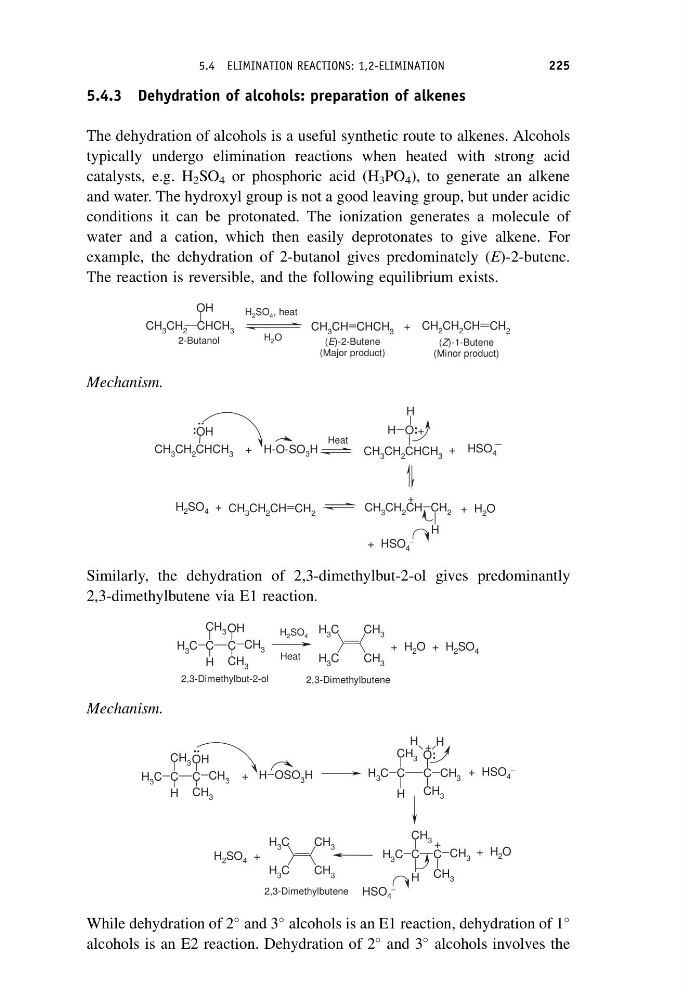
The dehydration of alcohols is a useful synthetic route to alkenes. Alcohols
typically undergo elimination reactions when heated with strong acid
catalysts, e.g. H 2 SO 4 or phosphoric acid (H 3 PO 4 ), to generate an alkene
and water. The hydroxyl group is not a good leaving group, but under acidic
conditions it can be protonated. The ionization generates a molecule of
water and a cation, which then easily deprotonates to give alkene. For
example, the dehydration of 2-butanol gives predominately (E)-2-butene.
The reaction is reversible, and the following equilibrium exists.
CH 3 CH CHCH 3
CH 2 CH 2 CH CH 2
OH
CH 3 CH 2 CHCH 3
(E)-2-Butene
(Major product)
+
(Z)-1-Butene
(Minor product)
2-Butanol
H 2 SO 4 , heat
H 2 O
Mechanism.
OH
CH 3 CH 2 CHCH 3
O
H
H
CH 3 CH 2 CHCH 3
CH 3 CH 2 CH CH 2
CH 3 CH 2 CH CH 2
H
+
+
:
+
Heat
+
_
..
H-O-SO 3 H
HSO 4
+ H 2 O
H 2 SO 4 +
:
+ HSO 4
−
Similarly, the dehydration of 2,3-dimethylbut-2-ol gives predominantly
2,3-dimethylbutene via E1 reaction.
C
CH 3
C
OH
CH 3
C
H 3
H
CH 3
C
H 3
CH 3
C
H 3
CH 3
H 2 SO 4
+ H 2 O + H 2 SO 4
2,3-Dimethylbut-2-ol
2,3-Dimethylbutene
Heat
Mechanism.
C
CH 3
C
OH
CH 3
C
H 3
H
CH 3
C
CH 3
C
O
CH 3
C
H 3
H
CH 3
H
H
C
CH 3
C
CH 3
C
H 3
H
CH 3
H OSO 3 H
C
H 3
CH 3
C
H 3
CH 3
..
+
2,3-Dimethylbutene
+
H 2 SO 4 +
+
:
+ H 2 O
+ HSO 4
−
HSO 4
−
While dehydration of 2
and 3
alcohols is an E1 reaction, dehydration of 1
alcohols is an E2 reaction. Dehydration of 2
and 3
alcohols involves the
5.4 ELIMINATION REACTIONS: 1,2-ELIMINATION
225
The dehydration of alcohols is a useful synthetic route to alkenes. Alcohols
typically undergo elimination reactions when heated with strong acid
catalysts, e.g. H 2 SO 4 or phosphoric acid (H 3 PO 4 ), to generate an alkene
and water. The hydroxyl group is not a good leaving group, but under acidic
conditions it can be protonated. The ionization generates a molecule of
water and a cation, which then easily deprotonates to give alkene. For
example, the dehydration of 2-butanol gives predominately (E)-2-butene.
The reaction is reversible, and the following equilibrium exists.
CH 3 CH CHCH 3
CH 2 CH 2 CH CH 2
OH
CH 3 CH 2 CHCH 3
(E)-2-Butene
(Major product)
+
(Z)-1-Butene
(Minor product)
2-Butanol
H 2 SO 4 , heat
H 2 O
Mechanism.
OH
CH 3 CH 2 CHCH 3
O
H
H
CH 3 CH 2 CHCH 3
CH 3 CH 2 CH CH 2
CH 3 CH 2 CH CH 2
H
+
+
:
+
Heat
+
_
..
H-O-SO 3 H
HSO 4
+ H 2 O
H 2 SO 4 +
:
+ HSO 4
−
Similarly, the dehydration of 2,3-dimethylbut-2-ol gives predominantly
2,3-dimethylbutene via E1 reaction.
C
CH 3
C
OH
CH 3
C
H 3
H
CH 3
C
H 3
CH 3
C
H 3
CH 3
H 2 SO 4
+ H 2 O + H 2 SO 4
2,3-Dimethylbut-2-ol
2,3-Dimethylbutene
Heat
Mechanism.
C
CH 3
C
OH
CH 3
C
H 3
H
CH 3
C
CH 3
C
O
CH 3
C
H 3
H
CH 3
H
H
C
CH 3
C
CH 3
C
H 3
H
CH 3
H OSO 3 H
C
H 3
CH 3
C
H 3
CH 3
..
+
2,3-Dimethylbutene
+
H 2 SO 4 +
+
:
+ H 2 O
+ HSO 4
−
HSO 4
−
While dehydration of 2
and 3
alcohols is an E1 reaction, dehydration of 1
alcohols is an E2 reaction. Dehydration of 2
and 3
alcohols involves the
5.4 ELIMINATION REACTIONS: 1,2-ELIMINATION
225