

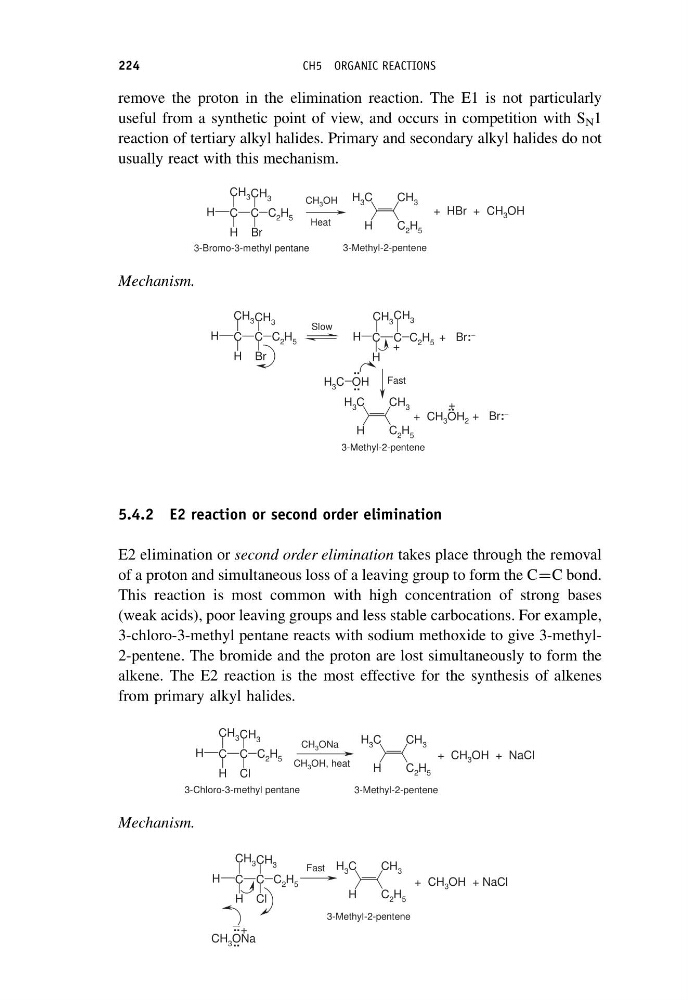
remove the proton in the elimination reaction. The E1 is not particularly
useful from a synthetic point of view, and occurs in competition with S N 1
reaction of tertiary alkyl halides. Primary and secondary alkyl halides do not
usually react with this mechanism.
C
Br
C
H
CH 3
C 2 H 5
H
CH 3
C
H 3
CH 3
H
C 2 H 5
3-Bromo-3-methyl pentane
3-Methyl-2-pentene
CH 3 OH
+ HBr + CH 3 OH
Heat
Mechanism.
OH
C
H 3
H
C
C
CH 3
C 2 H 5
H
CH 3
C
Br
C
H
CH 3
C 2 H 5
H
CH 3
C
H 3
CH 3
H
C 2 H 5
+
..
..
Slow
Fast
+ CH 3 OH 2
+
3-Methyl-2-pentene
+ Br: −
+ Br: −
..
5.4.2 E2 reaction or second order elimination
E2 elimination or second order elimination takes place through the removal
of a proton and simultaneous loss of a leaving group to form the C À À
À À C bond.
This reaction is most common with high concentration of strong bases
(weak acids), poor leaving groups and less stable carbocations. For example,
3-chloro-3-methyl pentane reacts with sodium methoxide to give 3-methyl2-pentene. The bromide and the proton are lost simultaneously to form the
alkene. The E2 reaction is the most effective for the synthesis of alkenes
from primary alkyl halides.
C
Cl
C
H
CH 3
C 2 H 5
H
CH 3
C
H 3
CH 3
H
C 2 H 5
3-Chloro-3-methyl pentane
3-Methyl-2-pentene
CH 3 ONa
CH 3 OH, heat
+ CH 3 OH + NaCl
Mechanism.
C
Cl
C
H
CH 3
C 2 H 5
H
CH 3
CH 3 ONa
C
H 3
CH 3
H
C 2 H 5
Fast
_
..
..
+ CH 3 OH + NaCl
+
3-Methyl-2-pentene
224
CH5 ORGANIC REACTIONS
useful from a synthetic point of view, and occurs in competition with S N 1
reaction of tertiary alkyl halides. Primary and secondary alkyl halides do not
usually react with this mechanism.
C
Br
C
H
CH 3
C 2 H 5
H
CH 3
C
H 3
CH 3
H
C 2 H 5
3-Bromo-3-methyl pentane
3-Methyl-2-pentene
CH 3 OH
+ HBr + CH 3 OH
Heat
Mechanism.
OH
C
H 3
H
C
C
CH 3
C 2 H 5
H
CH 3
C
Br
C
H
CH 3
C 2 H 5
H
CH 3
C
H 3
CH 3
H
C 2 H 5
+
..
..
Slow
Fast
+ CH 3 OH 2
+
3-Methyl-2-pentene
+ Br: −
+ Br: −
..
5.4.2 E2 reaction or second order elimination
E2 elimination or second order elimination takes place through the removal
of a proton and simultaneous loss of a leaving group to form the C À À
À À C bond.
This reaction is most common with high concentration of strong bases
(weak acids), poor leaving groups and less stable carbocations. For example,
3-chloro-3-methyl pentane reacts with sodium methoxide to give 3-methyl2-pentene. The bromide and the proton are lost simultaneously to form the
alkene. The E2 reaction is the most effective for the synthesis of alkenes
from primary alkyl halides.
C
Cl
C
H
CH 3
C 2 H 5
H
CH 3
C
H 3
CH 3
H
C 2 H 5
3-Chloro-3-methyl pentane
3-Methyl-2-pentene
CH 3 ONa
CH 3 OH, heat
+ CH 3 OH + NaCl
Mechanism.
C
Cl
C
H
CH 3
C 2 H 5
H
CH 3
CH 3 ONa
C
H 3
CH 3
H
C 2 H 5
Fast
_
..
..
+ CH 3 OH + NaCl
+
3-Methyl-2-pentene
224
CH5 ORGANIC REACTIONS