

5.4 Elimination reactions: 1,2-elimination
or b-elimination
The term elimination can be defined as the electronegative atom or a leaving
group being removed along with a hydrogen atom from adjacent carbons in
the presence of strong acids or strong bases and high temperatures. Alkenes
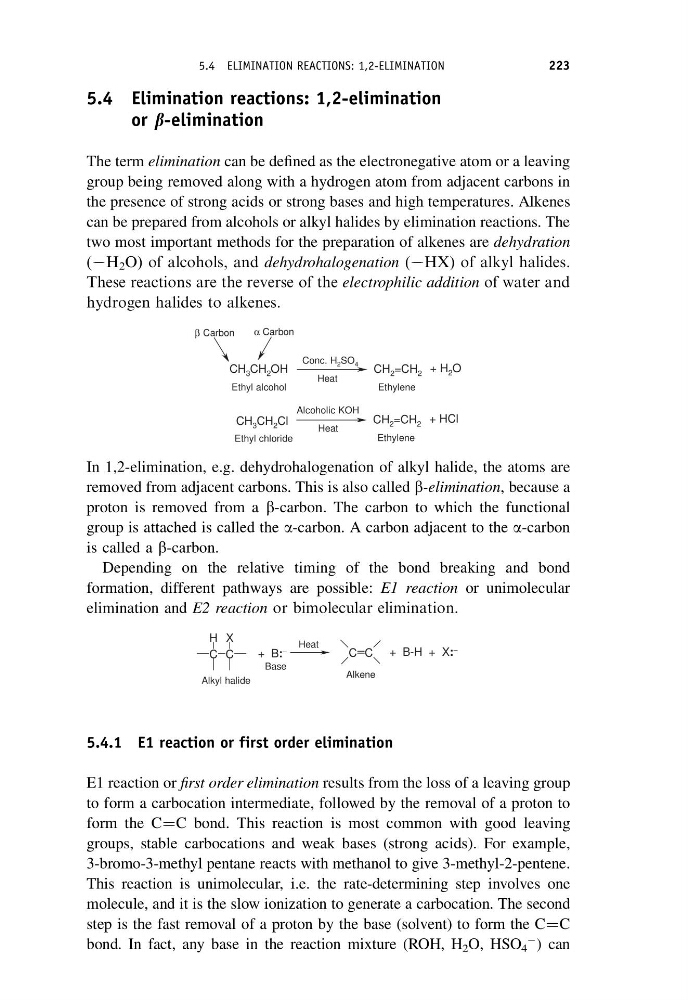
can be prepared from alcohols or alkyl halides by elimination reactions. The
two most important methods for the preparation of alkenes are dehydration
(À ÀH 2 O) of alcohols, and dehydrohalogenation (À ÀHX) of alkyl halides.
These reactions are the reverse of the electrophilic addition of water and
hydrogen halides to alkenes.
CH 3 CH 2 OH
Ethyl alcohol
Conc. H 2 SO 4
Heat
CH 2 =CH 2 + H 2 O
Ethylene
α Carbon
β Carbon
CH 3 CH 2 Cl
Alcoholic KOH
Heat
CH 2 =CH 2 + HCl
Ethylene
Ethyl chloride
In 1,2-elimination, e.g. dehydrohalogenation of alkyl halide, the atoms are
removed from adjacent carbons. This is also called b-elimination, because a
proton is removed from a b-carbon. The carbon to which the functional
group is attached is called the a-carbon. A carbon adjacent to the a-carbon
is called a b-carbon.
Depending on the relative timing of the bond breaking and bond
formation, different pathways are possible: E1 reaction or unimolecular
elimination and E2 reaction or bimolecular elimination.
C
H
C
X
C C + B-H + X: −
Base
Alkene
Alkyl halide
Heat
+ B: −
5.4.1 E1 reaction or first order elimination
E1 reaction or first order elimination results from the loss of a leaving group
to form a carbocation intermediate, followed by the removal of a proton to
form the C À À
À À C bond. This reaction is most common with good leaving
groups, stable carbocations and weak bases (strong acids). For example,
3-bromo-3-methyl pentane reacts with methanol to give 3-methyl-2-pentene.
This reaction is unimolecular, i.e. the rate-determining step involves one
molecule, and it is the slow ionization to generate a carbocation. The second
step is the fast removal of a proton by the base (solvent) to form the C À À
À À C
bond. In fact, any base in the reaction mixture (ROH, H 2 O, HSO 4
À ) can
5.4 ELIMINATION REACTIONS: 1,2-ELIMINATION
223
or b-elimination
The term elimination can be defined as the electronegative atom or a leaving
group being removed along with a hydrogen atom from adjacent carbons in
the presence of strong acids or strong bases and high temperatures. Alkenes
can be prepared from alcohols or alkyl halides by elimination reactions. The
two most important methods for the preparation of alkenes are dehydration
(À ÀH 2 O) of alcohols, and dehydrohalogenation (À ÀHX) of alkyl halides.
These reactions are the reverse of the electrophilic addition of water and
hydrogen halides to alkenes.
CH 3 CH 2 OH
Ethyl alcohol
Conc. H 2 SO 4
Heat
CH 2 =CH 2 + H 2 O
Ethylene
α Carbon
β Carbon
CH 3 CH 2 Cl
Alcoholic KOH
Heat
CH 2 =CH 2 + HCl
Ethylene
Ethyl chloride
In 1,2-elimination, e.g. dehydrohalogenation of alkyl halide, the atoms are
removed from adjacent carbons. This is also called b-elimination, because a
proton is removed from a b-carbon. The carbon to which the functional
group is attached is called the a-carbon. A carbon adjacent to the a-carbon
is called a b-carbon.
Depending on the relative timing of the bond breaking and bond
formation, different pathways are possible: E1 reaction or unimolecular
elimination and E2 reaction or bimolecular elimination.
C
H
C
X
C C + B-H + X: −
Base
Alkene
Alkyl halide
Heat
+ B: −
5.4.1 E1 reaction or first order elimination
E1 reaction or first order elimination results from the loss of a leaving group
to form a carbocation intermediate, followed by the removal of a proton to
form the C À À
À À C bond. This reaction is most common with good leaving
groups, stable carbocations and weak bases (strong acids). For example,
3-bromo-3-methyl pentane reacts with methanol to give 3-methyl-2-pentene.
This reaction is unimolecular, i.e. the rate-determining step involves one
molecule, and it is the slow ionization to generate a carbocation. The second
step is the fast removal of a proton by the base (solvent) to form the C À À
À À C
bond. In fact, any base in the reaction mixture (ROH, H 2 O, HSO 4
À ) can
5.4 ELIMINATION REACTIONS: 1,2-ELIMINATION
223