

Aldol condensation
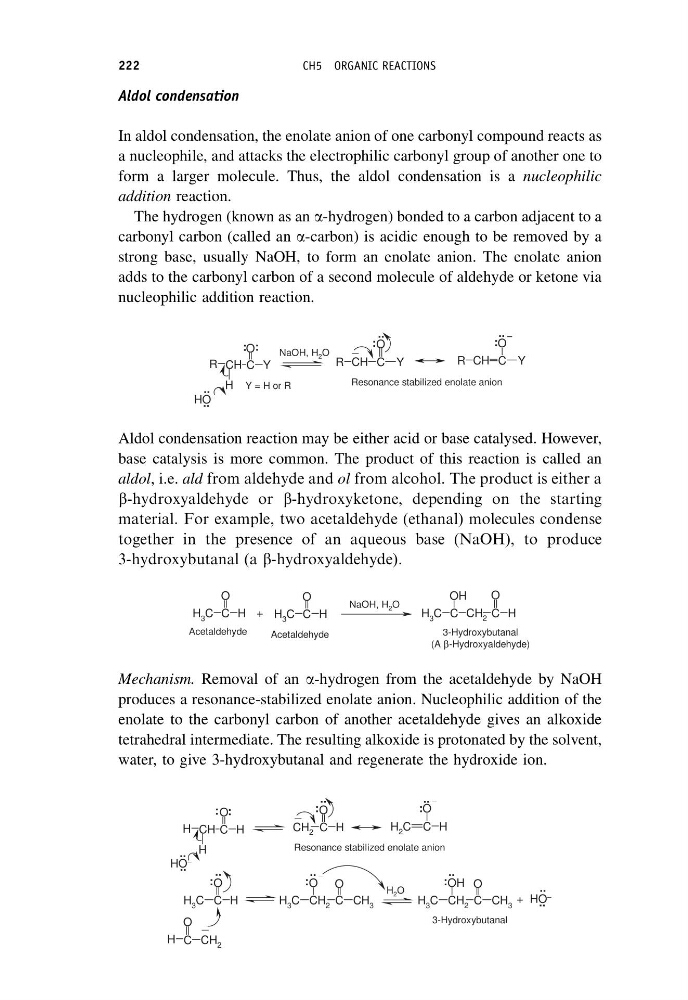
In aldol condensation, the enolate anion of one carbonyl compound reacts as
a nucleophile, and attacks the electrophilic carbonyl group of another one to
form a larger molecule. Thus, the aldol condensation is a nucleophilic
addition reaction.
The hydrogen (known as an a-hydrogen) bonded to a carbon adjacent to a
carbonyl carbon (called an a-carbon) is acidic enough to be removed by a
strong base, usually NaOH, to form an enolate anion. The enolate anion
adds to the carbonyl carbon of a second molecule of aldehyde or ketone via
nucleophilic addition reaction.
C Y
O
CH C
O
Y
CH
R
H
R
C Y
O
CH
R
Y = H or R
NaOH, H 2 O
HO −
..
_
: :
..
..
:
:
Resonance stabilized enolate anion
..
Aldol condensation reaction may be either acid or base catalysed. However,
base catalysis is more common. The product of this reaction is called an
aldol, i.e. ald from aldehyde and ol from alcohol. The product is either a
b-hydroxyaldehyde or b-hydroxyketone, depending on the starting
material. For example, two acetaldehyde (ethanal) molecules condense
together in the presence of an aqueous base (NaOH), to produce
3-hydroxybutanal (a b-hydroxyaldehyde).
C
H 3 C
O
H
C
O
H
C
H 3 C
O
H
CH 2
C
H 3 C
OH
Acetaldehyde
NaOH, H 2 O
+
Acetaldehyde
3-Hydroxybutanal
(A β-Hydroxyaldehyde)
Mechanism. Removal of an a-hydrogen from the acetaldehyde by NaOH
produces a resonance-stabilized enolate anion. Nucleophilic addition of the
enolate to the carbonyl carbon of another acetaldehyde gives an alkoxide
tetrahedral intermediate. The resulting alkoxide is protonated by the solvent,
water, to give 3-hydroxybutanal and regenerate the hydroxide ion.
CH 2 C
O
H
CH C
O
H
H
H
C
H 2
C
O
H
C
H 3
C
O
H
CH 2
C
O
H
C
H 3
CH 2
O
CH 3
C
O
C
H 3
CH 2
OH
CH 3
C
O
HO −
..
_
: :
..
..
:
:
Resonance stabilized enolate anion
_
:
:
..
..
H 2 O
:
..
3-Hydroxybutanal
+ HO −
..
..
..
222
CH5 ORGANIC REACTIONS
In aldol condensation, the enolate anion of one carbonyl compound reacts as
a nucleophile, and attacks the electrophilic carbonyl group of another one to
form a larger molecule. Thus, the aldol condensation is a nucleophilic
addition reaction.
The hydrogen (known as an a-hydrogen) bonded to a carbon adjacent to a
carbonyl carbon (called an a-carbon) is acidic enough to be removed by a
strong base, usually NaOH, to form an enolate anion. The enolate anion
adds to the carbonyl carbon of a second molecule of aldehyde or ketone via
nucleophilic addition reaction.
C Y
O
CH C
O
Y
CH
R
H
R
C Y
O
CH
R
Y = H or R
NaOH, H 2 O
HO −
..
_
: :
..
..
:
:
Resonance stabilized enolate anion
..
Aldol condensation reaction may be either acid or base catalysed. However,
base catalysis is more common. The product of this reaction is called an
aldol, i.e. ald from aldehyde and ol from alcohol. The product is either a
b-hydroxyaldehyde or b-hydroxyketone, depending on the starting
material. For example, two acetaldehyde (ethanal) molecules condense
together in the presence of an aqueous base (NaOH), to produce
3-hydroxybutanal (a b-hydroxyaldehyde).
C
H 3 C
O
H
C
O
H
C
H 3 C
O
H
CH 2
C
H 3 C
OH
Acetaldehyde
NaOH, H 2 O
+
Acetaldehyde
3-Hydroxybutanal
(A β-Hydroxyaldehyde)
Mechanism. Removal of an a-hydrogen from the acetaldehyde by NaOH
produces a resonance-stabilized enolate anion. Nucleophilic addition of the
enolate to the carbonyl carbon of another acetaldehyde gives an alkoxide
tetrahedral intermediate. The resulting alkoxide is protonated by the solvent,
water, to give 3-hydroxybutanal and regenerate the hydroxide ion.
CH 2 C
O
H
CH C
O
H
H
H
C
H 2
C
O
H
C
H 3
C
O
H
CH 2
C
O
H
C
H 3
CH 2
O
CH 3
C
O
C
H 3
CH 2
OH
CH 3
C
O
HO −
..
_
: :
..
..
:
:
Resonance stabilized enolate anion
_
:
:
..
..
H 2 O
:
..
3-Hydroxybutanal
+ HO −
..
..
..
222
CH5 ORGANIC REACTIONS