

OH
C H
R
O H
R'
R C H
OH
OR
C H
R
OH 2
C
OR'
R
H
R C H
O H
R'
OR
OR'
C H
R
OR'
OR'
C H
R
OH
O H
H
R'
O H
H
R'
R C
O
H
R'OH
:
+
:
:
+
..
..
+
+
R'OH ..
..
H 3 O +
H 2 O
: ..
..
:
..
..
+
+
+
H 3 O +
H 2 O +
± H +
H 2 O ..
..
: :
..
..
H 3 O +
..
+
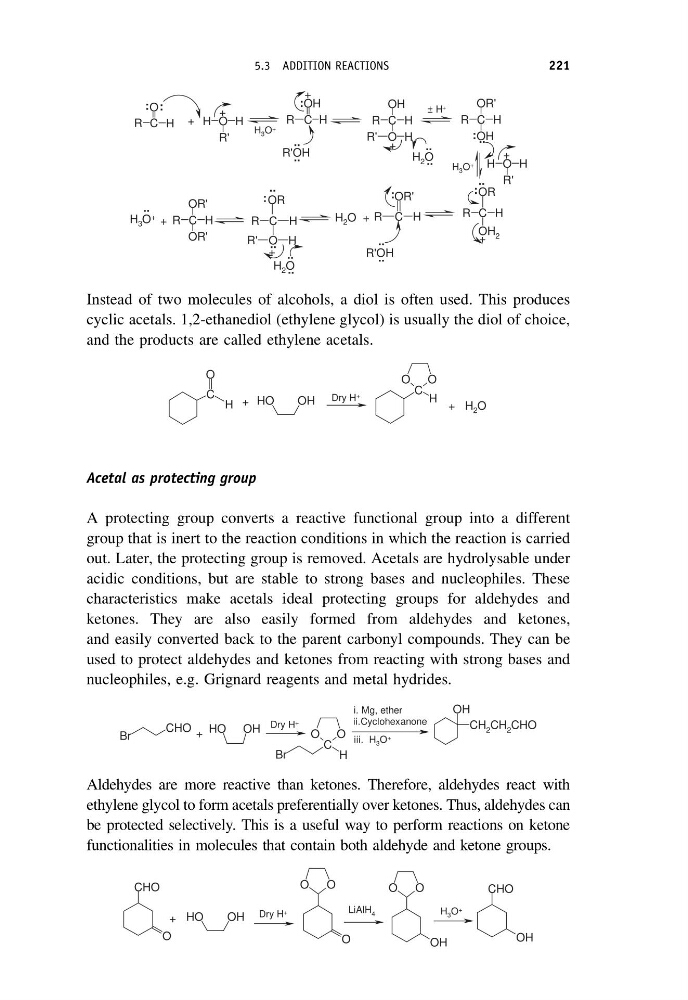
Instead of two molecules of alcohols, a diol is often used. This produces
cyclic acetals. 1,2-ethanediol (ethylene glycol) is usually the diol of choice,
and the products are called ethylene acetals.
OH
O
H
O
O
C H
C
O
H
+ H 2 O
+
Dry H +
Acetal as protecting group
A protecting group converts a reactive functional group into a different
group that is inert to the reaction conditions in which the reaction is carried
out. Later, the protecting group is removed. Acetals are hydrolysable under
acidic conditions, but are stable to strong bases and nucleophiles. These
characteristics make acetals ideal protecting groups for aldehydes and
ketones. They are also easily formed from aldehydes and ketones,
and easily converted back to the parent carbonyl compounds. They can be
used to protect aldehydes and ketones from reacting with strong bases and
nucleophiles, e.g. Grignard reagents and metal hydrides.
Br
CHO
Br
O
O
C
H
OH
CH 2 CH 2 CHO
OH
O
H
i. Mg, ether
+
ii.Cyclohexanone
iii. H 3 O +
Dry H +
Aldehydes are more reactive than ketones. Therefore, aldehydes react with
ethylene glycol to form acetals preferentially over ketones. Thus, aldehydes can
be protected selectively. This is a useful way to perform reactions on ketone
functionalities in molecules that contain both aldehyde and ketone groups.
CHO
O
O
O
O
LiAlH 4
OH
O
H
OH
CHO
OH
O
O
+
H 3 O +
Dry H +
5.3 ADDITION REACTIONS
221
C H
R
O H
R'
R C H
OH
OR
C H
R
OH 2
C
OR'
R
H
R C H
O H
R'
OR
OR'
C H
R
OR'
OR'
C H
R
OH
O H
H
R'
O H
H
R'
R C
O
H
R'OH
:
+
:
:
+
..
..
+
+
R'OH ..
..
H 3 O +
H 2 O
: ..
..
:
..
..
+
+
+
H 3 O +
H 2 O +
± H +
H 2 O ..
..
: :
..
..
H 3 O +
..
+
Instead of two molecules of alcohols, a diol is often used. This produces
cyclic acetals. 1,2-ethanediol (ethylene glycol) is usually the diol of choice,
and the products are called ethylene acetals.
OH
O
H
O
O
C H
C
O
H
+ H 2 O
+
Dry H +
Acetal as protecting group
A protecting group converts a reactive functional group into a different
group that is inert to the reaction conditions in which the reaction is carried
out. Later, the protecting group is removed. Acetals are hydrolysable under
acidic conditions, but are stable to strong bases and nucleophiles. These
characteristics make acetals ideal protecting groups for aldehydes and
ketones. They are also easily formed from aldehydes and ketones,
and easily converted back to the parent carbonyl compounds. They can be
used to protect aldehydes and ketones from reacting with strong bases and
nucleophiles, e.g. Grignard reagents and metal hydrides.
Br
CHO
Br
O
O
C
H
OH
CH 2 CH 2 CHO
OH
O
H
i. Mg, ether
+
ii.Cyclohexanone
iii. H 3 O +
Dry H +
Aldehydes are more reactive than ketones. Therefore, aldehydes react with
ethylene glycol to form acetals preferentially over ketones. Thus, aldehydes can
be protected selectively. This is a useful way to perform reactions on ketone
functionalities in molecules that contain both aldehyde and ketone groups.
CHO
O
O
O
O
LiAlH 4
OH
O
H
OH
CHO
OH
O
O
+
H 3 O +
Dry H +
5.3 ADDITION REACTIONS
221