

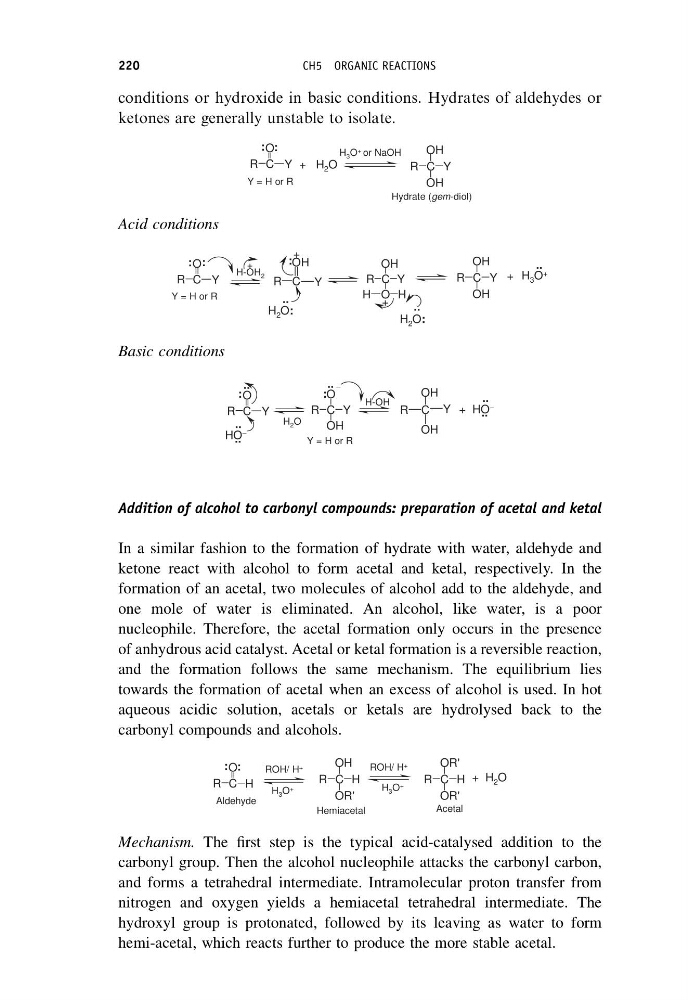
conditions or hydroxide in basic conditions. Hydrates of aldehydes or
ketones are generally unstable to isolate.
R C
OH
OH
Y
R C
O
Y + H 2 O
H 3 O + or NaOH
Y = H or R
Hydrate (gem-diol)
: :
Acid conditions
R C
OH
Y
O H
H
R C
OH
OH
Y
R C Y
OH
R C
O
Y
H-OH 2
H 3 O +
+
+
+
H 2 O:
..
H 2 O:
..
Y = H or R
+
: :
..
:
Basic conditions
R C
O
Y
OH
R C
OH
OH
Y
R C
O
Y
HO −
H-OH
+ HO −
Y = H or R
H 2 O
:
..
:
..
..
..
..
..
Addition of alcohol to carbonyl compounds: preparation of acetal and ketal
In a similar fashion to the formation of hydrate with water, aldehyde and
ketone react with alcohol to form acetal and ketal, respectively. In the
formation of an acetal, two molecules of alcohol add to the aldehyde, and
one mole of water is eliminated. An alcohol, like water, is a poor
nucleophile. Therefore, the acetal formation only occurs in the presence
of anhydrous acid catalyst. Acetal or ketal formation is a reversible reaction,
and the formation follows the same mechanism. The equilibrium lies
towards the formation of acetal when an excess of alcohol is used. In hot
aqueous acidic solution, acetals or ketals are hydrolysed back to the
carbonyl compounds and alcohols.
OR'
C H
R
OR'
OH
C H
R
OR'
R C
O
H
Aldehyde
Acetal
Hemiacetal
H 3 O +
H 3 O +
ROH/ H +
ROH/ H +
+ H 2 O
: :
Mechanism. The first step is the typical acid-catalysed addition to the
carbonyl group. Then the alcohol nucleophile attacks the carbonyl carbon,
and forms a tetrahedral intermediate. Intramolecular proton transfer from
nitrogen and oxygen yields a hemiacetal tetrahedral intermediate. The
hydroxyl group is protonated, followed by its leaving as water to form
hemi-acetal, which reacts further to produce the more stable acetal.
220
CH5 ORGANIC REACTIONS
ketones are generally unstable to isolate.
R C
OH
OH
Y
R C
O
Y + H 2 O
H 3 O + or NaOH
Y = H or R
Hydrate (gem-diol)
: :
Acid conditions
R C
OH
Y
O H
H
R C
OH
OH
Y
R C Y
OH
R C
O
Y
H-OH 2
H 3 O +
+
+
+
H 2 O:
..
H 2 O:
..
Y = H or R
+
: :
..
:
Basic conditions
R C
O
Y
OH
R C
OH
OH
Y
R C
O
Y
HO −
H-OH
+ HO −
Y = H or R
H 2 O
:
..
:
..
..
..
..
..
Addition of alcohol to carbonyl compounds: preparation of acetal and ketal
In a similar fashion to the formation of hydrate with water, aldehyde and
ketone react with alcohol to form acetal and ketal, respectively. In the
formation of an acetal, two molecules of alcohol add to the aldehyde, and
one mole of water is eliminated. An alcohol, like water, is a poor
nucleophile. Therefore, the acetal formation only occurs in the presence
of anhydrous acid catalyst. Acetal or ketal formation is a reversible reaction,
and the formation follows the same mechanism. The equilibrium lies
towards the formation of acetal when an excess of alcohol is used. In hot
aqueous acidic solution, acetals or ketals are hydrolysed back to the
carbonyl compounds and alcohols.
OR'
C H
R
OR'
OH
C H
R
OR'
R C
O
H
Aldehyde
Acetal
Hemiacetal
H 3 O +
H 3 O +
ROH/ H +
ROH/ H +
+ H 2 O
: :
Mechanism. The first step is the typical acid-catalysed addition to the
carbonyl group. Then the alcohol nucleophile attacks the carbonyl carbon,
and forms a tetrahedral intermediate. Intramolecular proton transfer from
nitrogen and oxygen yields a hemiacetal tetrahedral intermediate. The
hydroxyl group is protonated, followed by its leaving as water to form
hemi-acetal, which reacts further to produce the more stable acetal.
220
CH5 ORGANIC REACTIONS