

to generate a four-membered ring, an oxaphosphetane ring. This fourmembered ring quickly decomposes to generate an alkene and a stable
triphenyl phosphine oxide (Ph 3 P À À
À À O). The net result is replacement of the
carbonyl oxygen atom by the R 2 C À À
À À group, which was originally bonded to
the phosphorus atom. This is a good synthetic route to make alkenes from
aldehydes and ketones.
Addition of hydrogen cyanide to carbonyl compounds: preparation of
cyanohydrins
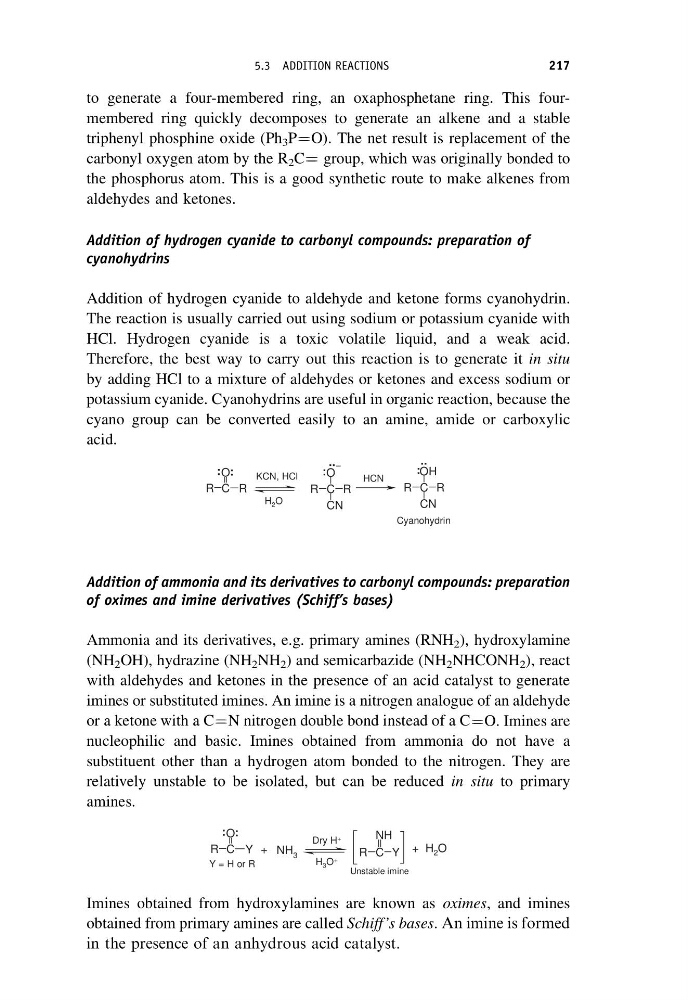
Addition of hydrogen cyanide to aldehyde and ketone forms cyanohydrin.
The reaction is usually carried out using sodium or potassium cyanide with
HCl. Hydrogen cyanide is a toxic volatile liquid, and a weak acid.
Therefore, the best way to carry out this reaction is to generate it in situ
by adding HCl to a mixture of aldehydes or ketones and excess sodium or
potassium cyanide. Cyanohydrins are useful in organic reaction, because the
cyano group can be converted easily to an amine, amide or carboxylic
acid.
R C R
O
O
C R
R
CN
OH
C R
R
CN
KCN, HCl
HCN
H 2 O
: :
..
..
:
:
Cyanohydrin
Addition of ammonia and its derivatives to carbonyl compounds: preparation
of oximes and imine derivatives (Schiff’s bases)
Ammonia and its derivatives, e.g. primary amines (RNH 2 ), hydroxylamine
(NH 2 OH), hydrazine (NH 2 NH 2 ) and semicarbazide (NH 2 NHCONH 2 ), react
with aldehydes and ketones in the presence of an acid catalyst to generate
imines or substituted imines. An imine is a nitrogen analogue of an aldehyde
or a ketone with a C À À
À À N nitrogen double bond instead of a C À À
À À O. Imines are
nucleophilic and basic. Imines obtained from ammonia do not have a
substituent other than a hydrogen atom bonded to the nitrogen. They are
relatively unstable to be isolated, but can be reduced in situ to primary
amines.
NH 3
Y
C
R
NH
R C
O
Y
Y = H or R
+
Dry H +
+ H 2 O
Unstable imine
H 3 O +
: :
Imines obtained from hydroxylamines are known as oximes, and imines
obtained from primary amines are called Schiff’s bases. An imine is formed
in the presence of an anhydrous acid catalyst.
5.3 ADDITION REACTIONS
217
triphenyl phosphine oxide (Ph 3 P À À
À À O). The net result is replacement of the
carbonyl oxygen atom by the R 2 C À À
À À group, which was originally bonded to
the phosphorus atom. This is a good synthetic route to make alkenes from
aldehydes and ketones.
Addition of hydrogen cyanide to carbonyl compounds: preparation of
cyanohydrins
Addition of hydrogen cyanide to aldehyde and ketone forms cyanohydrin.
The reaction is usually carried out using sodium or potassium cyanide with
HCl. Hydrogen cyanide is a toxic volatile liquid, and a weak acid.
Therefore, the best way to carry out this reaction is to generate it in situ
by adding HCl to a mixture of aldehydes or ketones and excess sodium or
potassium cyanide. Cyanohydrins are useful in organic reaction, because the
cyano group can be converted easily to an amine, amide or carboxylic
acid.
R C R
O
O
C R
R
CN
OH
C R
R
CN
KCN, HCl
HCN
H 2 O
: :
..
..
:
:
Cyanohydrin
Addition of ammonia and its derivatives to carbonyl compounds: preparation
of oximes and imine derivatives (Schiff’s bases)
Ammonia and its derivatives, e.g. primary amines (RNH 2 ), hydroxylamine
(NH 2 OH), hydrazine (NH 2 NH 2 ) and semicarbazide (NH 2 NHCONH 2 ), react
with aldehydes and ketones in the presence of an acid catalyst to generate
imines or substituted imines. An imine is a nitrogen analogue of an aldehyde
or a ketone with a C À À
À À N nitrogen double bond instead of a C À À
À À O. Imines are
nucleophilic and basic. Imines obtained from ammonia do not have a
substituent other than a hydrogen atom bonded to the nitrogen. They are
relatively unstable to be isolated, but can be reduced in situ to primary
amines.
NH 3
Y
C
R
NH
R C
O
Y
Y = H or R
+
Dry H +
+ H 2 O
Unstable imine
H 3 O +
: :
Imines obtained from hydroxylamines are known as oximes, and imines
obtained from primary amines are called Schiff’s bases. An imine is formed
in the presence of an anhydrous acid catalyst.
5.3 ADDITION REACTIONS
217