

molecule that is overall neutral, but exists as a carbanion bonded to a
positively charged phosphorus. The ylide can also be written in the doublebonded form, because phosphorus can have more than eight valence
electrons.
RCH 2 X
(Ph) 3 P CHR
(Ph) 3 P CHR
_
+
Phosphorus ylide
ii. BuLi, THF
i. (Ph) 3 P:
Alkyl halide
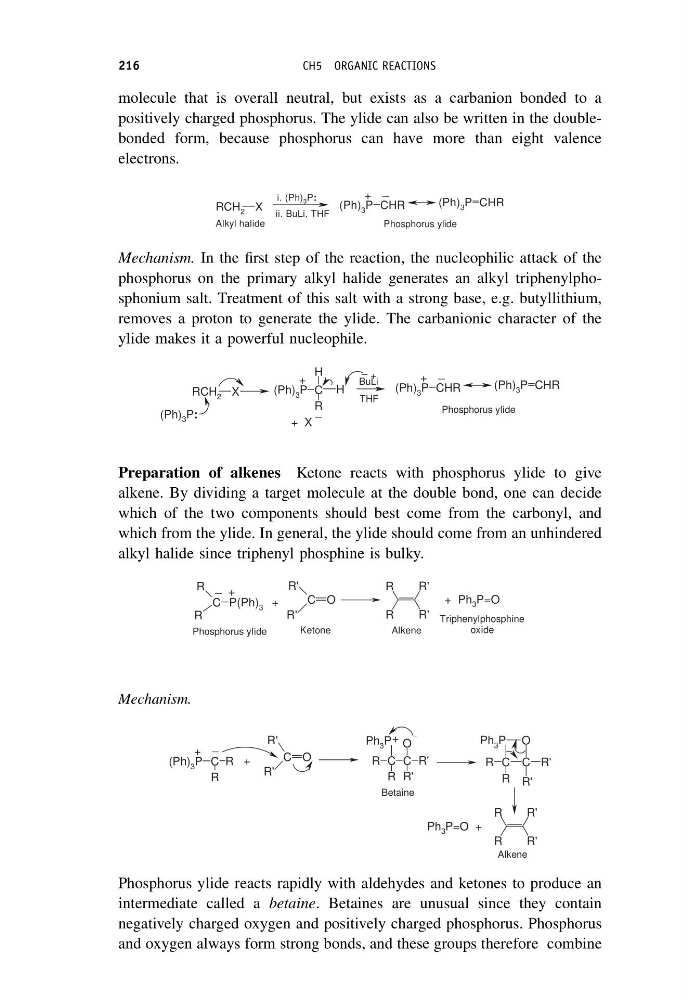
Mechanism. In the first step of the reaction, the nucleophilic attack of the
phosphorus on the primary alkyl halide generates an alkyl triphenylphosphonium salt. Treatment of this salt with a strong base, e.g. butyllithium,
removes a proton to generate the ylide. The carbanionic character of the
ylide makes it a powerful nucleophile.
(Ph) 3 P C
H
H
R
RCH 2 X
(Ph) 3 P CHR
(Ph) 3 P CHR
+
+ X
_
BuLi
THF
(Ph) 3 P:
_ +
_
+
Phosphorus ylide
Preparation of alkenes Ketone reacts with phosphorus ylide to give
alkene. By dividing a target molecule at the double bond, one can decide
which of the two components should best come from the carbonyl, and
which from the ylide. In general, the ylide should come from an unhindered
alkyl halide since triphenyl phosphine is bulky.
C P(Ph) 3
R
R
C O
R'
R'
R
R'
R
R'
+
+ Ph 3 P=O
_ +
Triphenylphosphine
oxide
Alkene
Phosphorus ylide
Ketone
Mechanism.
R C
Ph 3 P
R
C
O
R'
R'
C C
O
Ph 3 P
R
R R'
R'
(Ph) 3 P C R
R
C O
R'
R'
R
R'
R
R'
Ph 3 P=O +
_
+
+
+
Betaine
Alkene
Phosphorus ylide reacts rapidly with aldehydes and ketones to produce an
intermediate called a betaine. Betaines are unusual since they contain
negatively charged oxygen and positively charged phosphorus. Phosphorus
and oxygen always form strong bonds, and these groups therefore combine
216
CH5 ORGANIC REACTIONS
positively charged phosphorus. The ylide can also be written in the doublebonded form, because phosphorus can have more than eight valence
electrons.
RCH 2 X
(Ph) 3 P CHR
(Ph) 3 P CHR
_
+
Phosphorus ylide
ii. BuLi, THF
i. (Ph) 3 P:
Alkyl halide
Mechanism. In the first step of the reaction, the nucleophilic attack of the
phosphorus on the primary alkyl halide generates an alkyl triphenylphosphonium salt. Treatment of this salt with a strong base, e.g. butyllithium,
removes a proton to generate the ylide. The carbanionic character of the
ylide makes it a powerful nucleophile.
(Ph) 3 P C
H
H
R
RCH 2 X
(Ph) 3 P CHR
(Ph) 3 P CHR
+
+ X
_
BuLi
THF
(Ph) 3 P:
_ +
_
+
Phosphorus ylide
Preparation of alkenes Ketone reacts with phosphorus ylide to give
alkene. By dividing a target molecule at the double bond, one can decide
which of the two components should best come from the carbonyl, and
which from the ylide. In general, the ylide should come from an unhindered
alkyl halide since triphenyl phosphine is bulky.
C P(Ph) 3
R
R
C O
R'
R'
R
R'
R
R'
+
+ Ph 3 P=O
_ +
Triphenylphosphine
oxide
Alkene
Phosphorus ylide
Ketone
Mechanism.
R C
Ph 3 P
R
C
O
R'
R'
C C
O
Ph 3 P
R
R R'
R'
(Ph) 3 P C R
R
C O
R'
R'
R
R'
R
R'
Ph 3 P=O +
_
+
+
+
Betaine
Alkene
Phosphorus ylide reacts rapidly with aldehydes and ketones to produce an
intermediate called a betaine. Betaines are unusual since they contain
negatively charged oxygen and positively charged phosphorus. Phosphorus
and oxygen always form strong bonds, and these groups therefore combine
216
CH5 ORGANIC REACTIONS