

C
O
Y
R
C
N
Y
OH
R
C
N
Y
R'
R
C
R' 2 N+
Y
R
Y = H or R
NH 2 -OH
Oxime
Dry H +
R'NH 2
Imine (Schiff's base)
Dry H +
R' 2 NH
Iminium salt
Dry H +
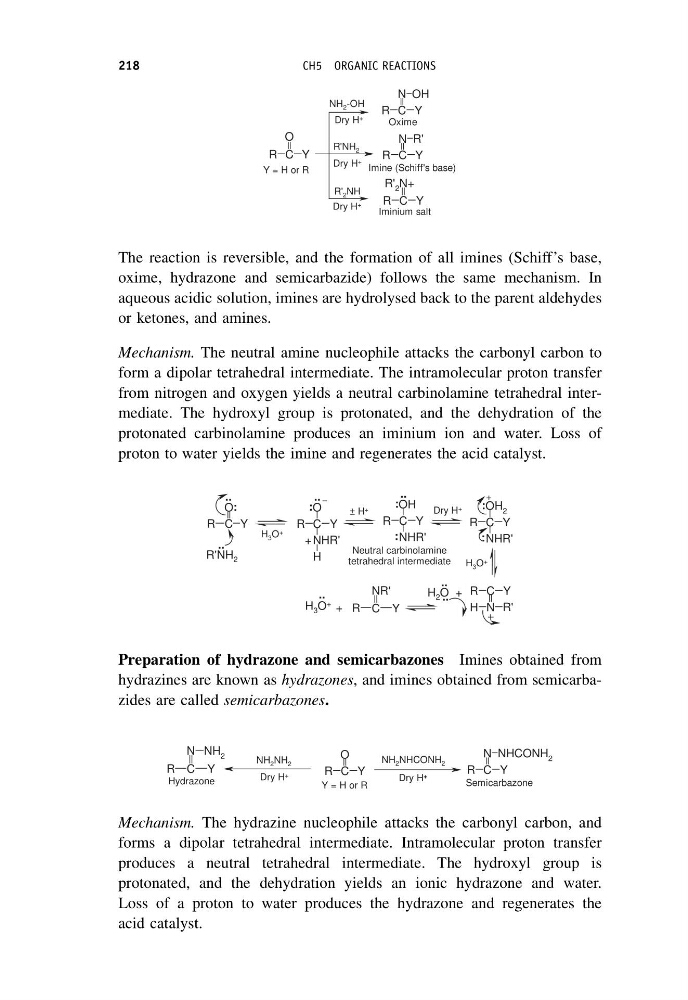
The reaction is reversible, and the formation of all imines (Schiff’s base,
oxime, hydrazone and semicarbazide) follows the same mechanism. In
aqueous acidic solution, imines are hydrolysed back to the parent aldehydes
or ketones, and amines.
Mechanism. The neutral amine nucleophile attacks the carbonyl carbon to
form a dipolar tetrahedral intermediate. The intramolecular proton transfer
from nitrogen and oxygen yields a neutral carbinolamine tetrahedral intermediate. The hydroxyl group is protonated, and the dehydration of the
protonated carbinolamine produces an iminium ion and water. Loss of
proton to water yields the imine and regenerates the acid catalyst.
O
C Y
R
NHR'
H
R C Y
O
Y
C
R
NR'
OH
C Y
R
NHR'
OH 2
C Y
R
NHR'
C Y
R
N R'
H
+
R'NH 2
..
+
:
:
+
H 3 O +
:
..
..
..
H 3 O +
..
H 3 O +
H 2 O +
..
Dry H +
± H +
:
:
+
:
..
Neutral carbinolamine
tetrahedral intermediate
Preparation of hydrazone and semicarbazones Imines obtained from
hydrazines are known as hydrazones, and imines obtained from semicarbazides are called semicarbazones.
N NH 2
C Y
R
C
O
Y
R
C
N
Y
NHCONH 2
R
NH 2 NH 2
Hydrazone
Y = H or R
Dry H +
NH 2 NHCONH 2
Semicarbazone
Dry H +
Mechanism. The hydrazine nucleophile attacks the carbonyl carbon, and
forms a dipolar tetrahedral intermediate. Intramolecular proton transfer
produces a neutral tetrahedral intermediate. The hydroxyl group is
protonated, and the dehydration yields an ionic hydrazone and water.
Loss of a proton to water produces the hydrazone and regenerates the
acid catalyst.
218
CH5 ORGANIC REACTIONS
O
Y
R
C
N
Y
OH
R
C
N
Y
R'
R
C
R' 2 N+
Y
R
Y = H or R
NH 2 -OH
Oxime
Dry H +
R'NH 2
Imine (Schiff's base)
Dry H +
R' 2 NH
Iminium salt
Dry H +
The reaction is reversible, and the formation of all imines (Schiff’s base,
oxime, hydrazone and semicarbazide) follows the same mechanism. In
aqueous acidic solution, imines are hydrolysed back to the parent aldehydes
or ketones, and amines.
Mechanism. The neutral amine nucleophile attacks the carbonyl carbon to
form a dipolar tetrahedral intermediate. The intramolecular proton transfer
from nitrogen and oxygen yields a neutral carbinolamine tetrahedral intermediate. The hydroxyl group is protonated, and the dehydration of the
protonated carbinolamine produces an iminium ion and water. Loss of
proton to water yields the imine and regenerates the acid catalyst.
O
C Y
R
NHR'
H
R C Y
O
Y
C
R
NR'
OH
C Y
R
NHR'
OH 2
C Y
R
NHR'
C Y
R
N R'
H
+
R'NH 2
..
+
:
:
+
H 3 O +
:
..
..
..
H 3 O +
..
H 3 O +
H 2 O +
..
Dry H +
± H +
:
:
+
:
..
Neutral carbinolamine
tetrahedral intermediate
Preparation of hydrazone and semicarbazones Imines obtained from
hydrazines are known as hydrazones, and imines obtained from semicarbazides are called semicarbazones.
N NH 2
C Y
R
C
O
Y
R
C
N
Y
NHCONH 2
R
NH 2 NH 2
Hydrazone
Y = H or R
Dry H +
NH 2 NHCONH 2
Semicarbazone
Dry H +
Mechanism. The hydrazine nucleophile attacks the carbonyl carbon, and
forms a dipolar tetrahedral intermediate. Intramolecular proton transfer
produces a neutral tetrahedral intermediate. The hydroxyl group is
protonated, and the dehydration yields an ionic hydrazone and water.
Loss of a proton to water produces the hydrazone and regenerates the
acid catalyst.
218
CH5 ORGANIC REACTIONS