

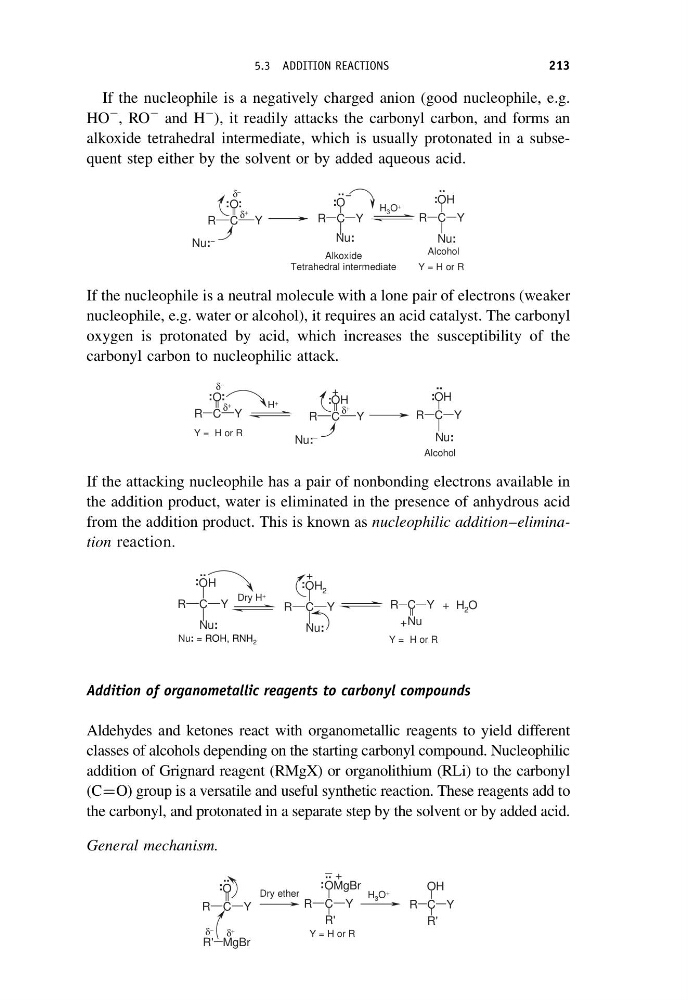
If the nucleophile is a negatively charged anion (good nucleophile, e.g.
HO
À , RO
À and H
À ), it readily attacks the carbonyl carbon, and forms an
alkoxide tetrahedral intermediate, which is usually protonated in a subsequent step either by the solvent or by added aqueous acid.
R C Y
O
C Y
O
R
C Y
OH
R
H 3 O +
δ +
δ −
: :
Nu: −
:
..
Y = H or R
Alkoxide
Tetrahedral intermediate
Alcohol
Nu:
:
Nu:
..
If the nucleophile is a neutral molecule with a lone pair of electrons (weaker
nucleophile, e.g. water or alcohol), it requires an acid catalyst. The carbonyl
oxygen is protonated by acid, which increases the susceptibility of the
carbonyl carbon to nucleophilic attack.
R C Y
OH
R C Y
O
C Y
OH
R
δ +
:
Y = H or R
δ +
δ −
: :
H +
+
..
Alcohol
:
Nu:
Nu: −
If the attacking nucleophile has a pair of nonbonding electrons available in
the addition product, water is eliminated in the presence of anhydrous acid
from the addition product. This is known as nucleophilic addition–elimination reaction.
C
R
C
OH
R
C
OH 2
R
Dry H +
+
+ H 2 O
:
2
:
..
:
Y
Nu
Y
Y
Y = H or R
+
Nu = ROH, RNH
Nu:
Nu:
Addition of organometallic reagents to carbonyl compounds
Aldehydes and ketones react with organometallic reagents to yield different
classes of alcohols depending on the starting carbonyl compound. Nucleophilic
addition of Grignard reagent (RMgX) or organolithium (RLi) to the carbonyl
(C À À
À À O) group is a versatile and useful synthetic reaction. These reagents add to
the carbonyl, and protonated in a separate step by the solvent or by added acid.
General mechanism.
R' MgBr
C
O
R
Y
C
OMgBr
R
Y
R'
C
OH
R
Y
R'
Dry ether
+
_
δ − δ +
H 3 O +
Y = H or R
..
:
..
:
5.3 ADDITION REACTIONS
213
HO
À , RO
À and H
À ), it readily attacks the carbonyl carbon, and forms an
alkoxide tetrahedral intermediate, which is usually protonated in a subsequent step either by the solvent or by added aqueous acid.
R C Y
O
C Y
O
R
C Y
OH
R
H 3 O +
δ +
δ −
: :
Nu: −
:
..
Y = H or R
Alkoxide
Tetrahedral intermediate
Alcohol
Nu:
:
Nu:
..
If the nucleophile is a neutral molecule with a lone pair of electrons (weaker
nucleophile, e.g. water or alcohol), it requires an acid catalyst. The carbonyl
oxygen is protonated by acid, which increases the susceptibility of the
carbonyl carbon to nucleophilic attack.
R C Y
OH
R C Y
O
C Y
OH
R
δ +
:
Y = H or R
δ +
δ −
: :
H +
+
..
Alcohol
:
Nu:
Nu: −
If the attacking nucleophile has a pair of nonbonding electrons available in
the addition product, water is eliminated in the presence of anhydrous acid
from the addition product. This is known as nucleophilic addition–elimination reaction.
C
R
C
OH
R
C
OH 2
R
Dry H +
+
+ H 2 O
:
2
:
..
:
Y
Nu
Y
Y
Y = H or R
+
Nu = ROH, RNH
Nu:
Nu:
Addition of organometallic reagents to carbonyl compounds
Aldehydes and ketones react with organometallic reagents to yield different
classes of alcohols depending on the starting carbonyl compound. Nucleophilic
addition of Grignard reagent (RMgX) or organolithium (RLi) to the carbonyl
(C À À
À À O) group is a versatile and useful synthetic reaction. These reagents add to
the carbonyl, and protonated in a separate step by the solvent or by added acid.
General mechanism.
R' MgBr
C
O
R
Y
C
OMgBr
R
Y
R'
C
OH
R
Y
R'
Dry ether
+
_
δ − δ +
H 3 O +
Y = H or R
..
:
..
:
5.3 ADDITION REACTIONS
213