

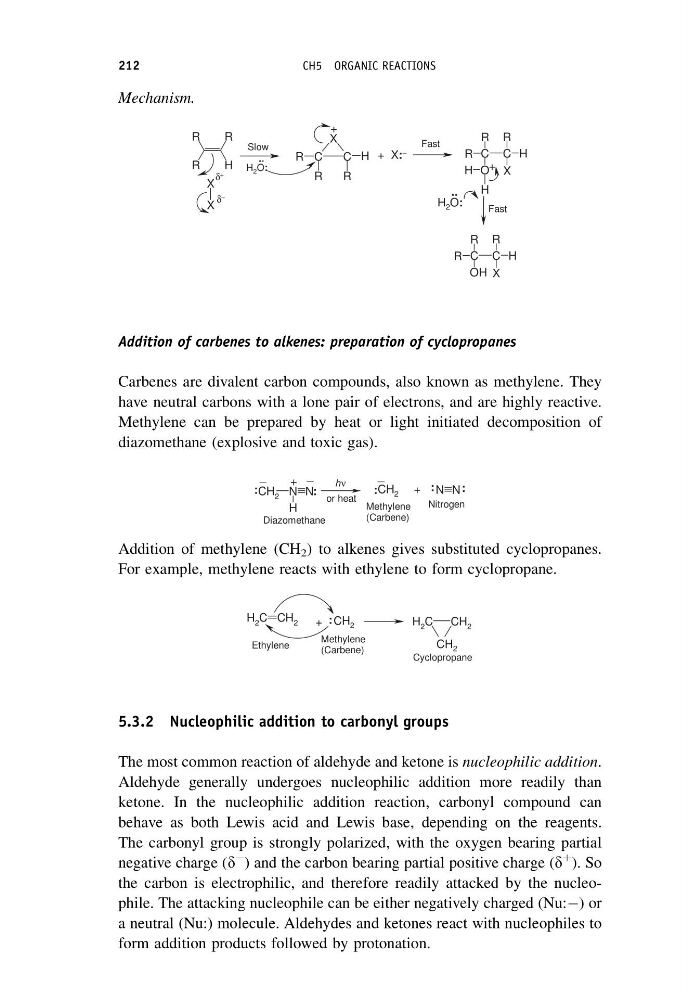
Mechanism.
X
X
C
X
C
R
H
R
R
O
H
H
C
X
C
R
H
R
R
C
X
C
OH
R
H
R
R
R
R
R
H
+
H 2 O:
δ +
δ −
..
Slow
Fast
+
H 2 O:
..
Fast
+ X: −
Addition of carbenes to alkenes: preparation of cyclopropanes
Carbenes are divalent carbon compounds, also known as methylene. They
have neutral carbons with a lone pair of electrons, and are highly reactive.
Methylene can be prepared by heat or light initiated decomposition of
diazomethane (explosive and toxic gas).
N N
CH 2 N N
H
Diazomethane
hν
or heat
CH 2 +
Methylene
(Carbene)
Nitrogen
_
_
+
:
:
:
_
:
:
Addition of methylene (CH 2 ) to alkenes gives substituted cyclopropanes.
For example, methylene reacts with ethylene to form cyclopropane.
C
H 2
CH 2
C
H 2
CH 2
+ CH 2
Ethylene
Cyclopropane
:
Methylene
(Carbene)
CH 2
5.3.2 Nucleophilic addition to carbonyl groups
The most common reaction of aldehyde and ketone is nucleophilic addition.
Aldehyde generally undergoes nucleophilic addition more readily than
ketone. In the nucleophilic addition reaction, carbonyl compound can
behave as both Lewis acid and Lewis base, depending on the reagents.
The carbonyl group is strongly polarized, with the oxygen bearing partial
negative charge (d
À ) and the carbon bearing partial positive charge (d
þ ). So
the carbon is electrophilic, and therefore readily attacked by the nucleophile. The attacking nucleophile can be either negatively charged (Nu:À) or
a neutral (Nu:) molecule. Aldehydes and ketones react with nucleophiles to
form addition products followed by protonation.
212
CH5 ORGANIC REACTIONS
X
X
C
X
C
R
H
R
R
O
H
H
C
X
C
R
H
R
R
C
X
C
OH
R
H
R
R
R
R
R
H
+
H 2 O:
δ +
δ −
..
Slow
Fast
+
H 2 O:
..
Fast
+ X: −
Addition of carbenes to alkenes: preparation of cyclopropanes
Carbenes are divalent carbon compounds, also known as methylene. They
have neutral carbons with a lone pair of electrons, and are highly reactive.
Methylene can be prepared by heat or light initiated decomposition of
diazomethane (explosive and toxic gas).
N N
CH 2 N N
H
Diazomethane
hν
or heat
CH 2 +
Methylene
(Carbene)
Nitrogen
_
_
+
:
:
:
_
:
:
Addition of methylene (CH 2 ) to alkenes gives substituted cyclopropanes.
For example, methylene reacts with ethylene to form cyclopropane.
C
H 2
CH 2
C
H 2
CH 2
+ CH 2
Ethylene
Cyclopropane
:
Methylene
(Carbene)
CH 2
5.3.2 Nucleophilic addition to carbonyl groups
The most common reaction of aldehyde and ketone is nucleophilic addition.
Aldehyde generally undergoes nucleophilic addition more readily than
ketone. In the nucleophilic addition reaction, carbonyl compound can
behave as both Lewis acid and Lewis base, depending on the reagents.
The carbonyl group is strongly polarized, with the oxygen bearing partial
negative charge (d
À ) and the carbon bearing partial positive charge (d
þ ). So
the carbon is electrophilic, and therefore readily attacked by the nucleophile. The attacking nucleophile can be either negatively charged (Nu:À) or
a neutral (Nu:) molecule. Aldehydes and ketones react with nucleophiles to
form addition products followed by protonation.
212
CH5 ORGANIC REACTIONS