

Addition of halides to alkynes: preparation of alkyl dihalides and
tetrahalides
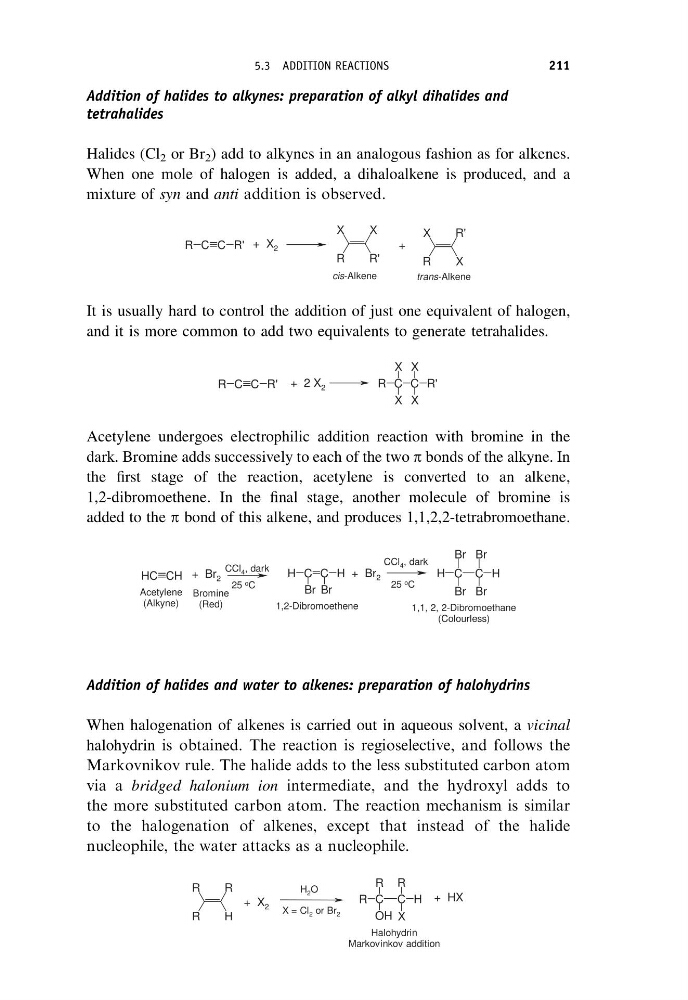
Halides (Cl 2 or Br 2 ) add to alkynes in an analogous fashion as for alkenes.
When one mole of halogen is added, a dihaloalkene is produced, and a
mixture of syn and anti addition is observed.
C
C
R
R'
X
X
R
R'
X
R'
R
X
+
+ X 2
cis-Alkene
trans-Alkene
It is usually hard to control the addition of just one equivalent of halogen,
and it is more common to add two equivalents to generate tetrahalides.
C
C
R
R'
R C
X
X
C
X
X
R'
+ 2 X 2
Acetylene undergoes electrophilic addition reaction with bromine in the
dark. Bromine adds successively to each of the two p bonds of the alkyne. In
the first stage of the reaction, acetylene is converted to an alkene,
1,2-dibromoethene. In the final stage, another molecule of bromine is
added to the p bond of this alkene, and produces 1,1,2,2-tetrabromoethane.
C
Br
H
Br
Br
H C
Br
C
H CH
C C
Br
Br
H
H
+ Br 2
CCl 4 , dark
25 o C
Acetylene
(Alkyne)
Bromine
(Red)
1,2-Dibromoethene
1,1, 2, 2-Dibromoethane
(Colourless)
+ Br 2
CCl 4 , dark
25 o C
Addition of halides and water to alkenes: preparation of halohydrins
When halogenation of alkenes is carried out in aqueous solvent, a vicinal
halohydrin is obtained. The reaction is regioselective, and follows the
Markovnikov rule. The halide adds to the less substituted carbon atom
via a bridged halonium ion intermediate, and the hydroxyl adds to
the more substituted carbon atom. The reaction mechanism is similar
to the halogenation of alkenes, except that instead of the halide
nucleophile, the water attacks as a nucleophile.
C
X
C
OH
R
H
R
R
R
R
R
H
+ X 2
H 2 O
X = Cl 2 or Br 2
+ HX
Halohydrin
Markovinkov addition
5.3 ADDITION REACTIONS
211
tetrahalides
Halides (Cl 2 or Br 2 ) add to alkynes in an analogous fashion as for alkenes.
When one mole of halogen is added, a dihaloalkene is produced, and a
mixture of syn and anti addition is observed.
C
C
R
R'
X
X
R
R'
X
R'
R
X
+
+ X 2
cis-Alkene
trans-Alkene
It is usually hard to control the addition of just one equivalent of halogen,
and it is more common to add two equivalents to generate tetrahalides.
C
C
R
R'
R C
X
X
C
X
X
R'
+ 2 X 2
Acetylene undergoes electrophilic addition reaction with bromine in the
dark. Bromine adds successively to each of the two p bonds of the alkyne. In
the first stage of the reaction, acetylene is converted to an alkene,
1,2-dibromoethene. In the final stage, another molecule of bromine is
added to the p bond of this alkene, and produces 1,1,2,2-tetrabromoethane.
C
Br
H
Br
Br
H C
Br
C
H CH
C C
Br
Br
H
H
+ Br 2
CCl 4 , dark
25 o C
Acetylene
(Alkyne)
Bromine
(Red)
1,2-Dibromoethene
1,1, 2, 2-Dibromoethane
(Colourless)
+ Br 2
CCl 4 , dark
25 o C
Addition of halides and water to alkenes: preparation of halohydrins
When halogenation of alkenes is carried out in aqueous solvent, a vicinal
halohydrin is obtained. The reaction is regioselective, and follows the
Markovnikov rule. The halide adds to the less substituted carbon atom
via a bridged halonium ion intermediate, and the hydroxyl adds to
the more substituted carbon atom. The reaction mechanism is similar
to the halogenation of alkenes, except that instead of the halide
nucleophile, the water attacks as a nucleophile.
C
X
C
OH
R
H
R
R
R
R
R
H
+ X 2
H 2 O
X = Cl 2 or Br 2
+ HX
Halohydrin
Markovinkov addition
5.3 ADDITION REACTIONS
211