

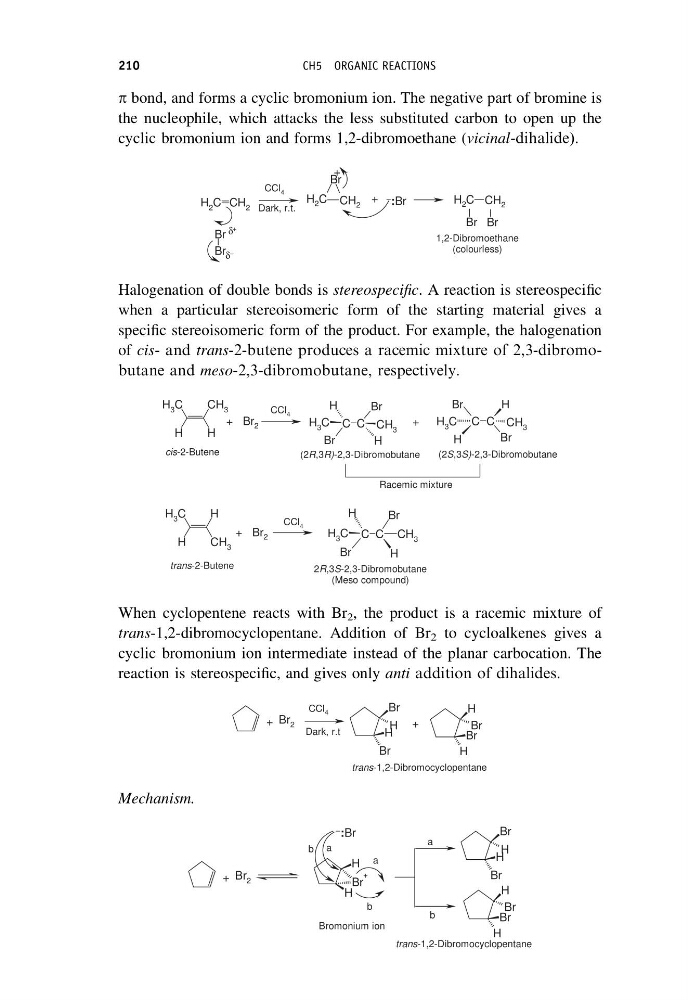
p bond, and forms a cyclic bromonium ion. The negative part of bromine is
the nucleophile, which attacks the less substituted carbon to open up the
cyclic bromonium ion and forms 1,2-dibromoethane (vicinal-dihalide).
C
H 2 CH 2
CCl 4
Br
Br
Br
Br
Br
Dark, r.t.
δ +
δ −
H 2 C CH 2
− :Br
+
+
H 2 C CH 2
1,2-Dibromoethane
(colourless)
Halogenation of double bonds is stereospecific. A reaction is stereospecific
when a particular stereoisomeric form of the starting material gives a
specific stereoisomeric form of the product. For example, the halogenation
of cis- and trans-2-butene produces a racemic mixture of 2,3-dibromobutane and meso-2,3-dibromobutane, respectively.
CCl 4
C
Br
C
CH 3
C
H 3
H
H
Br
C
H
C
CH 3
C
H 3
Br
Br
H
CCl 4
C
Br
C
CH 3
C
H 3
H
H
Br
C
H 3
CH 3
H
H
C
H 3
H
H
CH 3
cis-2-Butene
+
(2R,3R)-2,3-Dibromobutane
(2S,3S)-2,3-Dibromobutane
+ Br 2
trans-2-Butene
2R,3S-2,3-Dibromobutane
(Meso compound)
+ Br 2
Racemic mixture
When cyclopentene reacts with Br 2 , the product is a racemic mixture of
trans-1,2-dibromocyclopentane. Addition of Br 2 to cycloalkenes gives a
cyclic bromonium ion intermediate instead of the planar carbocation. The
reaction is stereospecific, and gives only anti addition of dihalides.
Br 2
Br
H
H
Br
H
Br
Br
H
+
trans-1,2-Dibromocyclopentane
+
CCl 4
Dark, r.t
Mechanism.
Br 2
H
H
Br
+
H
Br
Br
H
Br
H
H
Br
a
b
b
b
a
a
Bromonium ion
trans-1,2-Dibromocyclopentane
+
− :Br
210
CH5 ORGANIC REACTIONS
the nucleophile, which attacks the less substituted carbon to open up the
cyclic bromonium ion and forms 1,2-dibromoethane (vicinal-dihalide).
C
H 2 CH 2
CCl 4
Br
Br
Br
Br
Br
Dark, r.t.
δ +
δ −
H 2 C CH 2
− :Br
+
+
H 2 C CH 2
1,2-Dibromoethane
(colourless)
Halogenation of double bonds is stereospecific. A reaction is stereospecific
when a particular stereoisomeric form of the starting material gives a
specific stereoisomeric form of the product. For example, the halogenation
of cis- and trans-2-butene produces a racemic mixture of 2,3-dibromobutane and meso-2,3-dibromobutane, respectively.
CCl 4
C
Br
C
CH 3
C
H 3
H
H
Br
C
H
C
CH 3
C
H 3
Br
Br
H
CCl 4
C
Br
C
CH 3
C
H 3
H
H
Br
C
H 3
CH 3
H
H
C
H 3
H
H
CH 3
cis-2-Butene
+
(2R,3R)-2,3-Dibromobutane
(2S,3S)-2,3-Dibromobutane
+ Br 2
trans-2-Butene
2R,3S-2,3-Dibromobutane
(Meso compound)
+ Br 2
Racemic mixture
When cyclopentene reacts with Br 2 , the product is a racemic mixture of
trans-1,2-dibromocyclopentane. Addition of Br 2 to cycloalkenes gives a
cyclic bromonium ion intermediate instead of the planar carbocation. The
reaction is stereospecific, and gives only anti addition of dihalides.
Br 2
Br
H
H
Br
H
Br
Br
H
+
trans-1,2-Dibromocyclopentane
+
CCl 4
Dark, r.t
Mechanism.
Br 2
H
H
Br
+
H
Br
Br
H
Br
H
H
Br
a
b
b
b
a
a
Bromonium ion
trans-1,2-Dibromocyclopentane
+
− :Br
210
CH5 ORGANIC REACTIONS