

H 2 SO 4 , produces ethers. Addition of alcohol to an unsymmetrical alkene
follows Markovnikov’s rule. The reaction proceeds via protonation to give
the more stable carbocation intermediate. The mechanism is the reverse of
that for dehydration of ethers.
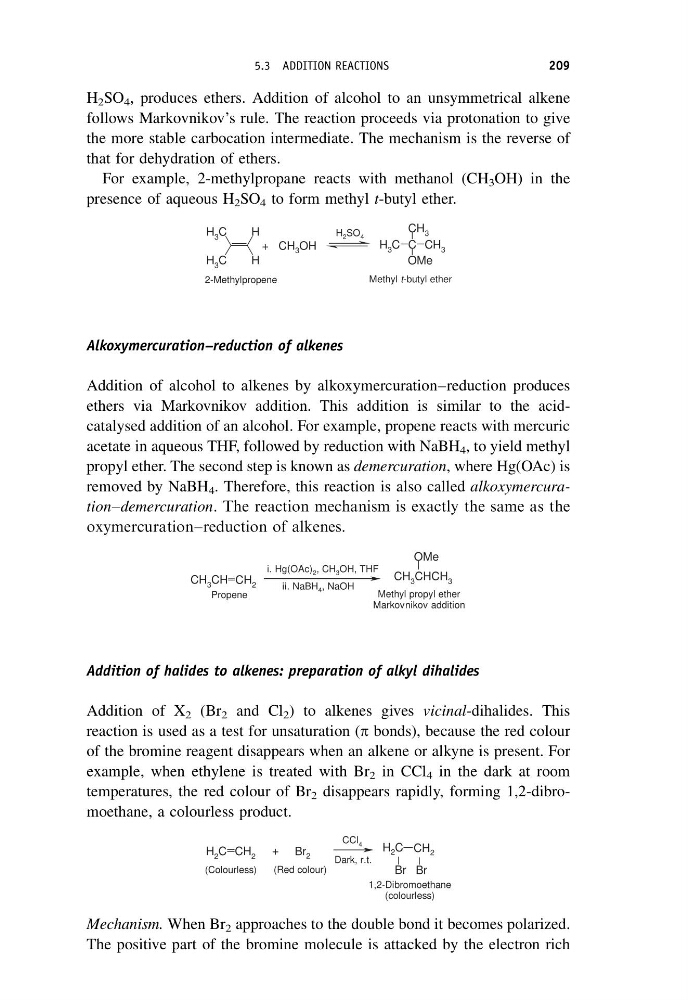
For example, 2-methylpropane reacts with methanol (CH 3 OH) in the
presence of aqueous H 2 SO 4 to form methyl t-butyl ether.
C
H 3 C CH 3
OMe
CH 3
C
H 3
H
C
H 3
H
+ CH 3 OH
Methyl t-butyl ether
H 2 SO 4
2-Methylpropene
Alkoxymercuration–reduction of alkenes
Addition of alcohol to alkenes by alkoxymercuration–reduction produces
ethers via Markovnikov addition. This addition is similar to the acidcatalysed addition of an alcohol. For example, propene reacts with mercuric
acetate in aqueous THF, followed by reduction with NaBH 4 , to yield methyl
propyl ether. The second step is known as demercuration, where Hg(OAc) is
removed by NaBH 4 . Therefore, this reaction is also called alkoxymercuration–demercuration. The reaction mechanism is exactly the same as the
oxymercuration–reduction of alkenes.
CH 3 CH CH 2
OMe
CH 3 CHCH 3
Propene
i. Hg(OAc) 2 , CH 3 OH, THF
ii. NaBH 4 , NaOH
Methyl propyl ether
Markovnikov addition
Addition of halides to alkenes: preparation of alkyl dihalides
Addition of X 2 (Br 2 and Cl 2 ) to alkenes gives vicinal-dihalides. This
reaction is used as a test for unsaturation (p bonds), because the red colour
of the bromine reagent disappears when an alkene or alkyne is present. For
example, when ethylene is treated with Br 2 in CCl 4 in the dark at room
temperatures, the red colour of Br 2 disappears rapidly, forming 1,2-dibromoethane, a colourless product.
Br
Br
CCl 4
C
H 2 CH 2
H 2 C CH 2
1,2-Dibromoethane
(colourless)
(Colourless)
+
Dark, r.t.
Br 2
(Red colour)
Mechanism. When Br 2 approaches to the double bond it becomes polarized.
The positive part of the bromine molecule is attacked by the electron rich
5.3 ADDITION REACTIONS
209
follows Markovnikov’s rule. The reaction proceeds via protonation to give
the more stable carbocation intermediate. The mechanism is the reverse of
that for dehydration of ethers.
For example, 2-methylpropane reacts with methanol (CH 3 OH) in the
presence of aqueous H 2 SO 4 to form methyl t-butyl ether.
C
H 3 C CH 3
OMe
CH 3
C
H 3
H
C
H 3
H
+ CH 3 OH
Methyl t-butyl ether
H 2 SO 4
2-Methylpropene
Alkoxymercuration–reduction of alkenes
Addition of alcohol to alkenes by alkoxymercuration–reduction produces
ethers via Markovnikov addition. This addition is similar to the acidcatalysed addition of an alcohol. For example, propene reacts with mercuric
acetate in aqueous THF, followed by reduction with NaBH 4 , to yield methyl
propyl ether. The second step is known as demercuration, where Hg(OAc) is
removed by NaBH 4 . Therefore, this reaction is also called alkoxymercuration–demercuration. The reaction mechanism is exactly the same as the
oxymercuration–reduction of alkenes.
CH 3 CH CH 2
OMe
CH 3 CHCH 3
Propene
i. Hg(OAc) 2 , CH 3 OH, THF
ii. NaBH 4 , NaOH
Methyl propyl ether
Markovnikov addition
Addition of halides to alkenes: preparation of alkyl dihalides
Addition of X 2 (Br 2 and Cl 2 ) to alkenes gives vicinal-dihalides. This
reaction is used as a test for unsaturation (p bonds), because the red colour
of the bromine reagent disappears when an alkene or alkyne is present. For
example, when ethylene is treated with Br 2 in CCl 4 in the dark at room
temperatures, the red colour of Br 2 disappears rapidly, forming 1,2-dibromoethane, a colourless product.
Br
Br
CCl 4
C
H 2 CH 2
H 2 C CH 2
1,2-Dibromoethane
(colourless)
(Colourless)
+
Dark, r.t.
Br 2
(Red colour)
Mechanism. When Br 2 approaches to the double bond it becomes polarized.
The positive part of the bromine molecule is attacked by the electron rich
5.3 ADDITION REACTIONS
209