

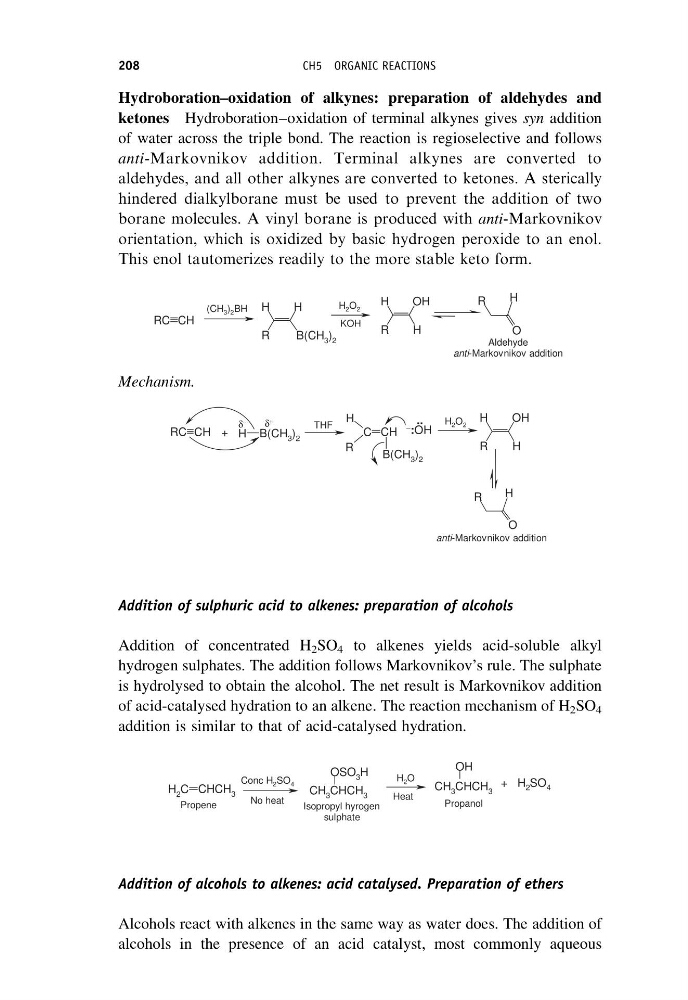
Hydroboration–oxidation of alkynes: preparation of aldehydes and
ketones Hydroboration–oxidation of terminal alkynes gives syn addition
of water across the triple bond. The reaction is regioselective and follows
anti-Markovnikov addition. Terminal alkynes are converted to
aldehydes, and all other alkynes are converted to ketones. A sterically
hindered dialkylborane must be used to prevent the addition of two
borane molecules. A vinyl borane is produced with anti-Markovnikov
orientation, which is oxidized by basic hydrogen peroxide to an enol.
This enol tautomerizes readily to the more stable keto form.
B(CH 3 ) 2
H
H
R
RC CH
R
O
H
H
OH
R
H
KOH
Aldehyde
anti-Markovnikov addition
(CH 3 ) 2 BH
H 2 O 2
Mechanism.
RC CH
B(CH 3 ) 2
H
C CH
H
R
B(CH 3 ) 2
R
O
H
H
OH
R
H
+
δ +
δ −
THF
− :OH
H 2 O 2
..
anti-Markovnikov addition
Addition of sulphuric acid to alkenes: preparation of alcohols
Addition of concentrated H 2 SO 4 to alkenes yields acid-soluble alkyl
hydrogen sulphates. The addition follows Markovnikov’s rule. The sulphate
is hydrolysed to obtain the alcohol. The net result is Markovnikov addition
of acid-catalysed hydration to an alkene. The reaction mechanism of H 2 SO 4
addition is similar to that of acid-catalysed hydration.
C
H 2
CHCH 3
OH
CH 3 CHCH 3
OSO 3 H
CH 3 CHCH 3
Propene
H 2 O
+ H 2 SO 4
Conc H 2 SO 4
Propanol
Heat
Isopropyl hyrogen
sulphate
No heat
Addition of alcohols to alkenes: acid catalysed. Preparation of ethers
Alcohols react with alkenes in the same way as water does. The addition of
alcohols in the presence of an acid catalyst, most commonly aqueous
208
CH5 ORGANIC REACTIONS
ketones Hydroboration–oxidation of terminal alkynes gives syn addition
of water across the triple bond. The reaction is regioselective and follows
anti-Markovnikov addition. Terminal alkynes are converted to
aldehydes, and all other alkynes are converted to ketones. A sterically
hindered dialkylborane must be used to prevent the addition of two
borane molecules. A vinyl borane is produced with anti-Markovnikov
orientation, which is oxidized by basic hydrogen peroxide to an enol.
This enol tautomerizes readily to the more stable keto form.
B(CH 3 ) 2
H
H
R
RC CH
R
O
H
H
OH
R
H
KOH
Aldehyde
anti-Markovnikov addition
(CH 3 ) 2 BH
H 2 O 2
Mechanism.
RC CH
B(CH 3 ) 2
H
C CH
H
R
B(CH 3 ) 2
R
O
H
H
OH
R
H
+
δ +
δ −
THF
− :OH
H 2 O 2
..
anti-Markovnikov addition
Addition of sulphuric acid to alkenes: preparation of alcohols
Addition of concentrated H 2 SO 4 to alkenes yields acid-soluble alkyl
hydrogen sulphates. The addition follows Markovnikov’s rule. The sulphate
is hydrolysed to obtain the alcohol. The net result is Markovnikov addition
of acid-catalysed hydration to an alkene. The reaction mechanism of H 2 SO 4
addition is similar to that of acid-catalysed hydration.
C
H 2
CHCH 3
OH
CH 3 CHCH 3
OSO 3 H
CH 3 CHCH 3
Propene
H 2 O
+ H 2 SO 4
Conc H 2 SO 4
Propanol
Heat
Isopropyl hyrogen
sulphate
No heat
Addition of alcohols to alkenes: acid catalysed. Preparation of ethers
Alcohols react with alkenes in the same way as water does. The addition of
alcohols in the presence of an acid catalyst, most commonly aqueous
208
CH5 ORGANIC REACTIONS