

C
H 3
O
C 2 H 5
CCH 3
CH 3 C
C
H 3
CH 3
O
H
H
2-Butyne
H 2 SO 4
H 2 O
2-Butanone
Enol
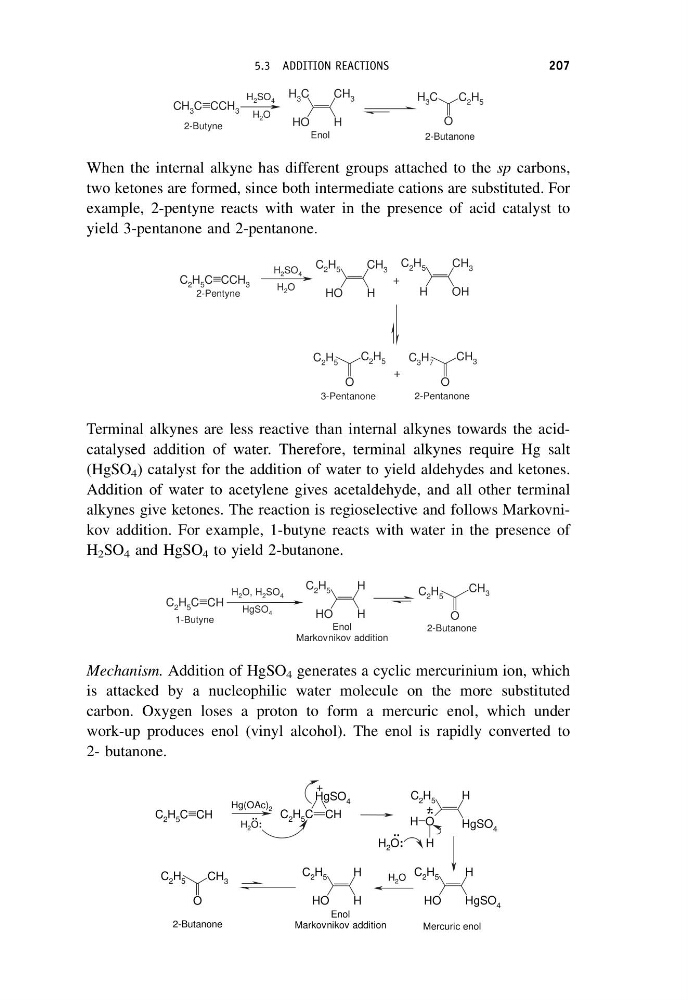
When the internal alkyne has different groups attached to the sp carbons,
two ketones are formed, since both intermediate cations are substituted. For
example, 2-pentyne reacts with water in the presence of acid catalyst to
yield 3-pentanone and 2-pentanone.
C 2 H 5
O
C 2 H 5
CCH 3
C 2 H 5 C
C 3 H 7
O
CH 3
C 2 H 5
CH 3
O
H
H
C 2 H 5
CH 3
H
OH
2-Pentyne
H 2 SO 4
H 2 O
+
+
3-Pentanone
2-Pentanone
Terminal alkynes are less reactive than internal alkynes towards the acidcatalysed addition of water. Therefore, terminal alkynes require Hg salt
(HgSO 4 ) catalyst for the addition of water to yield aldehydes and ketones.
Addition of water to acetylene gives acetaldehyde, and all other terminal
alkynes give ketones. The reaction is regioselective and follows Markovnikov addition. For example, 1-butyne reacts with water in the presence of
H 2 SO 4 and HgSO 4 to yield 2-butanone.
CH
C 2 H 5 C
C 2 H 5
O
CH 3
C 2 H 5
H
O
H
H
Enol
Markovnikov addition
2-Butanone
1-Butyne
H 2 O, H 2 SO 4
HgSO 4
Mechanism. Addition of HgSO 4 generates a cyclic mercurinium ion, which
is attacked by a nucleophilic water molecule on the more substituted
carbon. Oxygen loses a proton to form a mercuric enol, which under
work-up produces enol (vinyl alcohol). The enol is rapidly converted to
2- butanone.
CH
C 2 H 5 C
C 2 H 5 C CH
HgSO 4
O
H
H
C 2 H 5
H
HgSO 4
CH 3
O
C 2 H 5
C 2 H 5
H
O
H
HgSO 4
C 2 H 5
H
O
H
H
2-Butanone
+
+ ..
H 2 O:
Hg(OAc) 2
Enol
Markovnikov addition
..
H 2 O:
Mercuric enol
H 2 O
..
5.3 ADDITION REACTIONS
207
H 3
O
C 2 H 5
CCH 3
CH 3 C
C
H 3
CH 3
O
H
H
2-Butyne
H 2 SO 4
H 2 O
2-Butanone
Enol
When the internal alkyne has different groups attached to the sp carbons,
two ketones are formed, since both intermediate cations are substituted. For
example, 2-pentyne reacts with water in the presence of acid catalyst to
yield 3-pentanone and 2-pentanone.
C 2 H 5
O
C 2 H 5
CCH 3
C 2 H 5 C
C 3 H 7
O
CH 3
C 2 H 5
CH 3
O
H
H
C 2 H 5
CH 3
H
OH
2-Pentyne
H 2 SO 4
H 2 O
+
+
3-Pentanone
2-Pentanone
Terminal alkynes are less reactive than internal alkynes towards the acidcatalysed addition of water. Therefore, terminal alkynes require Hg salt
(HgSO 4 ) catalyst for the addition of water to yield aldehydes and ketones.
Addition of water to acetylene gives acetaldehyde, and all other terminal
alkynes give ketones. The reaction is regioselective and follows Markovnikov addition. For example, 1-butyne reacts with water in the presence of
H 2 SO 4 and HgSO 4 to yield 2-butanone.
CH
C 2 H 5 C
C 2 H 5
O
CH 3
C 2 H 5
H
O
H
H
Enol
Markovnikov addition
2-Butanone
1-Butyne
H 2 O, H 2 SO 4
HgSO 4
Mechanism. Addition of HgSO 4 generates a cyclic mercurinium ion, which
is attacked by a nucleophilic water molecule on the more substituted
carbon. Oxygen loses a proton to form a mercuric enol, which under
work-up produces enol (vinyl alcohol). The enol is rapidly converted to
2- butanone.
CH
C 2 H 5 C
C 2 H 5 C CH
HgSO 4
O
H
H
C 2 H 5
H
HgSO 4
CH 3
O
C 2 H 5
C 2 H 5
H
O
H
HgSO 4
C 2 H 5
H
O
H
H
2-Butanone
+
+ ..
H 2 O:
Hg(OAc) 2
Enol
Markovnikov addition
..
H 2 O:
Mercuric enol
H 2 O
..
5.3 ADDITION REACTIONS
207