

CH 3 CH CH 2
CH 2
CH
O
C
H 3
H
H
OAc
OAc
C
H 3 CH CH 2
Hg
OAc
Hg OAc
CH 3 CH CH 3
CH 2
CH
OH
C
H 3
Hg OAc
OH
2-Propanol
Markovnikov addition
+
Hg ..
+ AcO −
+
H 2 O:
..
+
..
AcO −
AcOH +
NaBH 4 , NaOH
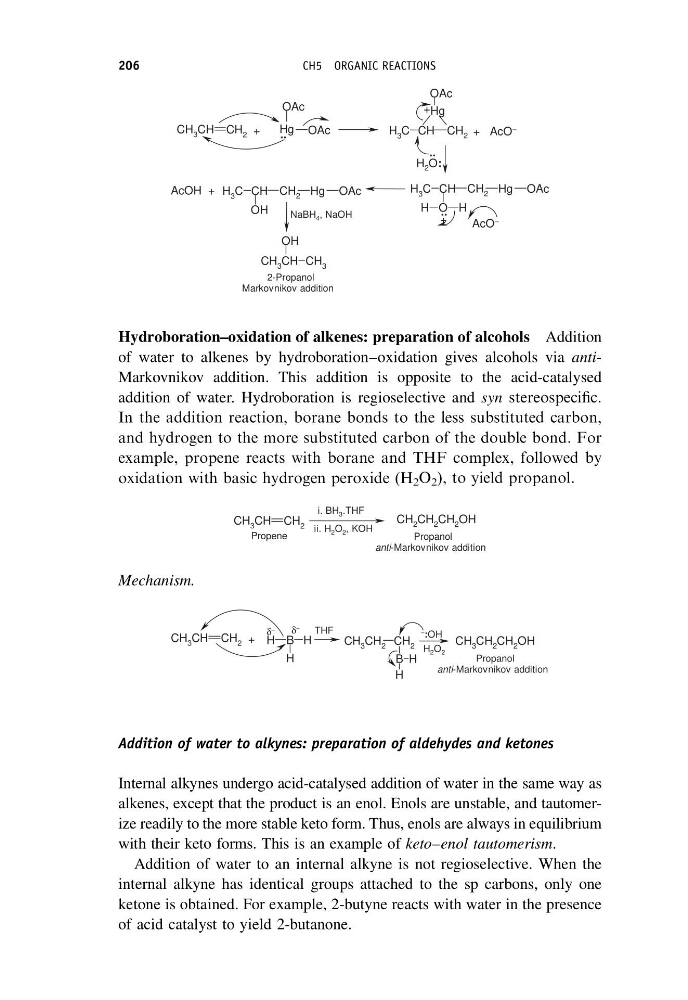
Hydroboration–oxidation of alkenes: preparation of alcohols Addition
of water to alkenes by hydroboration–oxidation gives alcohols via antiMarkovnikov addition. This addition is opposite to the acid-catalysed
addition of water. Hydroboration is regioselective and syn stereospecific.
In the addition reaction, borane bonds to the less substituted carbon,
and hydrogen to the more substituted carbon of the double bond. For
example, propene reacts with borane and THF complex, followed by
oxidation with basic hydrogen peroxide (H 2 O 2 ), to yield propanol.
CH 3 CH CH 2
CH 2 CH 2 CH 2 OH
Propene
i. BH 3 .THF
ii. H 2 O 2 , KOH
Propanol
anti-Markovnikov addition
Mechanism.
CH 3 CH CH 2
B H
H
H
CH 3 CH 2 CH 2
B H
H
CH 3 CH 2 CH 2 OH
+
δ +
δ −
THF
− :OH
H 2 O 2
Propanol
anti-Markovnikov addition
Addition of water to alkynes: preparation of aldehydes and ketones
Internal alkynes undergo acid-catalysed addition of water in the same way as
alkenes, except that the product is an enol. Enols are unstable, and tautomerize readily to the more stable keto form. Thus, enols are always in equilibrium
with their keto forms. This is an example of keto–enol tautomerism.
Addition of water to an internal alkyne is not regioselective. When the
internal alkyne has identical groups attached to the sp carbons, only one
ketone is obtained. For example, 2-butyne reacts with water in the presence
of acid catalyst to yield 2-butanone.
206
CH5 ORGANIC REACTIONS
CH 2
CH
O
C
H 3
H
H
OAc
OAc
C
H 3 CH CH 2
Hg
OAc
Hg OAc
CH 3 CH CH 3
CH 2
CH
OH
C
H 3
Hg OAc
OH
2-Propanol
Markovnikov addition
+
Hg ..
+ AcO −
+
H 2 O:
..
+
..
AcO −
AcOH +
NaBH 4 , NaOH
Hydroboration–oxidation of alkenes: preparation of alcohols Addition
of water to alkenes by hydroboration–oxidation gives alcohols via antiMarkovnikov addition. This addition is opposite to the acid-catalysed
addition of water. Hydroboration is regioselective and syn stereospecific.
In the addition reaction, borane bonds to the less substituted carbon,
and hydrogen to the more substituted carbon of the double bond. For
example, propene reacts with borane and THF complex, followed by
oxidation with basic hydrogen peroxide (H 2 O 2 ), to yield propanol.
CH 3 CH CH 2
CH 2 CH 2 CH 2 OH
Propene
i. BH 3 .THF
ii. H 2 O 2 , KOH
Propanol
anti-Markovnikov addition
Mechanism.
CH 3 CH CH 2
B H
H
H
CH 3 CH 2 CH 2
B H
H
CH 3 CH 2 CH 2 OH
+
δ +
δ −
THF
− :OH
H 2 O 2
Propanol
anti-Markovnikov addition
Addition of water to alkynes: preparation of aldehydes and ketones
Internal alkynes undergo acid-catalysed addition of water in the same way as
alkenes, except that the product is an enol. Enols are unstable, and tautomerize readily to the more stable keto form. Thus, enols are always in equilibrium
with their keto forms. This is an example of keto–enol tautomerism.
Addition of water to an internal alkyne is not regioselective. When the
internal alkyne has identical groups attached to the sp carbons, only one
ketone is obtained. For example, 2-butyne reacts with water in the presence
of acid catalyst to yield 2-butanone.
206
CH5 ORGANIC REACTIONS