

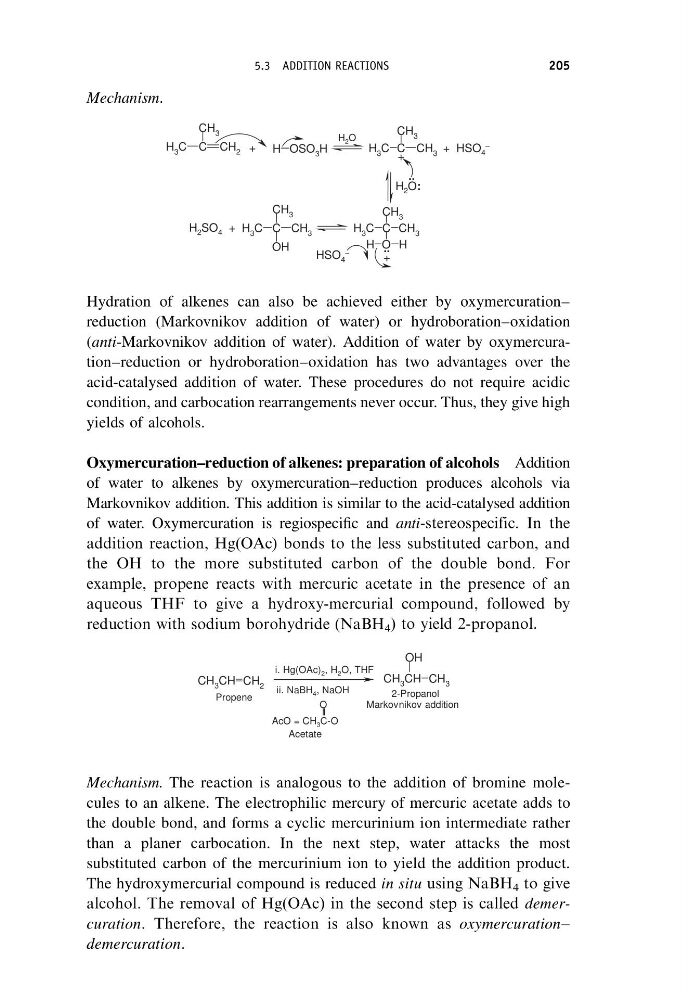
Mechanism.
C
CH 3
C
H 3
CH 3
H OSO 3 H
CH 2
C
C
H 3
CH 3
C
H 3 C CH 3
O H
H
CH 3
C
CH 3
OH
CH 3
C
H 3
+
+
+ HSO 4
−
H 2 O:
..
+
..
HSO 4
−
H 2 SO 4 +
H 2 O
Hydration of alkenes can also be achieved either by oxymercuration–
reduction (Markovnikov addition of water) or hydroboration–oxidation
(anti-Markovnikov addition of water). Addition of water by oxymercuration–reduction or hydroboration–oxidation has two advantages over the
acid-catalysed addition of water. These procedures do not require acidic
condition, and carbocation rearrangements never occur. Thus, they give high
yields of alcohols.
Oxymercuration–reduction of alkenes: preparation of alcohols Addition
of water to alkenes by oxymercuration–reduction produces alcohols via
Markovnikov addition. This addition is similar to the acid-catalysed addition
of water. Oxymercuration is regiospecific and anti-stereospecific. In the
addition reaction, Hg(OAc) bonds to the less substituted carbon, and
the OH to the more substituted carbon of the double bond. For
example, propene reacts with mercuric acetate in the presence of an
aqueous THF to give a hydroxy-mercurial compound, followed by
reduction with sodium borohydride (NaBH 4 ) to yield 2-propanol.
CH 3 CH CH 2
CH 3 CH CH 3
O
OH
Propene
i. Hg(OAc) 2 , H 2 O, THF
ii. NaBH 4 , NaOH
2-Propanol
Markovnikov addition
AcO = CH 3 C-O
Acetate
Mechanism. The reaction is analogous to the addition of bromine molecules to an alkene. The electrophilic mercury of mercuric acetate adds to
the double bond, and forms a cyclic mercurinium ion intermediate rather
than a planer carbocation. In the next step, water attacks the most
substituted carbon of the mercurinium ion to yield the addition product.
The hydroxymercurial compound is reduced in situ using NaBH 4 to give
alcohol. The removal of Hg(OAc) in the second step is called demercuration. Therefore, the reaction is also known as oxymercuration–
demercuration.
5.3 ADDITION REACTIONS
205
C
CH 3
C
H 3
CH 3
H OSO 3 H
CH 2
C
C
H 3
CH 3
C
H 3 C CH 3
O H
H
CH 3
C
CH 3
OH
CH 3
C
H 3
+
+
+ HSO 4
−
H 2 O:
..
+
..
HSO 4
−
H 2 SO 4 +
H 2 O
Hydration of alkenes can also be achieved either by oxymercuration–
reduction (Markovnikov addition of water) or hydroboration–oxidation
(anti-Markovnikov addition of water). Addition of water by oxymercuration–reduction or hydroboration–oxidation has two advantages over the
acid-catalysed addition of water. These procedures do not require acidic
condition, and carbocation rearrangements never occur. Thus, they give high
yields of alcohols.
Oxymercuration–reduction of alkenes: preparation of alcohols Addition
of water to alkenes by oxymercuration–reduction produces alcohols via
Markovnikov addition. This addition is similar to the acid-catalysed addition
of water. Oxymercuration is regiospecific and anti-stereospecific. In the
addition reaction, Hg(OAc) bonds to the less substituted carbon, and
the OH to the more substituted carbon of the double bond. For
example, propene reacts with mercuric acetate in the presence of an
aqueous THF to give a hydroxy-mercurial compound, followed by
reduction with sodium borohydride (NaBH 4 ) to yield 2-propanol.
CH 3 CH CH 2
CH 3 CH CH 3
O
OH
Propene
i. Hg(OAc) 2 , H 2 O, THF
ii. NaBH 4 , NaOH
2-Propanol
Markovnikov addition
AcO = CH 3 C-O
Acetate
Mechanism. The reaction is analogous to the addition of bromine molecules to an alkene. The electrophilic mercury of mercuric acetate adds to
the double bond, and forms a cyclic mercurinium ion intermediate rather
than a planer carbocation. In the next step, water attacks the most
substituted carbon of the mercurinium ion to yield the addition product.
The hydroxymercurial compound is reduced in situ using NaBH 4 to give
alcohol. The removal of Hg(OAc) in the second step is called demercuration. Therefore, the reaction is also known as oxymercuration–
demercuration.
5.3 ADDITION REACTIONS
205