

C
Br
CH 2 Br
CH 3
C
H 3
C
CH 3
C
H 3
C
CH 3
C
H 3
C
CH 3
C
H 3
BrCH 2 C
C
CH 3
CH 3
CH 2 Br
CH 3
CH 3
Bromine radical
+ Br .
Br .
Bromine radical
Br 2
Bromine molecule
+ Br .
Bromine radical
1,2-Dibromo-2-methyl propane
1,5-Dibromo-3,3,4,4-tetramethyl butane
CH 2 Br
.
Tertiary alkyl radical
CH 2 Br
.
Tertiary alkyl radical
CH 2 Br
.
Tertiary alkyl radical
Free radical addition of HBr to alkynes: peroxide effect. Preparation of
bromoalkenes
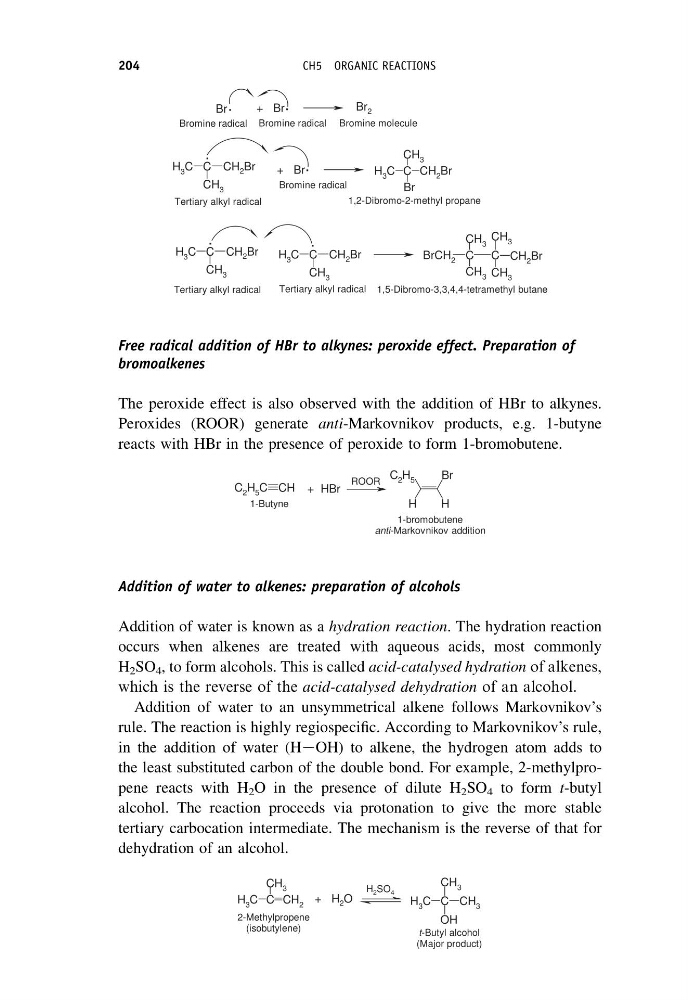
The peroxide effect is also observed with the addition of HBr to alkynes.
Peroxides (ROOR) generate anti-Markovnikov products, e.g. 1-butyne
reacts with HBr in the presence of peroxide to form 1-bromobutene.
C 2 H 5 C CH
C 2 H 5
Br
H
H
1-bromobutene
anti-Markovnikov addition
+ HBr
ROOR
1-Butyne
Addition of water to alkenes: preparation of alcohols
Addition of water is known as a hydration reaction. The hydration reaction
occurs when alkenes are treated with aqueous acids, most commonly
H 2 SO 4 , to form alcohols. This is called acid-catalysed hydration of alkenes,
which is the reverse of the acid-catalysed dehydration of an alcohol.
Addition of water to an unsymmetrical alkene follows Markovnikov’s
rule. The reaction is highly regiospecific. According to Markovnikov’s rule,
in the addition of water (HÀ ÀOH) to alkene, the hydrogen atom adds to
the least substituted carbon of the double bond. For example, 2-methylpropene reacts with H 2 O in the presence of dilute H 2 SO 4 to form t-butyl
alcohol. The reaction proceeds via protonation to give the more stable
tertiary carbocation intermediate. The mechanism is the reverse of that for
dehydration of an alcohol.
C CH 2
CH 3
C
H 3
C
CH 3
OH
CH 3
C
H 3
+ H 2 O
t-Butyl alcohol
(Major product)
H 2 SO 4
2-Methylpropene
(isobutylene)
204
CH5 ORGANIC REACTIONS
Br
CH 2 Br
CH 3
C
H 3
C
CH 3
C
H 3
C
CH 3
C
H 3
C
CH 3
C
H 3
BrCH 2 C
C
CH 3
CH 3
CH 2 Br
CH 3
CH 3
Bromine radical
+ Br .
Br .
Bromine radical
Br 2
Bromine molecule
+ Br .
Bromine radical
1,2-Dibromo-2-methyl propane
1,5-Dibromo-3,3,4,4-tetramethyl butane
CH 2 Br
.
Tertiary alkyl radical
CH 2 Br
.
Tertiary alkyl radical
CH 2 Br
.
Tertiary alkyl radical
Free radical addition of HBr to alkynes: peroxide effect. Preparation of
bromoalkenes
The peroxide effect is also observed with the addition of HBr to alkynes.
Peroxides (ROOR) generate anti-Markovnikov products, e.g. 1-butyne
reacts with HBr in the presence of peroxide to form 1-bromobutene.
C 2 H 5 C CH
C 2 H 5
Br
H
H
1-bromobutene
anti-Markovnikov addition
+ HBr
ROOR
1-Butyne
Addition of water to alkenes: preparation of alcohols
Addition of water is known as a hydration reaction. The hydration reaction
occurs when alkenes are treated with aqueous acids, most commonly
H 2 SO 4 , to form alcohols. This is called acid-catalysed hydration of alkenes,
which is the reverse of the acid-catalysed dehydration of an alcohol.
Addition of water to an unsymmetrical alkene follows Markovnikov’s
rule. The reaction is highly regiospecific. According to Markovnikov’s rule,
in the addition of water (HÀ ÀOH) to alkene, the hydrogen atom adds to
the least substituted carbon of the double bond. For example, 2-methylpropene reacts with H 2 O in the presence of dilute H 2 SO 4 to form t-butyl
alcohol. The reaction proceeds via protonation to give the more stable
tertiary carbocation intermediate. The mechanism is the reverse of that for
dehydration of an alcohol.
C CH 2
CH 3
C
H 3
C
CH 3
OH
CH 3
C
H 3
+ H 2 O
t-Butyl alcohol
(Major product)
H 2 SO 4
2-Methylpropene
(isobutylene)
204
CH5 ORGANIC REACTIONS