

Free radical addition of HBr to alkenes: peroxide effect. Preparation
of alkyl halides
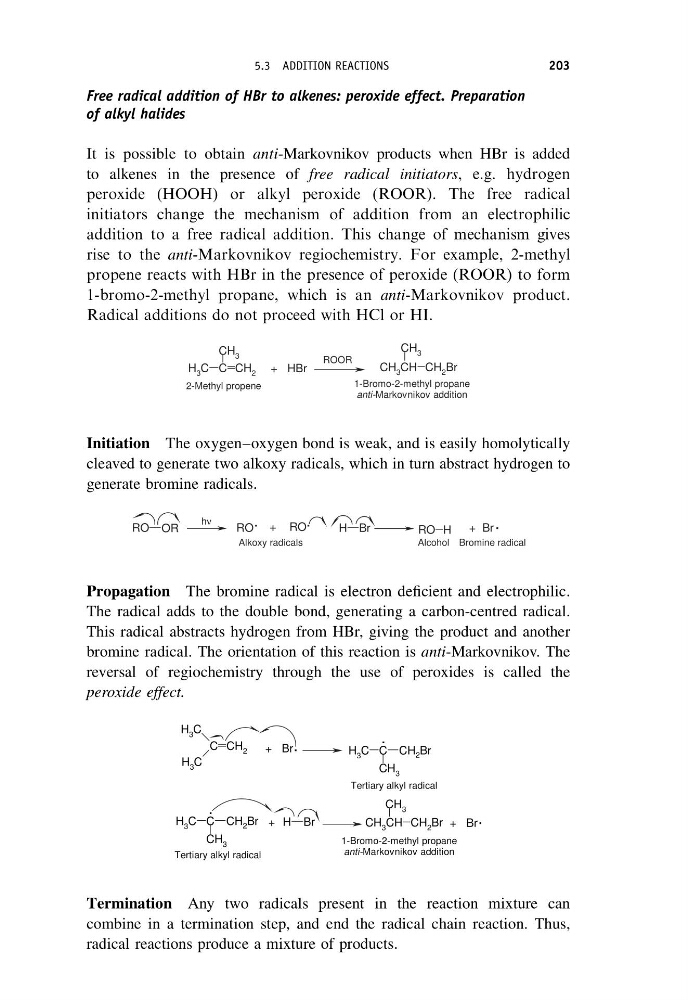
It is possible to obtain anti-Markovnikov products when HBr is added
to alkenes in the presence of free radical initiators, e.g. hydrogen
peroxide (HOOH) or alkyl peroxide (ROOR). The free radical
initiators change the mechanism of addition from an electrophilic
addition to a free radical addition. This change of mechanism gives
rise to the anti-Markovnikov regiochemistry. For example, 2-methyl
propene reacts with HBr in the presence of peroxide (ROOR) to form
1-bromo-2-methyl propane, which is an anti-Markovnikov product.
Radical additions do not proceed with HCl or HI.
CH 3 CH CH 2 Br
C CH 2
CH 3
C
H 3
CH 3
+ HBr
2-Methyl propene
1-Bromo-2-methyl propane
anti-Markovnikov addition
ROOR
Initiation The oxygen–oxygen bond is weak, and is easily homolytically
cleaved to generate two alkoxy radicals, which in turn abstract hydrogen to
generate bromine radicals.
RO
Br
H
RO H
hν
RO
OR
+ Br
.
.
Bromine radical
Alcohol
Alkoxy radicals
+ RO .
Propagation The bromine radical is electron deficient and electrophilic.
The radical adds to the double bond, generating a carbon-centred radical.
This radical abstracts hydrogen from HBr, giving the product and another
bromine radical. The orientation of this reaction is anti-Markovnikov. The
reversal of regiochemistry through the use of peroxides is called the
peroxide effect.
C CH 2
C
H 3
C
H 3
CH 3 CH CH 2 Br
CH 3
C
CH 3
C
H 3
C
CH 3
C
H 3
H Br
+ Br
1-Bromo-2-methyl propane
anti-Markovnikov addition
.
CH 2 Br
.
Tertiary alkyl radical
Tertiary alkyl radical
+
+ Br .
CH 2 Br
.
Termination Any two radicals present in the reaction mixture can
combine in a termination step, and end the radical chain reaction. Thus,
radical reactions produce a mixture of products.
5.3 ADDITION REACTIONS
203
of alkyl halides
It is possible to obtain anti-Markovnikov products when HBr is added
to alkenes in the presence of free radical initiators, e.g. hydrogen
peroxide (HOOH) or alkyl peroxide (ROOR). The free radical
initiators change the mechanism of addition from an electrophilic
addition to a free radical addition. This change of mechanism gives
rise to the anti-Markovnikov regiochemistry. For example, 2-methyl
propene reacts with HBr in the presence of peroxide (ROOR) to form
1-bromo-2-methyl propane, which is an anti-Markovnikov product.
Radical additions do not proceed with HCl or HI.
CH 3 CH CH 2 Br
C CH 2
CH 3
C
H 3
CH 3
+ HBr
2-Methyl propene
1-Bromo-2-methyl propane
anti-Markovnikov addition
ROOR
Initiation The oxygen–oxygen bond is weak, and is easily homolytically
cleaved to generate two alkoxy radicals, which in turn abstract hydrogen to
generate bromine radicals.
RO
Br
H
RO H
hν
RO
OR
+ Br
.
.
Bromine radical
Alcohol
Alkoxy radicals
+ RO .
Propagation The bromine radical is electron deficient and electrophilic.
The radical adds to the double bond, generating a carbon-centred radical.
This radical abstracts hydrogen from HBr, giving the product and another
bromine radical. The orientation of this reaction is anti-Markovnikov. The
reversal of regiochemistry through the use of peroxides is called the
peroxide effect.
C CH 2
C
H 3
C
H 3
CH 3 CH CH 2 Br
CH 3
C
CH 3
C
H 3
C
CH 3
C
H 3
H Br
+ Br
1-Bromo-2-methyl propane
anti-Markovnikov addition
.
CH 2 Br
.
Tertiary alkyl radical
Tertiary alkyl radical
+
+ Br .
CH 2 Br
.
Termination Any two radicals present in the reaction mixture can
combine in a termination step, and end the radical chain reaction. Thus,
radical reactions produce a mixture of products.
5.3 ADDITION REACTIONS
203