

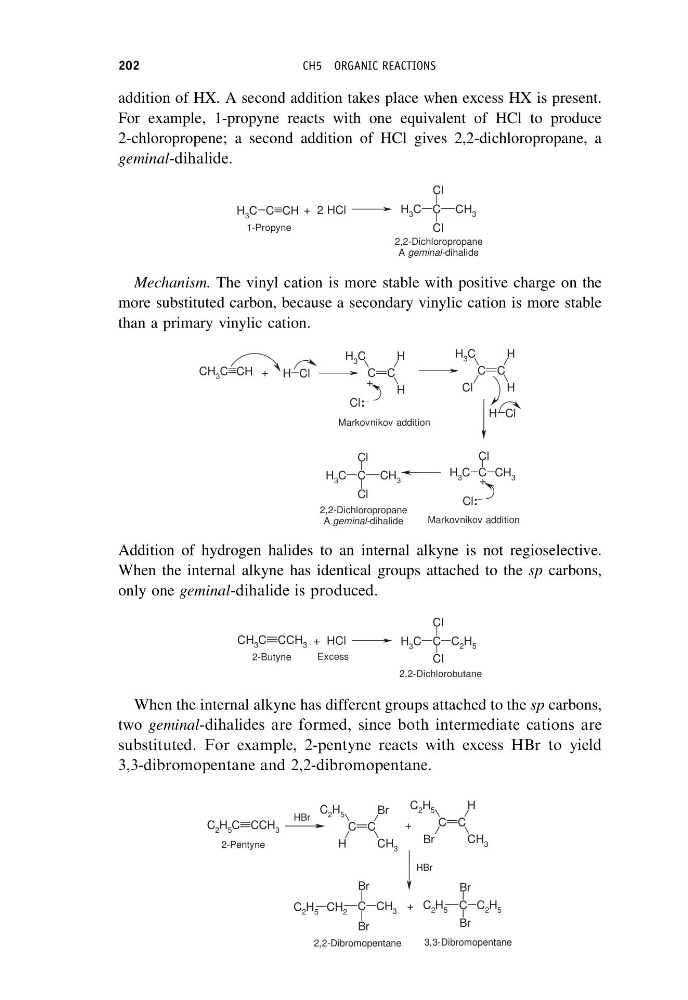
addition of HX. A second addition takes place when excess HX is present.
For example, 1-propyne reacts with one equivalent of HCl to produce
2-chloropropene; a second addition of HCl gives 2,2-dichloropropane, a
geminal-dihalide.
C
H 3 C CH
C
H 3
C
Cl
Cl
CH 3
+ 2 HCl
1-Propyne
2,2-Dichloropropane
A geminal-dihalide
Mechanism. The vinyl cation is more stable with positive charge on the
more substituted carbon, because a secondary vinylic cation is more stable
than a primary vinylic cation.
H Cl
H Cl
CH 3 C CH
C
H 3
C
Cl
Cl
CH 3
C CH 3
Cl
C
H 3
C C
H
H
C
H 3
Cl
C C
H
H
C
H 3
Markovnikov addition
+
+
Markovnikov addition
2,2-Dichloropropane
A geminal-dihalide
+
Cl: −
Cl: −
Addition of hydrogen halides to an internal alkyne is not regioselective.
When the internal alkyne has identical groups attached to the sp carbons,
only one geminal-dihalide is produced.
CH 3 C CCH 3
C
H 3
C
Cl
Cl
C 2 H 5
+ HCl
2-Butyne
2,2-Dichlorobutane
Excess
When the internal alkyne has different groups attached to the sp carbons,
two geminal-dihalides are formed, since both intermediate cations are
substituted. For example, 2-pentyne reacts with excess HBr to yield
3,3-dibromopentane and 2,2-dibromopentane.
C 2 H 5 C CCH 3
C 2 H 5 C C 2 H 5
Br
Br
C 2 H 5 CH 2 C CH 3
Br
Br
C C
H
CH 3
C 2 H 5
Br
C C
CH 3
C 2 H 5
H
Br
HBr
3,3-Dibromopentane
2,2-Dibromopentane
2-Pentyne
+
+
HBr
202
CH5 ORGANIC REACTIONS
For example, 1-propyne reacts with one equivalent of HCl to produce
2-chloropropene; a second addition of HCl gives 2,2-dichloropropane, a
geminal-dihalide.
C
H 3 C CH
C
H 3
C
Cl
Cl
CH 3
+ 2 HCl
1-Propyne
2,2-Dichloropropane
A geminal-dihalide
Mechanism. The vinyl cation is more stable with positive charge on the
more substituted carbon, because a secondary vinylic cation is more stable
than a primary vinylic cation.
H Cl
H Cl
CH 3 C CH
C
H 3
C
Cl
Cl
CH 3
C CH 3
Cl
C
H 3
C C
H
H
C
H 3
Cl
C C
H
H
C
H 3
Markovnikov addition
+
+
Markovnikov addition
2,2-Dichloropropane
A geminal-dihalide
+
Cl: −
Cl: −
Addition of hydrogen halides to an internal alkyne is not regioselective.
When the internal alkyne has identical groups attached to the sp carbons,
only one geminal-dihalide is produced.
CH 3 C CCH 3
C
H 3
C
Cl
Cl
C 2 H 5
+ HCl
2-Butyne
2,2-Dichlorobutane
Excess
When the internal alkyne has different groups attached to the sp carbons,
two geminal-dihalides are formed, since both intermediate cations are
substituted. For example, 2-pentyne reacts with excess HBr to yield
3,3-dibromopentane and 2,2-dibromopentane.
C 2 H 5 C CCH 3
C 2 H 5 C C 2 H 5
Br
Br
C 2 H 5 CH 2 C CH 3
Br
Br
C C
H
CH 3
C 2 H 5
Br
C C
CH 3
C 2 H 5
H
Br
HBr
3,3-Dibromopentane
2,2-Dibromopentane
2-Pentyne
+
+
HBr
202
CH5 ORGANIC REACTIONS