

C CH 3
H
C
H 3
Br
CH 3 CHCH 3
Br
C C
CH 3
H
H
H
H
+
+
2-Bromopropane
Br: −
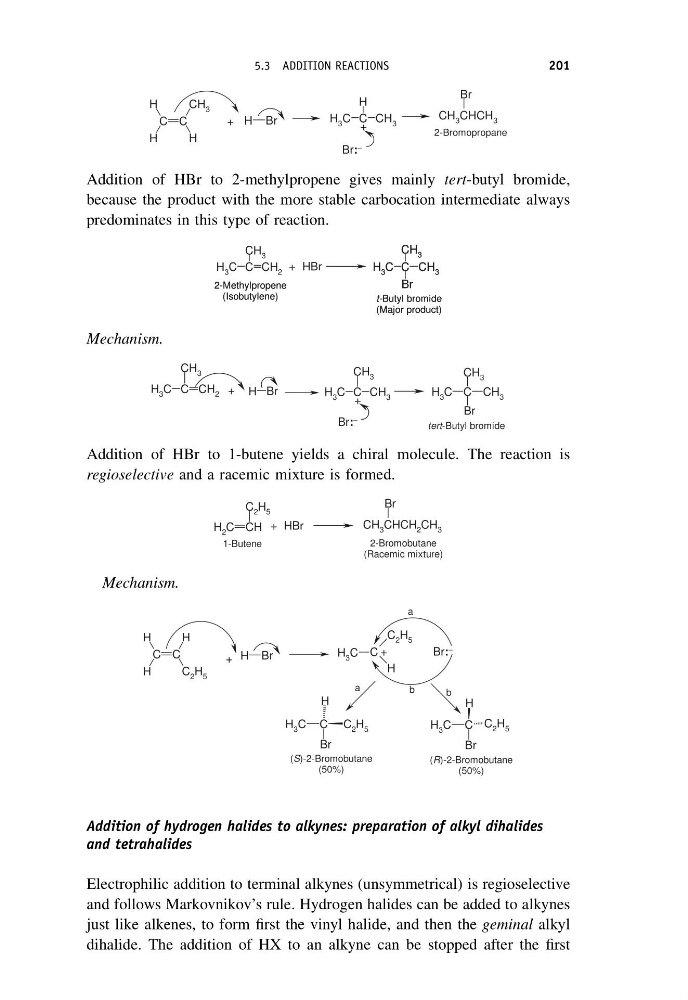
Addition of HBr to 2-methylpropene gives mainly tert-butyl bromide,
because the product with the more stable carbocation intermediate always
predominates in this type of reaction.
CH 2
C
C
H 3
CH 3
C
Br
CH 3
C
H 3
CH 3
2-Methylpropene
(Isobutylene)
+ HBr
t-Butyl bromide
(Major product)
C
Br
CH 3
C
H 3
CH 3
2-Methylpropene
(Isobutylene)
+ HBr
t-Butyl bromide
(Major product)
Mechanism.
C
Br
C
H 3
CH 3
CH 3
Br
CH 2
C
C
H 3
CH 3
C CH 3
CH 3
C
H 3
+ H
tert-Butyl bromide
+
Br: −
Addition of HBr to 1-butene yields a chiral molecule. The reaction is
regioselective and a racemic mixture is formed.
CH
C
H 2
C 2 H 5
CH 3 CHCH 2 CH 3
Br
2-Bromobutane
(Racemic mixture)
+ HBr
1-Butene
Mechanism.
C
H 3
C
H
Br
C 2 H 5
C
H 3
Br
C 2 H 5
H
C
Br
C 2 H 5
C
H 3
H
C C
H
C 2 H 5
H
H
+
C
H
(S)-2-Bromobutane
(50%)
a
b
(R)-2-Bromobutane
(50%)
a
b
+
B r : −
Addition of hydrogen halides to alkynes: preparation of alkyl dihalides
and tetrahalides
Electrophilic addition to terminal alkynes (unsymmetrical) is regioselective
and follows Markovnikov’s rule. Hydrogen halides can be added to alkynes
just like alkenes, to form first the vinyl halide, and then the geminal alkyl
dihalide. The addition of HX to an alkyne can be stopped after the first
5.3 ADDITION REACTIONS
201
H
C
H 3
Br
CH 3 CHCH 3
Br
C C
CH 3
H
H
H
H
+
+
2-Bromopropane
Br: −
Addition of HBr to 2-methylpropene gives mainly tert-butyl bromide,
because the product with the more stable carbocation intermediate always
predominates in this type of reaction.
CH 2
C
C
H 3
CH 3
C
Br
CH 3
C
H 3
CH 3
2-Methylpropene
(Isobutylene)
+ HBr
t-Butyl bromide
(Major product)
C
Br
CH 3
C
H 3
CH 3
2-Methylpropene
(Isobutylene)
+ HBr
t-Butyl bromide
(Major product)
Mechanism.
C
Br
C
H 3
CH 3
CH 3
Br
CH 2
C
C
H 3
CH 3
C CH 3
CH 3
C
H 3
+ H
tert-Butyl bromide
+
Br: −
Addition of HBr to 1-butene yields a chiral molecule. The reaction is
regioselective and a racemic mixture is formed.
CH
C
H 2
C 2 H 5
CH 3 CHCH 2 CH 3
Br
2-Bromobutane
(Racemic mixture)
+ HBr
1-Butene
Mechanism.
C
H 3
C
H
Br
C 2 H 5
C
H 3
Br
C 2 H 5
H
C
Br
C 2 H 5
C
H 3
H
C C
H
C 2 H 5
H
H
+
C
H
(S)-2-Bromobutane
(50%)
a
b
(R)-2-Bromobutane
(50%)
a
b
+
B r : −
Addition of hydrogen halides to alkynes: preparation of alkyl dihalides
and tetrahalides
Electrophilic addition to terminal alkynes (unsymmetrical) is regioselective
and follows Markovnikov’s rule. Hydrogen halides can be added to alkynes
just like alkenes, to form first the vinyl halide, and then the geminal alkyl
dihalide. The addition of HX to an alkyne can be stopped after the first
5.3 ADDITION REACTIONS
201