

Electrophilic addition to symmetrical and unsymmetrical p bonds
When the same substituents are at each end of the double or triple bond, it
is called symmetrical. Unsymmetrical means different substituents are at
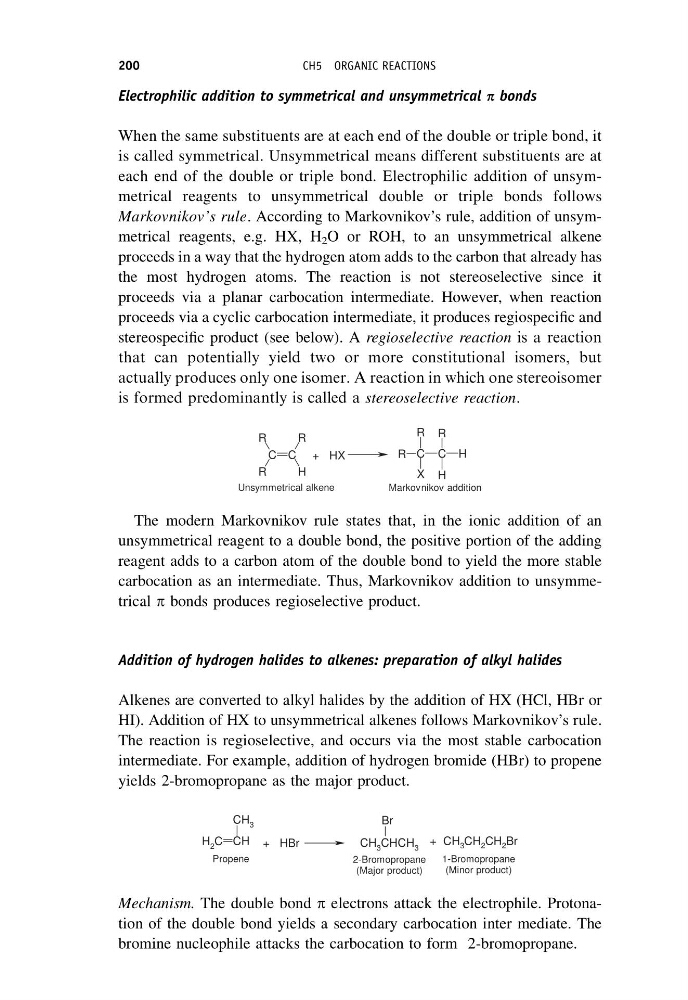
each end of the double or triple bond. Electrophilic addition of unsymmetrical reagents to unsymmetrical double or triple bonds follows
Markovnikov’s rule. According to Markovnikov’s rule, addition of unsymmetrical reagents, e.g. HX, H 2 O or ROH, to an unsymmetrical alkene
proceeds in a way that the hydrogen atom adds to the carbon that already has
the most hydrogen atoms. The reaction is not stereoselective since it
proceeds via a planar carbocation intermediate. However, when reaction
proceeds via a cyclic carbocation intermediate, it produces regiospecific and
stereospecific product (see below). A regioselective reaction is a reaction
that can potentially yield two or more constitutional isomers, but
actually produces only one isomer. A reaction in which one stereoisomer
is formed predominantly is called a stereoselective reaction.
C
C
X H
H
R
R
R
C C
R
H
R
R
+ HX
Markovnikov addition
Unsymmetrical alkene
The modern Markovnikov rule states that, in the ionic addition of an
unsymmetrical reagent to a double bond, the positive portion of the adding
reagent adds to a carbon atom of the double bond to yield the more stable
carbocation as an intermediate. Thus, Markovnikov addition to unsymmetrical p bonds produces regioselective product.
Addition of hydrogen halides to alkenes: preparation of alkyl halides
Alkenes are converted to alkyl halides by the addition of HX (HCl, HBr or
HI). Addition of HX to unsymmetrical alkenes follows Markovnikov’s rule.
The reaction is regioselective, and occurs via the most stable carbocation
intermediate. For example, addition of hydrogen bromide (HBr) to propene
yields 2-bromopropane as the major product.
CH
C
H 2
CH 3
CH 3 CHCH 3
Br
2-Bromopropane
(Major product)
Propene
1-Bromopropane
(Minor product)
+ HBr
+ CH 3 CH 2 CH 2 Br
Mechanism. The double bond p electrons attack the electrophile. Protonation of the double bond yields a secondary carbocation inter mediate. The
bromine nucleophile attacks the carbocation to form 2-bromopropane.
200
CH5 ORGANIC REACTIONS
When the same substituents are at each end of the double or triple bond, it
is called symmetrical. Unsymmetrical means different substituents are at
each end of the double or triple bond. Electrophilic addition of unsymmetrical reagents to unsymmetrical double or triple bonds follows
Markovnikov’s rule. According to Markovnikov’s rule, addition of unsymmetrical reagents, e.g. HX, H 2 O or ROH, to an unsymmetrical alkene
proceeds in a way that the hydrogen atom adds to the carbon that already has
the most hydrogen atoms. The reaction is not stereoselective since it
proceeds via a planar carbocation intermediate. However, when reaction
proceeds via a cyclic carbocation intermediate, it produces regiospecific and
stereospecific product (see below). A regioselective reaction is a reaction
that can potentially yield two or more constitutional isomers, but
actually produces only one isomer. A reaction in which one stereoisomer
is formed predominantly is called a stereoselective reaction.
C
C
X H
H
R
R
R
C C
R
H
R
R
+ HX
Markovnikov addition
Unsymmetrical alkene
The modern Markovnikov rule states that, in the ionic addition of an
unsymmetrical reagent to a double bond, the positive portion of the adding
reagent adds to a carbon atom of the double bond to yield the more stable
carbocation as an intermediate. Thus, Markovnikov addition to unsymmetrical p bonds produces regioselective product.
Addition of hydrogen halides to alkenes: preparation of alkyl halides
Alkenes are converted to alkyl halides by the addition of HX (HCl, HBr or
HI). Addition of HX to unsymmetrical alkenes follows Markovnikov’s rule.
The reaction is regioselective, and occurs via the most stable carbocation
intermediate. For example, addition of hydrogen bromide (HBr) to propene
yields 2-bromopropane as the major product.
CH
C
H 2
CH 3
CH 3 CHCH 3
Br
2-Bromopropane
(Major product)
Propene
1-Bromopropane
(Minor product)
+ HBr
+ CH 3 CH 2 CH 2 Br
Mechanism. The double bond p electrons attack the electrophile. Protonation of the double bond yields a secondary carbocation inter mediate. The
bromine nucleophile attacks the carbocation to form 2-bromopropane.
200
CH5 ORGANIC REACTIONS