

Addition of organometallic reagent to formaldehyde: preparation of primary
alcohols
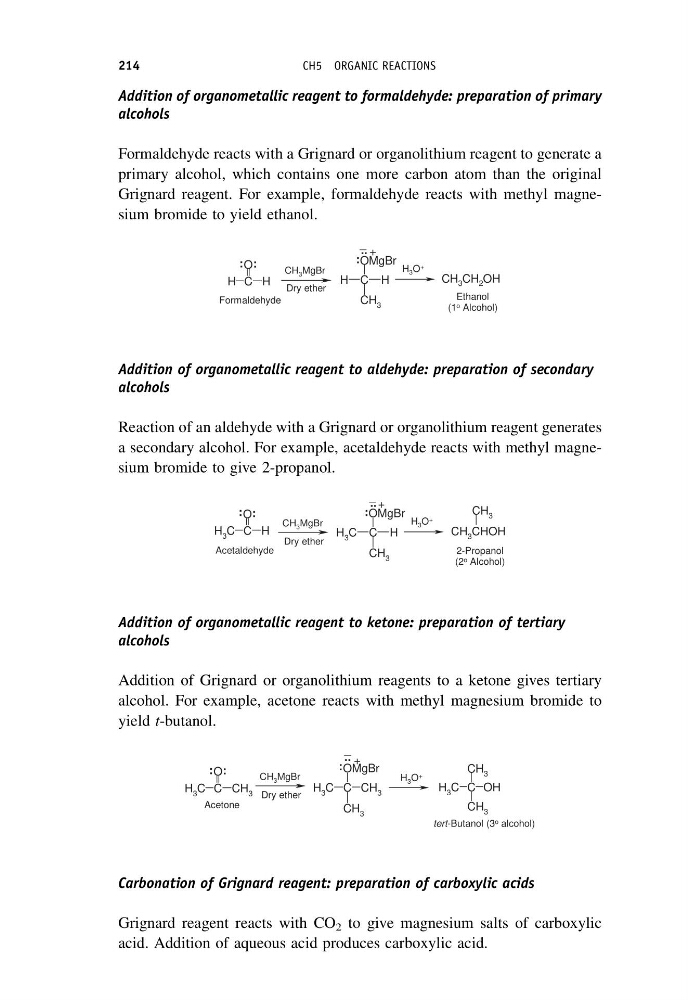
Formaldehyde reacts with a Grignard or organolithium reagent to generate a
primary alcohol, which contains one more carbon atom than the original
Grignard reagent. For example, formaldehyde reacts with methyl magnesium bromide to yield ethanol.
C
OMgBr
H
H
CH 3
C
O
H
H Dry ether
H 3 O +
Formaldehyde
Ethanol
(1 o Alcohol)
CH 3 MgBr
CH 3 CH 2 OH
..
:
: :
+
_
Addition of organometallic reagent to aldehyde: preparation of secondary
alcohols
Reaction of an aldehyde with a Grignard or organolithium reagent generates
a secondary alcohol. For example, acetaldehyde reacts with methyl magnesium bromide to give 2-propanol.
C
O
C
H 3
H
CH 3
CH 3 CHOH
C
OMgBr
C
H 3
H
CH 3
Acetaldehyde
2-Propanol
(2 o Alcohol)
: :
Dry ether
H 3 O +
CH 3 MgBr
..
:
+
_
Addition of organometallic reagent to ketone: preparation of tertiary
alcohols
Addition of Grignard or organolithium reagents to a ketone gives tertiary
alcohol. For example, acetone reacts with methyl magnesium bromide to
yield t-butanol.
C
OMgBr
C
H 3
CH 3
CH 3
CH 3
C OH
CH 3
C
H 3
C
O
C
H 3
CH 3
Acetone
tert-Butanol (3 o alcohol)
..
:
: :
Dry ether
H 3 O +
CH 3 MgBr
+
_
Carbonation of Grignard reagent: preparation of carboxylic acids
Grignard reagent reacts with CO 2 to give magnesium salts of carboxylic
acid. Addition of aqueous acid produces carboxylic acid.
214
CH5 ORGANIC REACTIONS
alcohols
Formaldehyde reacts with a Grignard or organolithium reagent to generate a
primary alcohol, which contains one more carbon atom than the original
Grignard reagent. For example, formaldehyde reacts with methyl magnesium bromide to yield ethanol.
C
OMgBr
H
H
CH 3
C
O
H
H Dry ether
H 3 O +
Formaldehyde
Ethanol
(1 o Alcohol)
CH 3 MgBr
CH 3 CH 2 OH
..
:
: :
+
_
Addition of organometallic reagent to aldehyde: preparation of secondary
alcohols
Reaction of an aldehyde with a Grignard or organolithium reagent generates
a secondary alcohol. For example, acetaldehyde reacts with methyl magnesium bromide to give 2-propanol.
C
O
C
H 3
H
CH 3
CH 3 CHOH
C
OMgBr
C
H 3
H
CH 3
Acetaldehyde
2-Propanol
(2 o Alcohol)
: :
Dry ether
H 3 O +
CH 3 MgBr
..
:
+
_
Addition of organometallic reagent to ketone: preparation of tertiary
alcohols
Addition of Grignard or organolithium reagents to a ketone gives tertiary
alcohol. For example, acetone reacts with methyl magnesium bromide to
yield t-butanol.
C
OMgBr
C
H 3
CH 3
CH 3
CH 3
C OH
CH 3
C
H 3
C
O
C
H 3
CH 3
Acetone
tert-Butanol (3 o alcohol)
..
:
: :
Dry ether
H 3 O +
CH 3 MgBr
+
_
Carbonation of Grignard reagent: preparation of carboxylic acids
Grignard reagent reacts with CO 2 to give magnesium salts of carboxylic
acid. Addition of aqueous acid produces carboxylic acid.
214
CH5 ORGANIC REACTIONS