

General reaction and mechanism
C C
C
C
Nu E
E Nu
Alkene
+
δ + δ − Addition
Reagent
Product
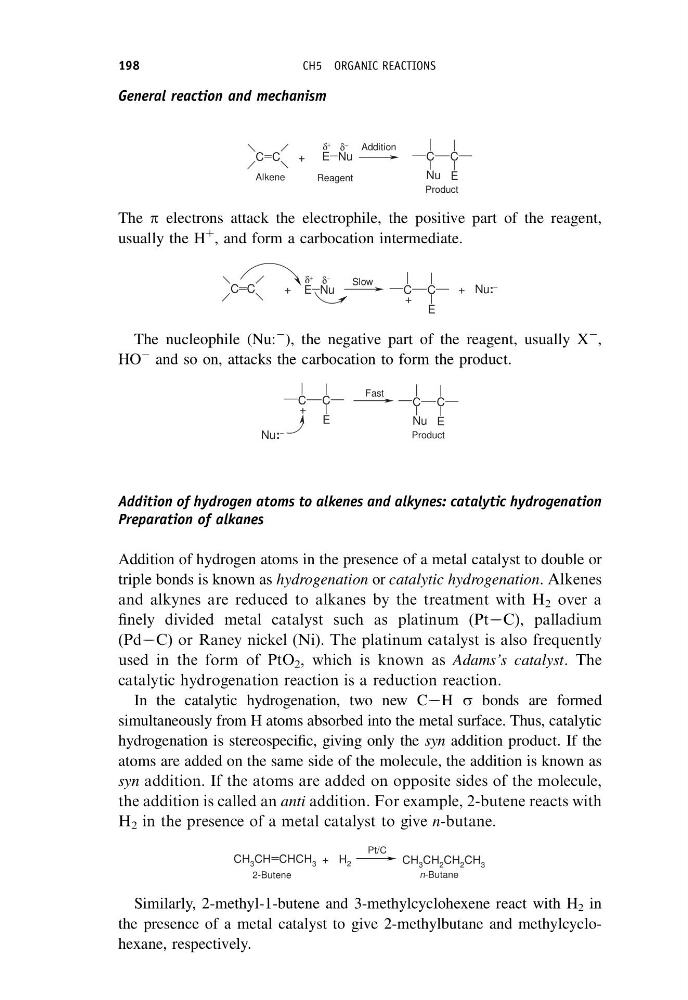
The p electrons attack the electrophile, the positive part of the reagent,
usually the H
þ
, and form a carbocation intermediate.
C C
E Nu
C
C
E
+
Slow
δ + δ −
Nu: −
+
+
The nucleophile (Nu:
À ), the negative part of the reagent, usually X
À
,
HO
À and so on, attacks the carbocation to form the product.
C
C
Nu E
C
C
E
Fast
Product
+
Nu: −
Addition of hydrogen atoms to alkenes and alkynes: catalytic hydrogenation
Preparation of alkanes
Addition of hydrogen atoms in the presence of a metal catalyst to double or
triple bonds is known as hydrogenation or catalytic hydrogenation. Alkenes
and alkynes are reduced to alkanes by the treatment with H 2 over a
finely divided metal catalyst such as platinum (PtÀ ÀC), palladium
(PdÀ ÀC) or Raney nickel (Ni). The platinum catalyst is also frequently
used in the form of PtO 2 , which is known as Adams’s catalyst. The
catalytic hydrogenation reaction is a reduction reaction.
In the catalytic hydrogenation, two new CÀ ÀH s bonds are formed
simultaneously from H atoms absorbed into the metal surface. Thus, catalytic
hydrogenation is stereospecific, giving only the syn addition product. If the
atoms are added on the same side of the molecule, the addition is known as
syn addition. If the atoms are added on opposite sides of the molecule,
the addition is called an anti addition. For example, 2-butene reacts with
H 2 in the presence of a metal catalyst to give n-butane.
CH 3 CH CHCH 3
CH 3 CH 2 CH 2 CH 3
2-Butene
+ H 2
Pt/C
n-Butane
Similarly, 2-methyl-1-butene and 3-methylcyclohexene react with H 2 in
the presence of a metal catalyst to give 2-methylbutane and methylcyclohexane, respectively.
198
CH5 ORGANIC REACTIONS
C C
C
C
Nu E
E Nu
Alkene
+
δ + δ − Addition
Reagent
Product
The p electrons attack the electrophile, the positive part of the reagent,
usually the H
þ
, and form a carbocation intermediate.
C C
E Nu
C
C
E
+
Slow
δ + δ −
Nu: −
+
+
The nucleophile (Nu:
À ), the negative part of the reagent, usually X
À
,
HO
À and so on, attacks the carbocation to form the product.
C
C
Nu E
C
C
E
Fast
Product
+
Nu: −
Addition of hydrogen atoms to alkenes and alkynes: catalytic hydrogenation
Preparation of alkanes
Addition of hydrogen atoms in the presence of a metal catalyst to double or
triple bonds is known as hydrogenation or catalytic hydrogenation. Alkenes
and alkynes are reduced to alkanes by the treatment with H 2 over a
finely divided metal catalyst such as platinum (PtÀ ÀC), palladium
(PdÀ ÀC) or Raney nickel (Ni). The platinum catalyst is also frequently
used in the form of PtO 2 , which is known as Adams’s catalyst. The
catalytic hydrogenation reaction is a reduction reaction.
In the catalytic hydrogenation, two new CÀ ÀH s bonds are formed
simultaneously from H atoms absorbed into the metal surface. Thus, catalytic
hydrogenation is stereospecific, giving only the syn addition product. If the
atoms are added on the same side of the molecule, the addition is known as
syn addition. If the atoms are added on opposite sides of the molecule,
the addition is called an anti addition. For example, 2-butene reacts with
H 2 in the presence of a metal catalyst to give n-butane.
CH 3 CH CHCH 3
CH 3 CH 2 CH 2 CH 3
2-Butene
+ H 2
Pt/C
n-Butane
Similarly, 2-methyl-1-butene and 3-methylcyclohexene react with H 2 in
the presence of a metal catalyst to give 2-methylbutane and methylcyclohexane, respectively.
198
CH5 ORGANIC REACTIONS