

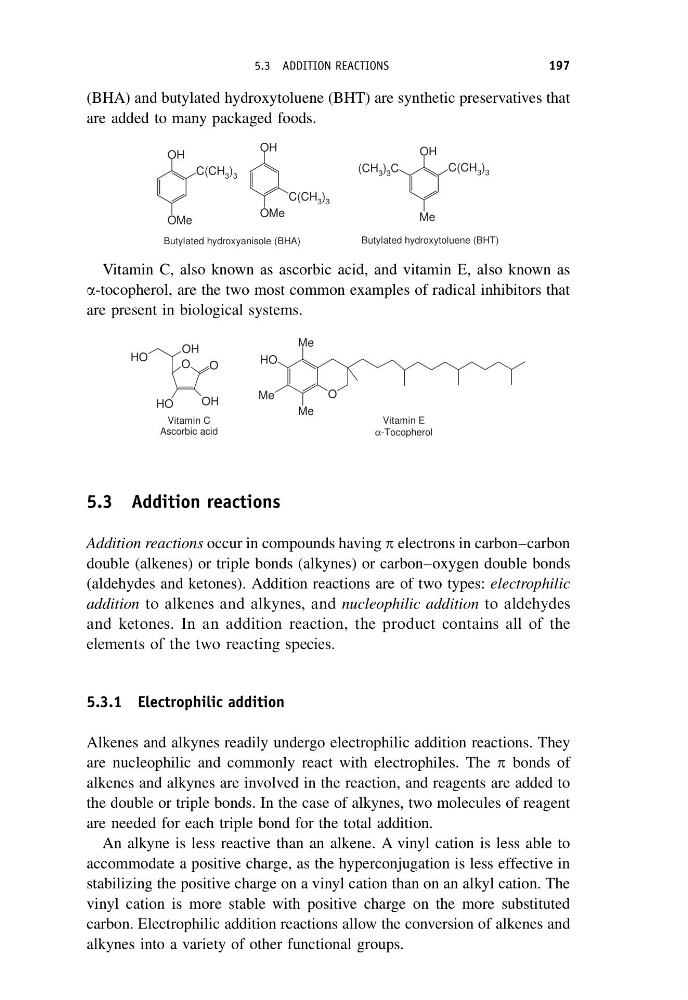
(BHA) and butylated hydroxytoluene (BHT) are synthetic preservatives that
are added to many packaged foods.
OH
C(CH 3 ) 3
OMe
OH
C(CH 3 ) 3
OMe
OH
C(CH 3 ) 3
Me
(CH 3 ) 3 C
Butylated hydroxyanisole (BHA)
Butylated hydroxytoluene (BHT)
Vitamin C, also known as ascorbic acid, and vitamin E, also known as
a-tocopherol, are the two most common examples of radical inhibitors that
are present in biological systems.
O
O
OH
O
H
O
H
OH
O
H
Me
Me
Me
O
Vitamin C
Ascorbic acid
Vitamin E
α-Tocopherol
5.3 Addition reactions
Addition reactions occur in compounds having p electrons in carbon–carbon
double (alkenes) or triple bonds (alkynes) or carbon–oxygen double bonds
(aldehydes and ketones). Addition reactions are of two types: electrophilic
addition to alkenes and alkynes, and nucleophilic addition to aldehydes
and ketones. In an addition reaction, the product contains all of the
elements of the two reacting species.
5.3.1 Electrophilic addition
Alkenes and alkynes readily undergo electrophilic addition reactions. They
are nucleophilic and commonly react with electrophiles. The p bonds of
alkenes and alkynes are involved in the reaction, and reagents are added to
the double or triple bonds. In the case of alkynes, two molecules of reagent
are needed for each triple bond for the total addition.
An alkyne is less reactive than an alkene. A vinyl cation is less able to
accommodate a positive charge, as the hyperconjugation is less effective in
stabilizing the positive charge on a vinyl cation than on an alkyl cation. The
vinyl cation is more stable with positive charge on the more substituted
carbon. Electrophilic addition reactions allow the conversion of alkenes and
alkynes into a variety of other functional groups.
5.3 ADDITION REACTIONS
197
are added to many packaged foods.
OH
C(CH 3 ) 3
OMe
OH
C(CH 3 ) 3
OMe
OH
C(CH 3 ) 3
Me
(CH 3 ) 3 C
Butylated hydroxyanisole (BHA)
Butylated hydroxytoluene (BHT)
Vitamin C, also known as ascorbic acid, and vitamin E, also known as
a-tocopherol, are the two most common examples of radical inhibitors that
are present in biological systems.
O
O
OH
O
H
O
H
OH
O
H
Me
Me
Me
O
Vitamin C
Ascorbic acid
Vitamin E
α-Tocopherol
5.3 Addition reactions
Addition reactions occur in compounds having p electrons in carbon–carbon
double (alkenes) or triple bonds (alkynes) or carbon–oxygen double bonds
(aldehydes and ketones). Addition reactions are of two types: electrophilic
addition to alkenes and alkynes, and nucleophilic addition to aldehydes
and ketones. In an addition reaction, the product contains all of the
elements of the two reacting species.
5.3.1 Electrophilic addition
Alkenes and alkynes readily undergo electrophilic addition reactions. They
are nucleophilic and commonly react with electrophiles. The p bonds of
alkenes and alkynes are involved in the reaction, and reagents are added to
the double or triple bonds. In the case of alkynes, two molecules of reagent
are needed for each triple bond for the total addition.
An alkyne is less reactive than an alkene. A vinyl cation is less able to
accommodate a positive charge, as the hyperconjugation is less effective in
stabilizing the positive charge on a vinyl cation than on an alkyl cation. The
vinyl cation is more stable with positive charge on the more substituted
carbon. Electrophilic addition reactions allow the conversion of alkenes and
alkynes into a variety of other functional groups.
5.3 ADDITION REACTIONS
197