

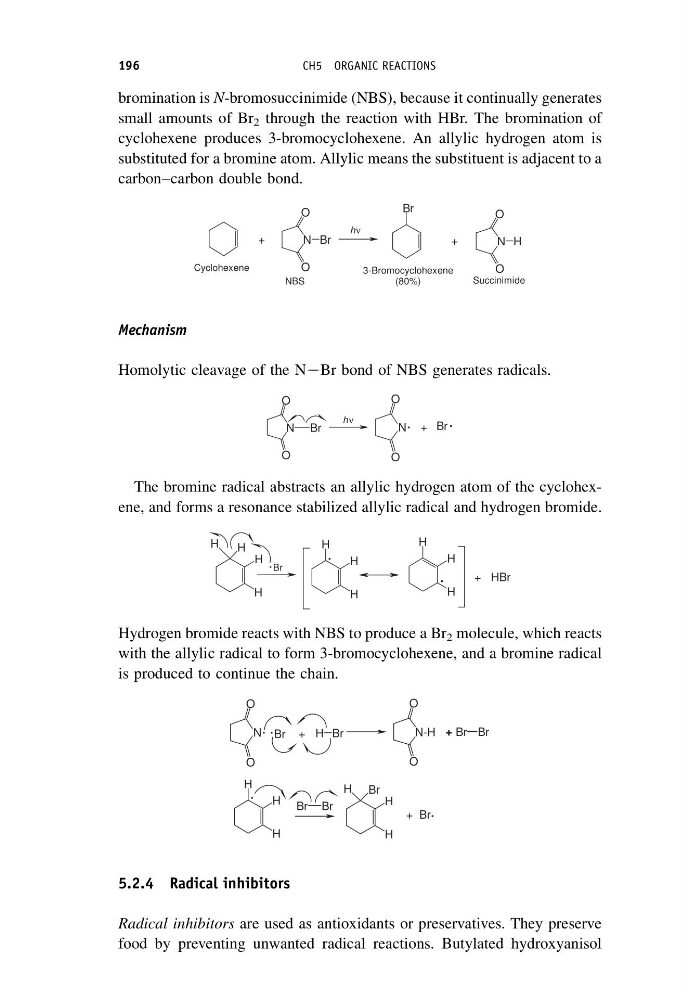
bromination is N-bromosuccinimide (NBS), because it continually generates
small amounts of Br 2 through the reaction with HBr. The bromination of
cyclohexene produces 3-bromocyclohexene. An allylic hydrogen atom is
substituted for a bromine atom. Allylic means the substituent is adjacent to a
carbon–carbon double bond.
Br
N
O
O
Br
N
O
O
H
+
hν
+
3-Bromocyclohexene
(80%)
Cyclohexene
NBS
Succinimide
Mechanism
Homolytic cleavage of the NÀ ÀBr bond of NBS generates radicals.
N
O
O
Br
O
O
N
Br
hν
.
. +
The bromine radical abstracts an allylic hydrogen atom of the cyclohexene, and forms a resonance stabilized allylic radical and hydrogen bromide.
H
H
H
H
H
H
H
H
H
H
+ HBr
.
.
.
Br
Hydrogen bromide reacts with NBS to produce a Br 2 molecule, which reacts
with the allylic radical to form 3-bromocyclohexene, and a bromine radical
is produced to continue the chain.
N-H
O
O
O
O
H Br
Br Br
Br Br
Br
H
H
H
H
H
H
N Br +
+
.
.
+ Br .
.
5.2.4 Radical inhibitors
Radical inhibitors are used as antioxidants or preservatives. They preserve
food by preventing unwanted radical reactions. Butylated hydroxyanisol
196
CH5 ORGANIC REACTIONS
small amounts of Br 2 through the reaction with HBr. The bromination of
cyclohexene produces 3-bromocyclohexene. An allylic hydrogen atom is
substituted for a bromine atom. Allylic means the substituent is adjacent to a
carbon–carbon double bond.
Br
N
O
O
Br
N
O
O
H
+
hν
+
3-Bromocyclohexene
(80%)
Cyclohexene
NBS
Succinimide
Mechanism
Homolytic cleavage of the NÀ ÀBr bond of NBS generates radicals.
N
O
O
Br
O
O
N
Br
hν
.
. +
The bromine radical abstracts an allylic hydrogen atom of the cyclohexene, and forms a resonance stabilized allylic radical and hydrogen bromide.
H
H
H
H
H
H
H
H
H
H
+ HBr
.
.
.
Br
Hydrogen bromide reacts with NBS to produce a Br 2 molecule, which reacts
with the allylic radical to form 3-bromocyclohexene, and a bromine radical
is produced to continue the chain.
N-H
O
O
O
O
H Br
Br Br
Br Br
Br
H
H
H
H
H
H
N Br +
+
.
.
+ Br .
.
5.2.4 Radical inhibitors
Radical inhibitors are used as antioxidants or preservatives. They preserve
food by preventing unwanted radical reactions. Butylated hydroxyanisol
196
CH5 ORGANIC REACTIONS