

stabilities of the corresponding carbocations. Carbocations are classified
according to the number of alkyl groups that are bonded to the positively
charged carbon. A primary (1
) carbocation has one alkyl group, a
secondary (2
) has two and a tertiary (3
) has three alkyl groups.
Alkyl groups are able to decrease the concentration of positive charge on the
carbocation by donating electrons inductively, thus increasing the stability of
the carbocation. The greater the number of alkyl groups bonded to the
positively charged carbon, the more stable is the carbocation. Therefore, a 3
carbocation is more stable than a 2
carbocation, and a 2
carbocation is more
stable than a 1
carbocation, which in turn is more stable than a methyl cation.
In molecular orbital terms, alkyl groups can stabilize a carbocation by hyperconjugation. This is the overlap of the filled s orbitals of the CÀ ÀH or CÀ ÀC
bonds adjacent to the carbocation with an empty p orbital on the positively
charged carbon atom. As a result, the positive charge is delocalized onto
more than one atom, and thus increases the stability of the system. The
more alkyl groups there are attached to the carbocation, the more s bonds
there are for hyperconjugation, and the more stable is the carbocation.
C
R
R
R
C
R
R
H
C
R
H
H
C
H
H
H
>
>
>
+
3 o carbocation
Methyl cation
+
+
+
2 o carbocation 1 o carbocation
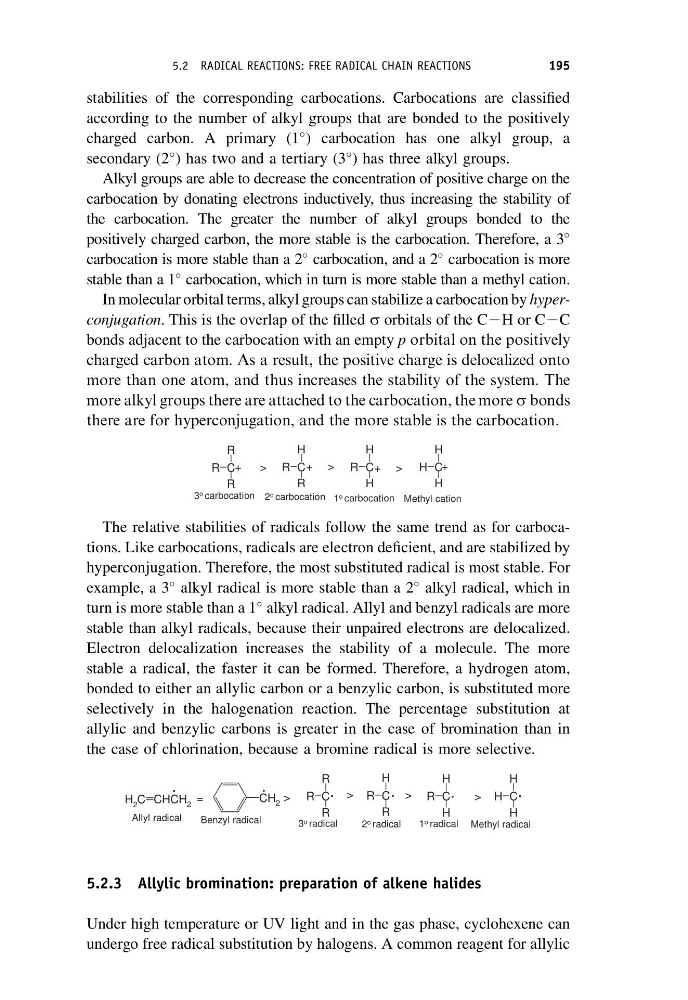
The relative stabilities of radicals follow the same trend as for carbocations. Like carbocations, radicals are electron deficient, and are stabilized by
hyperconjugation. Therefore, the most substituted radical is most stable. For
example, a 3
alkyl radical is more stable than a 2
alkyl radical, which in
turn is more stable than a 1
alkyl radical. Allyl and benzyl radicals are more
stable than alkyl radicals, because their unpaired electrons are delocalized.
Electron delocalization increases the stability of a molecule. The more
stable a radical, the faster it can be formed. Therefore, a hydrogen atom,
bonded to either an allylic carbon or a benzylic carbon, is substituted more
selectively in the halogenation reaction. The percentage substitution at
allylic and benzylic carbons is greater in the case of bromination than in
the case of chlorination, because a bromine radical is more selective.
C
H 2 CHCH 2
CH 2
C
R
R
R
C
R
R
H
C
R
H
H
C
H
H
H
>
=
>
>
>
.
.
.
.
.
.
Allyl radical
Benzyl radical
3 o radical
Methyl radical
2 o radical
1 o radical
5.2.3 Allylic bromination: preparation of alkene halides
Under high temperature or UV light and in the gas phase, cyclohexene can
undergo free radical substitution by halogens. A common reagent for allylic
5.2 RADICAL REACTIONS: FREE RADICAL CHAIN REACTIONS
195
according to the number of alkyl groups that are bonded to the positively
charged carbon. A primary (1
) carbocation has one alkyl group, a
secondary (2
) has two and a tertiary (3
) has three alkyl groups.
Alkyl groups are able to decrease the concentration of positive charge on the
carbocation by donating electrons inductively, thus increasing the stability of
the carbocation. The greater the number of alkyl groups bonded to the
positively charged carbon, the more stable is the carbocation. Therefore, a 3
carbocation is more stable than a 2
carbocation, and a 2
carbocation is more
stable than a 1
carbocation, which in turn is more stable than a methyl cation.
In molecular orbital terms, alkyl groups can stabilize a carbocation by hyperconjugation. This is the overlap of the filled s orbitals of the CÀ ÀH or CÀ ÀC
bonds adjacent to the carbocation with an empty p orbital on the positively
charged carbon atom. As a result, the positive charge is delocalized onto
more than one atom, and thus increases the stability of the system. The
more alkyl groups there are attached to the carbocation, the more s bonds
there are for hyperconjugation, and the more stable is the carbocation.
C
R
R
R
C
R
R
H
C
R
H
H
C
H
H
H
>
>
>
+
3 o carbocation
Methyl cation
+
+
+
2 o carbocation 1 o carbocation
The relative stabilities of radicals follow the same trend as for carbocations. Like carbocations, radicals are electron deficient, and are stabilized by
hyperconjugation. Therefore, the most substituted radical is most stable. For
example, a 3
alkyl radical is more stable than a 2
alkyl radical, which in
turn is more stable than a 1
alkyl radical. Allyl and benzyl radicals are more
stable than alkyl radicals, because their unpaired electrons are delocalized.
Electron delocalization increases the stability of a molecule. The more
stable a radical, the faster it can be formed. Therefore, a hydrogen atom,
bonded to either an allylic carbon or a benzylic carbon, is substituted more
selectively in the halogenation reaction. The percentage substitution at
allylic and benzylic carbons is greater in the case of bromination than in
the case of chlorination, because a bromine radical is more selective.
C
H 2 CHCH 2
CH 2
C
R
R
R
C
R
R
H
C
R
H
H
C
H
H
H
>
=
>
>
>
.
.
.
.
.
.
Allyl radical
Benzyl radical
3 o radical
Methyl radical
2 o radical
1 o radical
5.2.3 Allylic bromination: preparation of alkene halides
Under high temperature or UV light and in the gas phase, cyclohexene can
undergo free radical substitution by halogens. A common reagent for allylic
5.2 RADICAL REACTIONS: FREE RADICAL CHAIN REACTIONS
195