

C
H 3 H
HCl
Cl
.
Chlorine
radical
+
+
Methane
Methyl
radical
Hydrogen
chloride
Methyl
radical
+ Cl Cl
Cl
+
Methyl
chloride
Chlorine
.
.
hν
Chlorine
radical
CH 3
. CH 3
CH 3 Cl
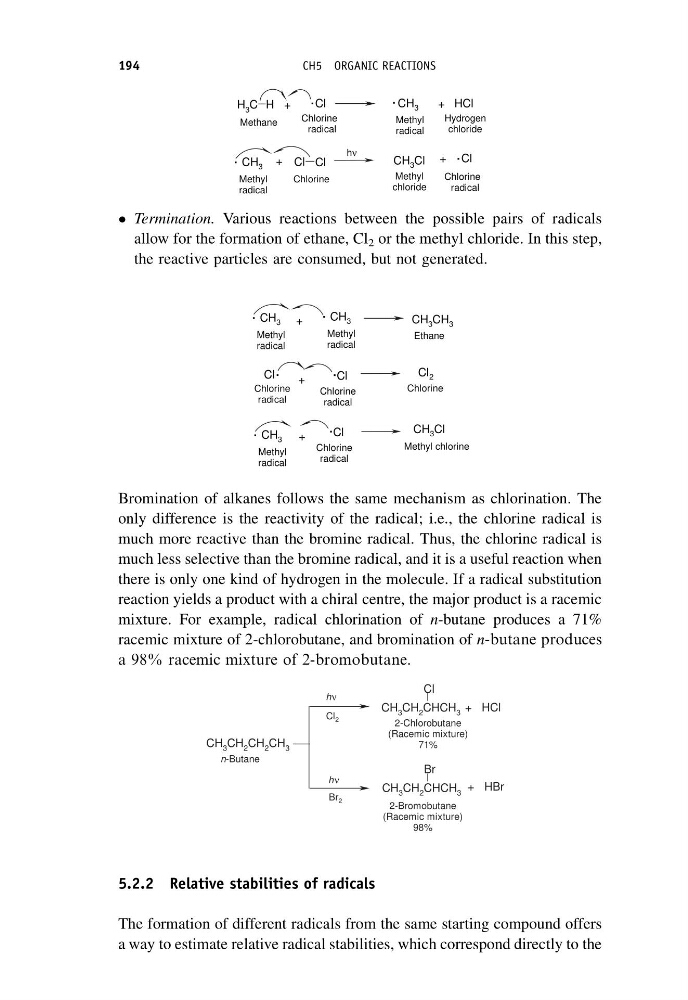
Termination. Various reactions between the possible pairs of radicals
allow for the formation of ethane, Cl 2 or the methyl chloride. In this step,
the reactive particles are consumed, but not generated.
Cl
.
+
+
Cl
Chlorine
radical
.
+
Chlorine
Methyl
radical
. CH 3
Methyl
radical
. CH 3
CH 3 CH 3
Ethane
Chlorine
radical
Cl 2
Methyl
radical
. CH 3
Cl
.
Chlorine
radical
Methyl chlorine
CH 3 Cl
Bromination of alkanes follows the same mechanism as chlorination. The
only difference is the reactivity of the radical; i.e., the chlorine radical is
much more reactive than the bromine radical. Thus, the chlorine radical is
much less selective than the bromine radical, and it is a useful reaction when
there is only one kind of hydrogen in the molecule. If a radical substitution
reaction yields a product with a chiral centre, the major product is a racemic
mixture. For example, radical chlorination of n-butane produces a 71%
racemic mixture of 2-chlorobutane, and bromination of n-butane produces
a 98% racemic mixture of 2-bromobutane.
Cl
Br
CH 3 CH 2 CH 2 CH 3
CH 3 CH 2 CHCH 3
CH 3 CH 2 CHCH 3 + HBr
2-Bromobutane
(Racemic mixture)
98%
Br 2
hν
hν
Cl 2
+ HCl
2-Chlorobutane
(Racemic mixture)
71%
n-Butane
5.2.2 Relative stabilities of radicals
The formation of different radicals from the same starting compound offers
a way to estimate relative radical stabilities, which correspond directly to the
194
CH5 ORGANIC REACTIONS
H 3 H
HCl
Cl
.
Chlorine
radical
+
+
Methane
Methyl
radical
Hydrogen
chloride
Methyl
radical
+ Cl Cl
Cl
+
Methyl
chloride
Chlorine
.
.
hν
Chlorine
radical
CH 3
. CH 3
CH 3 Cl
Termination. Various reactions between the possible pairs of radicals
allow for the formation of ethane, Cl 2 or the methyl chloride. In this step,
the reactive particles are consumed, but not generated.
Cl
.
+
+
Cl
Chlorine
radical
.
+
Chlorine
Methyl
radical
. CH 3
Methyl
radical
. CH 3
CH 3 CH 3
Ethane
Chlorine
radical
Cl 2
Methyl
radical
. CH 3
Cl
.
Chlorine
radical
Methyl chlorine
CH 3 Cl
Bromination of alkanes follows the same mechanism as chlorination. The
only difference is the reactivity of the radical; i.e., the chlorine radical is
much more reactive than the bromine radical. Thus, the chlorine radical is
much less selective than the bromine radical, and it is a useful reaction when
there is only one kind of hydrogen in the molecule. If a radical substitution
reaction yields a product with a chiral centre, the major product is a racemic
mixture. For example, radical chlorination of n-butane produces a 71%
racemic mixture of 2-chlorobutane, and bromination of n-butane produces
a 98% racemic mixture of 2-bromobutane.
Cl
Br
CH 3 CH 2 CH 2 CH 3
CH 3 CH 2 CHCH 3
CH 3 CH 2 CHCH 3 + HBr
2-Bromobutane
(Racemic mixture)
98%
Br 2
hν
hν
Cl 2
+ HCl
2-Chlorobutane
(Racemic mixture)
71%
n-Butane
5.2.2 Relative stabilities of radicals
The formation of different radicals from the same starting compound offers
a way to estimate relative radical stabilities, which correspond directly to the
194
CH5 ORGANIC REACTIONS