

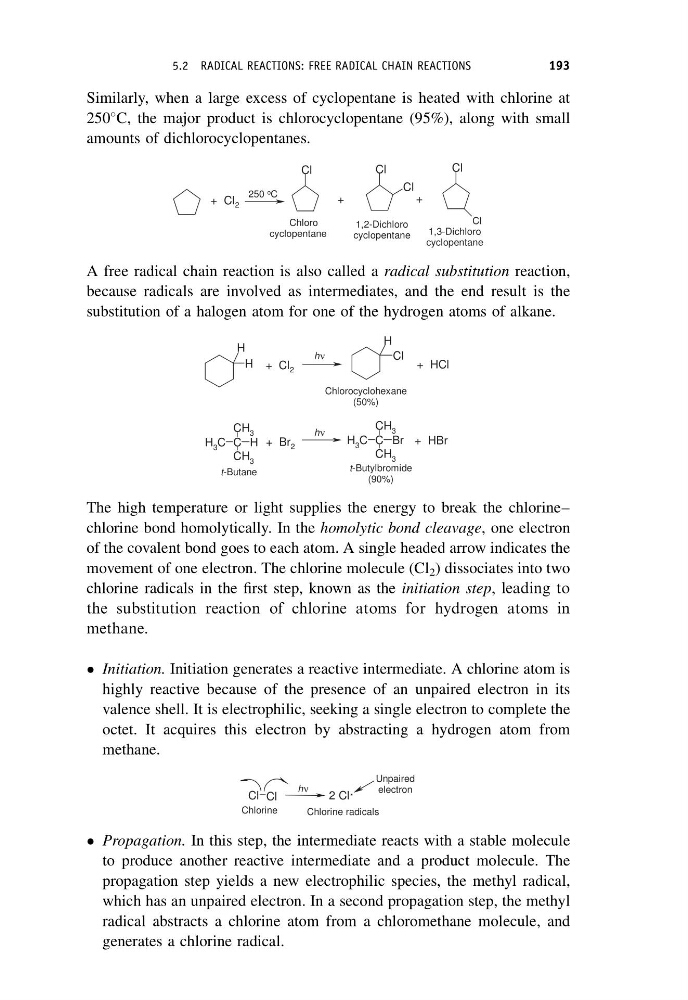
Similarly, when a large excess of cyclopentane is heated with chlorine at
250
C, the major product is chlorocyclopentane (95%), along with small
amounts of dichlorocyclopentanes.
Cl
Cl
Cl
Cl
Cl
+ Cl 2
250 o C
+
+
Chloro
cyclopentane
1,2-Dichloro
cyclopentane
1,3-Dichloro
cyclopentane
A free radical chain reaction is also called a radical substitution reaction,
because radicals are involved as intermediates, and the end result is the
substitution of a halogen atom for one of the hydrogen atoms of alkane.
H
Cl
H
H
C
C
H 3
CH 3
H
CH 3
C
C
H 3
CH 3
Br
CH 3
Chlorocyclohexane
(50%)
+ Cl 2
t-Butylbromide
(90%)
+ Br 2
t-Butane
hν
hν
+ HCl
+ HBr
The high temperature or light supplies the energy to break the chlorine–
chlorine bond homolytically. In the homolytic bond cleavage, one electron
of the covalent bond goes to each atom. A single headed arrow indicates the
movement of one electron. The chlorine molecule (Cl 2 ) dissociates into two
chlorine radicals in the first step, known as the initiation step, leading to
the substitution reaction of chlorine atoms for hydrogen atoms in
methane.
Initiation. Initiation generates a reactive intermediate. A chlorine atom is
highly reactive because of the presence of an unpaired electron in its
valence shell. It is electrophilic, seeking a single electron to complete the
octet. It acquires this electron by abstracting a hydrogen atom from
methane.
2 Cl
Cl Cl
.
Chlorine
Chlorine radicals
Unpaired
electron
hν
Propagation. In this step, the intermediate reacts with a stable molecule
to produce another reactive intermediate and a product molecule. The
propagation step yields a new electrophilic species, the methyl radical,
which has an unpaired electron. In a second propagation step, the methyl
radical abstracts a chlorine atom from a chloromethane molecule, and
generates a chlorine radical.
5.2 RADICAL REACTIONS: FREE RADICAL CHAIN REACTIONS
193
250
C, the major product is chlorocyclopentane (95%), along with small
amounts of dichlorocyclopentanes.
Cl
Cl
Cl
Cl
Cl
+ Cl 2
250 o C
+
+
Chloro
cyclopentane
1,2-Dichloro
cyclopentane
1,3-Dichloro
cyclopentane
A free radical chain reaction is also called a radical substitution reaction,
because radicals are involved as intermediates, and the end result is the
substitution of a halogen atom for one of the hydrogen atoms of alkane.
H
Cl
H
H
C
C
H 3
CH 3
H
CH 3
C
C
H 3
CH 3
Br
CH 3
Chlorocyclohexane
(50%)
+ Cl 2
t-Butylbromide
(90%)
+ Br 2
t-Butane
hν
hν
+ HCl
+ HBr
The high temperature or light supplies the energy to break the chlorine–
chlorine bond homolytically. In the homolytic bond cleavage, one electron
of the covalent bond goes to each atom. A single headed arrow indicates the
movement of one electron. The chlorine molecule (Cl 2 ) dissociates into two
chlorine radicals in the first step, known as the initiation step, leading to
the substitution reaction of chlorine atoms for hydrogen atoms in
methane.
Initiation. Initiation generates a reactive intermediate. A chlorine atom is
highly reactive because of the presence of an unpaired electron in its
valence shell. It is electrophilic, seeking a single electron to complete the
octet. It acquires this electron by abstracting a hydrogen atom from
methane.
2 Cl
Cl Cl
.
Chlorine
Chlorine radicals
Unpaired
electron
hν
Propagation. In this step, the intermediate reacts with a stable molecule
to produce another reactive intermediate and a product molecule. The
propagation step yields a new electrophilic species, the methyl radical,
which has an unpaired electron. In a second propagation step, the methyl
radical abstracts a chlorine atom from a chloromethane molecule, and
generates a chlorine radical.
5.2 RADICAL REACTIONS: FREE RADICAL CHAIN REACTIONS
193