

and reduce toxicity. Penicillin G is rather a complex molecule, and
possesses various types of functional group, e.g. phenyl, alkyl, amide,
carboxylic acid and b-lactam.
All penicillins are susceptible to attack in acidic solution via intramolecular attack of the amide carbonyl oxygen on the b-lactam carbonyl, leading
to the complete destruction of the b-lactam ring, and thus the antibacterial
activity. Similarly, penicillins are unstable in basic solution because of blactam ring opening by free basic nucleophiles. Thus, for the antibacterial
activity, the stability of the b-lactam functional group in penicillins is of
paramount importance.
N
S
O
COOH
H
N
H
O
H
Penicillin G
The first penicillin of the penicillin group of antibiotics
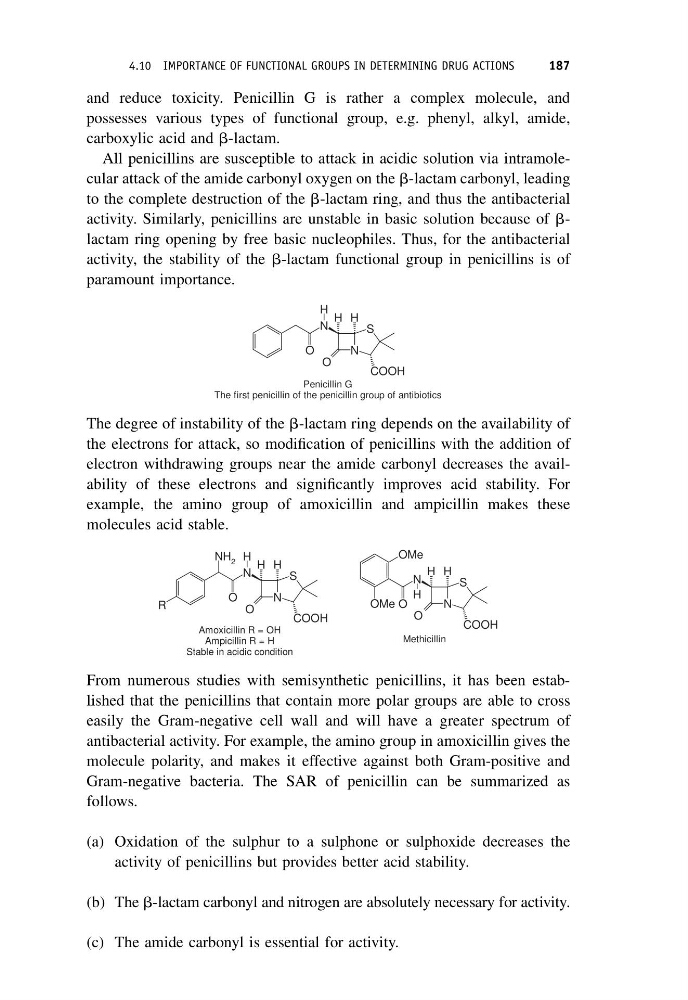
The degree of instability of the b-lactam ring depends on the availability of
the electrons for attack, so modification of penicillins with the addition of
electron withdrawing groups near the amide carbonyl decreases the availability of these electrons and significantly improves acid stability. For
example, the amino group of amoxicillin and ampicillin makes these
molecules acid stable.
N
S
O
COOH
H
N
H
O
H
NH 2
R
N
S
O
COOH
H
N
H
O
H
OMe
OMe
Amoxicillin R = OH
Ampicillin R = H
Stable in acidic condition
Methicillin
From numerous studies with semisynthetic penicillins, it has been established that the penicillins that contain more polar groups are able to cross
easily the Gram-negative cell wall and will have a greater spectrum of
antibacterial activity. For example, the amino group in amoxicillin gives the
molecule polarity, and makes it effective against both Gram-positive and
Gram-negative bacteria. The SAR of penicillin can be summarized as
follows.
(a) Oxidation of the sulphur to a sulphone or sulphoxide decreases the
activity of penicillins but provides better acid stability.
(b) The b-lactam carbonyl and nitrogen are absolutely necessary for activity.
(c) The amide carbonyl is essential for activity.
4.10 IMPORTANCE OF FUNCTIONAL GROUPS IN DETERMINING DRUG ACTIONS
187
possesses various types of functional group, e.g. phenyl, alkyl, amide,
carboxylic acid and b-lactam.
All penicillins are susceptible to attack in acidic solution via intramolecular attack of the amide carbonyl oxygen on the b-lactam carbonyl, leading
to the complete destruction of the b-lactam ring, and thus the antibacterial
activity. Similarly, penicillins are unstable in basic solution because of blactam ring opening by free basic nucleophiles. Thus, for the antibacterial
activity, the stability of the b-lactam functional group in penicillins is of
paramount importance.
N
S
O
COOH
H
N
H
O
H
Penicillin G
The first penicillin of the penicillin group of antibiotics
The degree of instability of the b-lactam ring depends on the availability of
the electrons for attack, so modification of penicillins with the addition of
electron withdrawing groups near the amide carbonyl decreases the availability of these electrons and significantly improves acid stability. For
example, the amino group of amoxicillin and ampicillin makes these
molecules acid stable.
N
S
O
COOH
H
N
H
O
H
NH 2
R
N
S
O
COOH
H
N
H
O
H
OMe
OMe
Amoxicillin R = OH
Ampicillin R = H
Stable in acidic condition
Methicillin
From numerous studies with semisynthetic penicillins, it has been established that the penicillins that contain more polar groups are able to cross
easily the Gram-negative cell wall and will have a greater spectrum of
antibacterial activity. For example, the amino group in amoxicillin gives the
molecule polarity, and makes it effective against both Gram-positive and
Gram-negative bacteria. The SAR of penicillin can be summarized as
follows.
(a) Oxidation of the sulphur to a sulphone or sulphoxide decreases the
activity of penicillins but provides better acid stability.
(b) The b-lactam carbonyl and nitrogen are absolutely necessary for activity.
(c) The amide carbonyl is essential for activity.
4.10 IMPORTANCE OF FUNCTIONAL GROUPS IN DETERMINING DRUG ACTIONS
187