

(d) The group attached to the amide carbonyl (the R group) is the basis for
the changes in activity, acid stability and susceptibility to resistance.
(e) Any other changes generally decrease activity.
(f) A bulky group directly adjacent to the amide carbonyl usually offers a
b-lactamase resistant property.
A bulky group directly adjacent to the amide carbonyl will prevent the
penicillin from entering the active site of penicillin-destroying enzymes, e.g.
b-lactamases, but still allow them to enter the active site of penicillin
binding proteins. For example, methicillin has a bulky group directly
adjacent to the amide carbonyl, and is b-lactamase resistance.
The addition of polar groups to the R group, i.e. the group directly linked
to the amide carbonyl, generally allows the penicillin molecule, e.g.
amoxicillin, to more easily pass through the Gram-negative cell wall, and
thus increases antibacterial activity.
4.10.3 Paracetamol toxicity
Bioactivation is a classic toxicity mechanism where the functional group or
the chemical structure of the drug molecule is altered by enzymatic
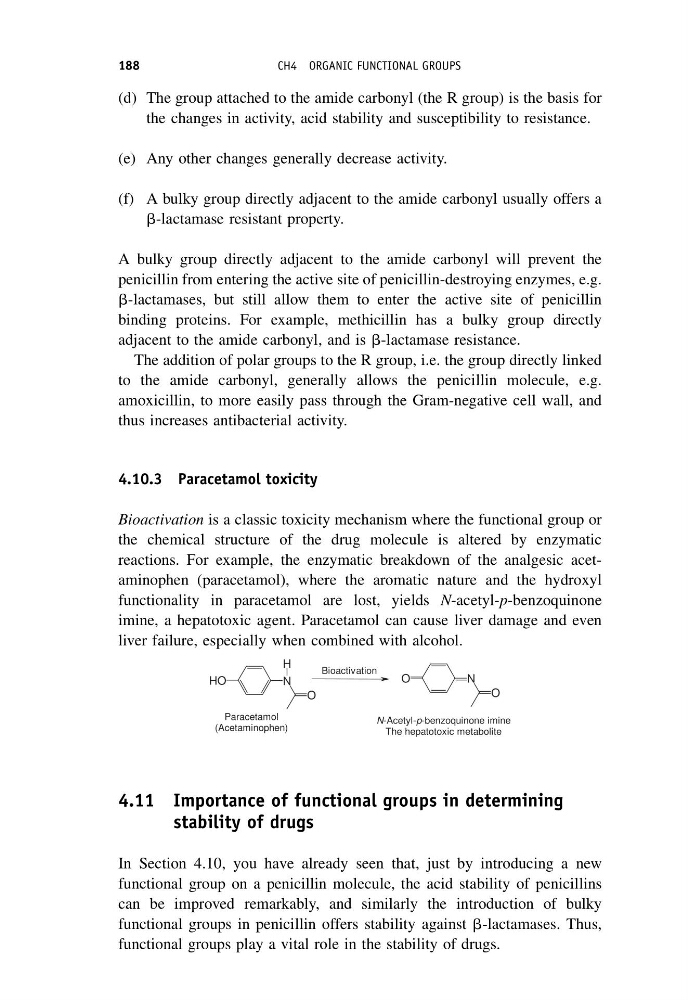
reactions. For example, the enzymatic breakdown of the analgesic acetaminophen (paracetamol), where the aromatic nature and the hydroxyl
functionality in paracetamol are lost, yields N-acetyl-p-benzoquinone
imine, a hepatotoxic agent. Paracetamol can cause liver damage and even
liver failure, especially when combined with alcohol.
N
O
H
O
H
N
O
O
Paracetamol
(Acetaminophen)
Bioactivation
N-Acetyl-p-benzoquinone imine
The hepatotoxic metabolite
4.11 Importance of functional groups in determining
stability of drugs
In Section 4.10, you have already seen that, just by introducing a new
functional group on a penicillin molecule, the acid stability of penicillins
can be improved remarkably, and similarly the introduction of bulky
functional groups in penicillin offers stability against b-lactamases. Thus,
functional groups play a vital role in the stability of drugs.
188
CH4 ORGANIC FUNCTIONAL GROUPS
the changes in activity, acid stability and susceptibility to resistance.
(e) Any other changes generally decrease activity.
(f) A bulky group directly adjacent to the amide carbonyl usually offers a
b-lactamase resistant property.
A bulky group directly adjacent to the amide carbonyl will prevent the
penicillin from entering the active site of penicillin-destroying enzymes, e.g.
b-lactamases, but still allow them to enter the active site of penicillin
binding proteins. For example, methicillin has a bulky group directly
adjacent to the amide carbonyl, and is b-lactamase resistance.
The addition of polar groups to the R group, i.e. the group directly linked
to the amide carbonyl, generally allows the penicillin molecule, e.g.
amoxicillin, to more easily pass through the Gram-negative cell wall, and
thus increases antibacterial activity.
4.10.3 Paracetamol toxicity
Bioactivation is a classic toxicity mechanism where the functional group or
the chemical structure of the drug molecule is altered by enzymatic
reactions. For example, the enzymatic breakdown of the analgesic acetaminophen (paracetamol), where the aromatic nature and the hydroxyl
functionality in paracetamol are lost, yields N-acetyl-p-benzoquinone
imine, a hepatotoxic agent. Paracetamol can cause liver damage and even
liver failure, especially when combined with alcohol.
N
O
H
O
H
N
O
O
Paracetamol
(Acetaminophen)
Bioactivation
N-Acetyl-p-benzoquinone imine
The hepatotoxic metabolite
4.11 Importance of functional groups in determining
stability of drugs
In Section 4.10, you have already seen that, just by introducing a new
functional group on a penicillin molecule, the acid stability of penicillins
can be improved remarkably, and similarly the introduction of bulky
functional groups in penicillin offers stability against b-lactamases. Thus,
functional groups play a vital role in the stability of drugs.
188
CH4 ORGANIC FUNCTIONAL GROUPS