

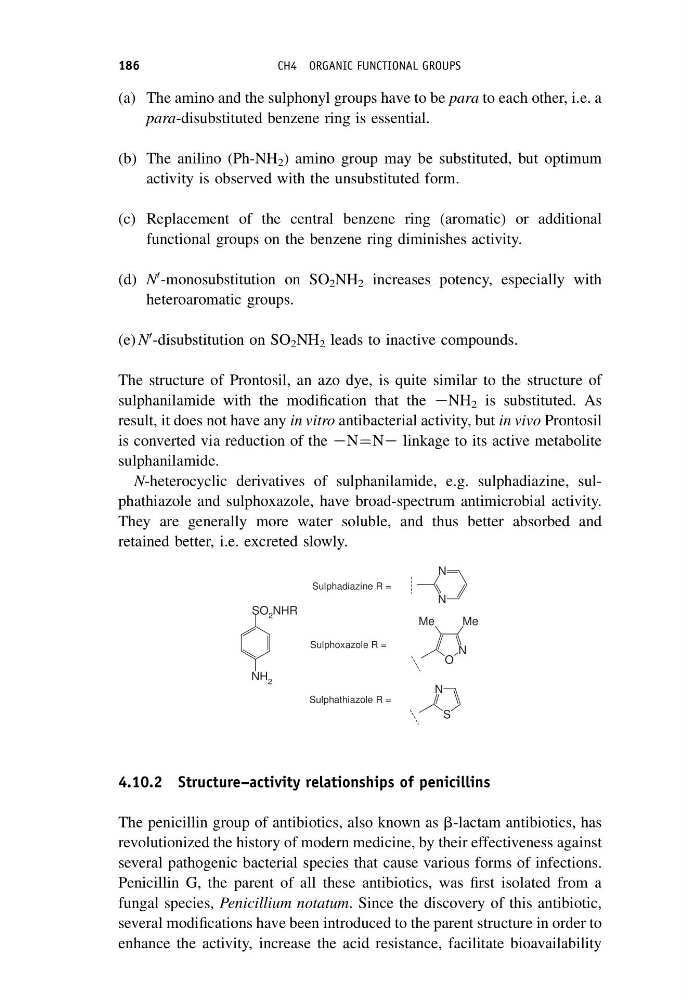
(a) The amino and the sulphonyl groups have to be para to each other, i.e. a
para-disubstituted benzene ring is essential.
(b) The anilino (Ph-NH 2 ) amino group may be substituted, but optimum
activity is observed with the unsubstituted form.
(c) Replacement of the central benzene ring (aromatic) or additional
functional groups on the benzene ring diminishes activity.
(d) N
0 -monosubstitution on SO 2 NH 2 increases potency, especially with
heteroaromatic groups.
(e) N
0 -disubstitution on SO 2 NH 2 leads to inactive compounds.
The structure of Prontosil, an azo dye, is quite similar to the structure of
sulphanilamide with the modification that the À ÀNH 2 is substituted. As
result, it does not have any in vitro antibacterial activity, but in vivo Prontosil
is converted via reduction of the À ÀNÀ À
À À NÀ À linkage to its active metabolite
sulphanilamide.
N-heterocyclic derivatives of sulphanilamide, e.g. sulphadiazine, sulphathiazole and sulphoxazole, have broad-spectrum antimicrobial activity.
They are generally more water soluble, and thus better absorbed and
retained better, i.e. excreted slowly.
NH 2
SO 2 NHR
N
N
O
N
Me
Me
N
S
Sulphadiazine R =
Sulphoxazole R =
Sulphathiazole R =
4.10.2 Structure–activity relationships of penicillins
The penicillin group of antibiotics, also known as b-lactam antibiotics, has
revolutionized the history of modern medicine, by their effectiveness against
several pathogenic bacterial species that cause various forms of infections.
Penicillin G, the parent of all these antibiotics, was first isolated from a
fungal species, Penicillium notatum. Since the discovery of this antibiotic,
several modifications have been introduced to the parent structure in order to
enhance the activity, increase the acid resistance, facilitate bioavailability
186
CH4 ORGANIC FUNCTIONAL GROUPS
para-disubstituted benzene ring is essential.
(b) The anilino (Ph-NH 2 ) amino group may be substituted, but optimum
activity is observed with the unsubstituted form.
(c) Replacement of the central benzene ring (aromatic) or additional
functional groups on the benzene ring diminishes activity.
(d) N
0 -monosubstitution on SO 2 NH 2 increases potency, especially with
heteroaromatic groups.
(e) N
0 -disubstitution on SO 2 NH 2 leads to inactive compounds.
The structure of Prontosil, an azo dye, is quite similar to the structure of
sulphanilamide with the modification that the À ÀNH 2 is substituted. As
result, it does not have any in vitro antibacterial activity, but in vivo Prontosil
is converted via reduction of the À ÀNÀ À
À À NÀ À linkage to its active metabolite
sulphanilamide.
N-heterocyclic derivatives of sulphanilamide, e.g. sulphadiazine, sulphathiazole and sulphoxazole, have broad-spectrum antimicrobial activity.
They are generally more water soluble, and thus better absorbed and
retained better, i.e. excreted slowly.
NH 2
SO 2 NHR
N
N
O
N
Me
Me
N
S
Sulphadiazine R =
Sulphoxazole R =
Sulphathiazole R =
4.10.2 Structure–activity relationships of penicillins
The penicillin group of antibiotics, also known as b-lactam antibiotics, has
revolutionized the history of modern medicine, by their effectiveness against
several pathogenic bacterial species that cause various forms of infections.
Penicillin G, the parent of all these antibiotics, was first isolated from a
fungal species, Penicillium notatum. Since the discovery of this antibiotic,
several modifications have been introduced to the parent structure in order to
enhance the activity, increase the acid resistance, facilitate bioavailability
186
CH4 ORGANIC FUNCTIONAL GROUPS