

By changing the functional groups of any drug, several analogues are
usually synthesized in an effort to improve its binding to the receptor,
facilitate absorption by the human body, increase specificity for different
organs/tissue types, broaden the spectrum of activity or reduce the toxicity/
side-effects. Toxicity prevents many compounds from being developed and
approved. A number of approved drugs have also been forced to be
withdrawn from the market beacuse of toxicities. For example, in 2004,
Merck’s arthritis drug Vioxx was withdrawn owing to severe cardiovascular
side-effects, and the Parke-Davis and Warner-Lambert antidiabetic drug
troglitazone (Rezulin) was withdrawn from the market in 2000 after it was
found to cause severe liver toxicity. The drug industries expend considerable
time and effort trying to avoid or minimize toxic effects by identifying and
altering the functional groups responsible for toxic effects. A change in
functional groups leading to toxicty can be demonstrated by paracetamol
toxicity.
The sulpha drugs and the penicillin group of antibacterial agents can be
the ideal examples for demonstrating the importance of functional groups in
drug actions and effectiveness. In Chapter 6, you will also see how a small
change in the functional group(s) of steroidal molecules can render
remarkable changes in their pharmacological and hormonal functions.
4.10.1 Structure–activity relationships of sulpha drugs
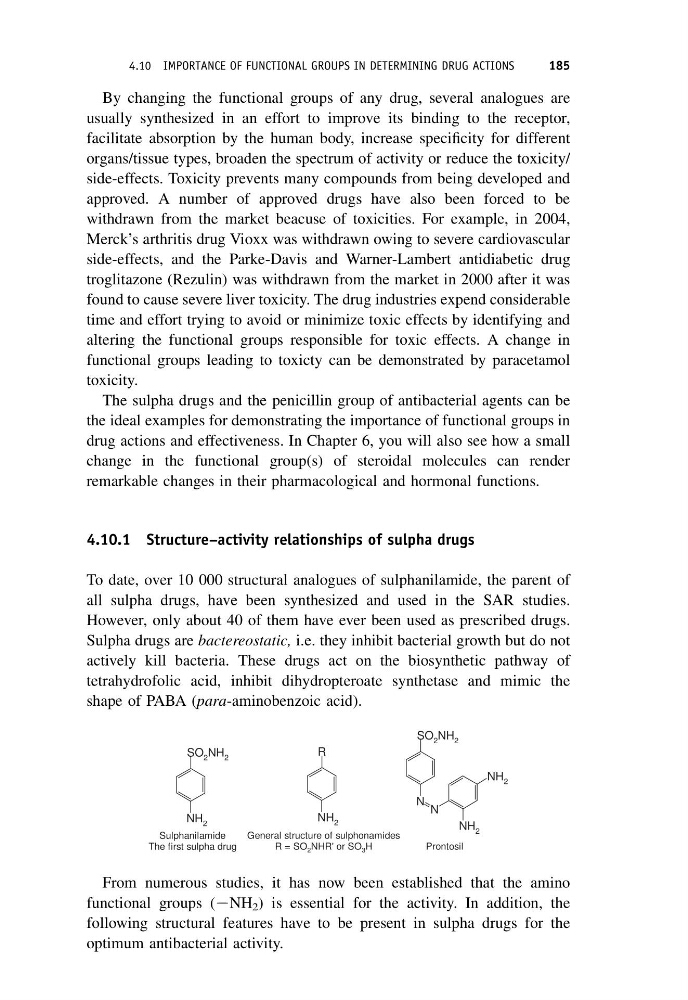
To date, over 10 000 structural analogues of sulphanilamide, the parent of
all sulpha drugs, have been synthesized and used in the SAR studies.
However, only about 40 of them have ever been used as prescribed drugs.
Sulpha drugs are bactereostatic, i.e. they inhibit bacterial growth but do not
actively kill bacteria. These drugs act on the biosynthetic pathway of
tetrahydrofolic acid, inhibit dihydropteroate synthetase and mimic the
shape of PABA (para-aminobenzoic acid).
N
SO 2 NH 2
N
NH 2
NH 2
NH 2
SO 2 NH 2
NH 2
R
Prontosil
Sulphanilamide
The first sulpha drug
General structure of sulphonamides
R = SO 2 NHR' or SO 3 H
From numerous studies, it has now been established that the amino
functional groups (À ÀNH 2 ) is essential for the activity. In addition, the
following structural features have to be present in sulpha drugs for the
optimum antibacterial activity.
4.10 IMPORTANCE OF FUNCTIONAL GROUPS IN DETERMINING DRUG ACTIONS
185
usually synthesized in an effort to improve its binding to the receptor,
facilitate absorption by the human body, increase specificity for different
organs/tissue types, broaden the spectrum of activity or reduce the toxicity/
side-effects. Toxicity prevents many compounds from being developed and
approved. A number of approved drugs have also been forced to be
withdrawn from the market beacuse of toxicities. For example, in 2004,
Merck’s arthritis drug Vioxx was withdrawn owing to severe cardiovascular
side-effects, and the Parke-Davis and Warner-Lambert antidiabetic drug
troglitazone (Rezulin) was withdrawn from the market in 2000 after it was
found to cause severe liver toxicity. The drug industries expend considerable
time and effort trying to avoid or minimize toxic effects by identifying and
altering the functional groups responsible for toxic effects. A change in
functional groups leading to toxicty can be demonstrated by paracetamol
toxicity.
The sulpha drugs and the penicillin group of antibacterial agents can be
the ideal examples for demonstrating the importance of functional groups in
drug actions and effectiveness. In Chapter 6, you will also see how a small
change in the functional group(s) of steroidal molecules can render
remarkable changes in their pharmacological and hormonal functions.
4.10.1 Structure–activity relationships of sulpha drugs
To date, over 10 000 structural analogues of sulphanilamide, the parent of
all sulpha drugs, have been synthesized and used in the SAR studies.
However, only about 40 of them have ever been used as prescribed drugs.
Sulpha drugs are bactereostatic, i.e. they inhibit bacterial growth but do not
actively kill bacteria. These drugs act on the biosynthetic pathway of
tetrahydrofolic acid, inhibit dihydropteroate synthetase and mimic the
shape of PABA (para-aminobenzoic acid).
N
SO 2 NH 2
N
NH 2
NH 2
NH 2
SO 2 NH 2
NH 2
R
Prontosil
Sulphanilamide
The first sulpha drug
General structure of sulphonamides
R = SO 2 NHR' or SO 3 H
From numerous studies, it has now been established that the amino
functional groups (À ÀNH 2 ) is essential for the activity. In addition, the
following structural features have to be present in sulpha drugs for the
optimum antibacterial activity.
4.10 IMPORTANCE OF FUNCTIONAL GROUPS IN DETERMINING DRUG ACTIONS
185