

at room temperature, and posseses an intense faecal smell. However, at low
concentrations it has a flowery smell. Indole is slightly soluble in water, but
readily soluble in organic solvents, e.g. ethanol, ether and benzene.
Preparation of indole
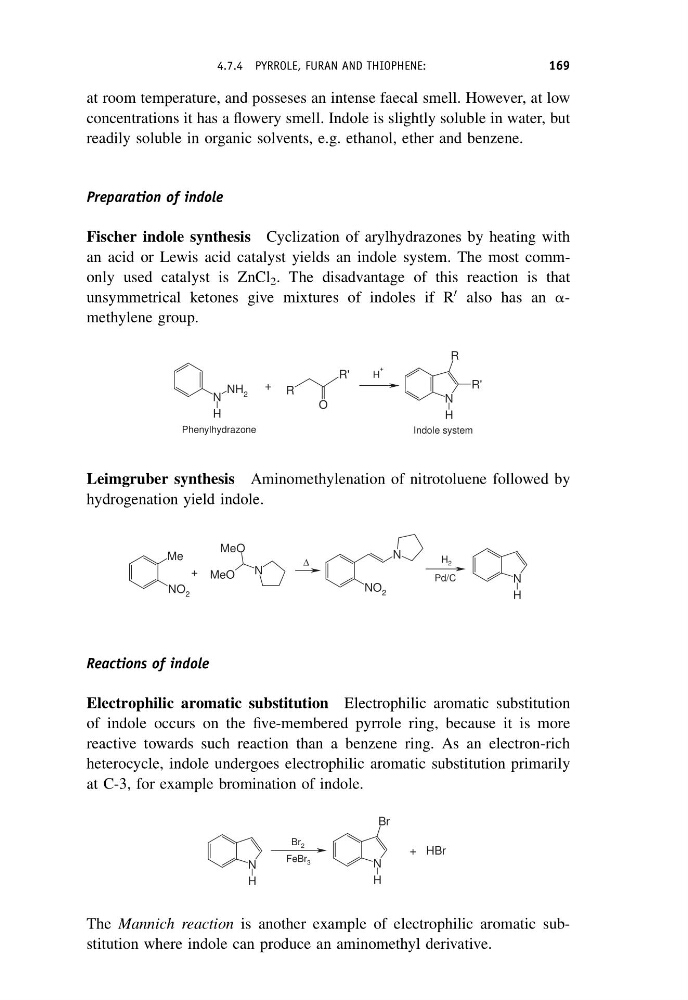
Fischer indole synthesis Cyclization of arylhydrazones by heating with
an acid or Lewis acid catalyst yields an indole system. The most commonly used catalyst is ZnCl 2 . The disadvantage of this reaction is that
unsymmetrical ketones give mixtures of indoles if R
0 also has an amethylene group.
N
NH 2
H
R'
O
R
N
R
R'
H
H
+
Phenylhydrazone
Indole system
+
Leimgruber synthesis Aminomethylenation of nitrotoluene followed by
hydrogenation yield indole.
N
H
Me
NO 2
N
MeO
MeO
N
NO 2
+
∆
H 2
Pd/C
Reactions of indole
Electrophilic aromatic substitution Electrophilic aromatic substitution
of indole occurs on the five-membered pyrrole ring, because it is more
reactive towards such reaction than a benzene ring. As an electron-rich
heterocycle, indole undergoes electrophilic aromatic substitution primarily
at C-3, for example bromination of indole.
N
H
N
H
Br
Br 2
FeBr 3
+ HBr
The Mannich reaction is another example of electrophilic aromatic substitution where indole can produce an aminomethyl derivative.
4.7.4 PYRROLE, FURAN AND THIOPHENE:
169
concentrations it has a flowery smell. Indole is slightly soluble in water, but
readily soluble in organic solvents, e.g. ethanol, ether and benzene.
Preparation of indole
Fischer indole synthesis Cyclization of arylhydrazones by heating with
an acid or Lewis acid catalyst yields an indole system. The most commonly used catalyst is ZnCl 2 . The disadvantage of this reaction is that
unsymmetrical ketones give mixtures of indoles if R
0 also has an amethylene group.
N
NH 2
H
R'
O
R
N
R
R'
H
H
+
Phenylhydrazone
Indole system
+
Leimgruber synthesis Aminomethylenation of nitrotoluene followed by
hydrogenation yield indole.
N
H
Me
NO 2
N
MeO
MeO
N
NO 2
+
∆
H 2
Pd/C
Reactions of indole
Electrophilic aromatic substitution Electrophilic aromatic substitution
of indole occurs on the five-membered pyrrole ring, because it is more
reactive towards such reaction than a benzene ring. As an electron-rich
heterocycle, indole undergoes electrophilic aromatic substitution primarily
at C-3, for example bromination of indole.
N
H
N
H
Br
Br 2
FeBr 3
+ HBr
The Mannich reaction is another example of electrophilic aromatic substitution where indole can produce an aminomethyl derivative.
4.7.4 PYRROLE, FURAN AND THIOPHENE:
169