

N
H
N
H
Me
Me
N
Me
Me
H
HCHO
AcOH
+
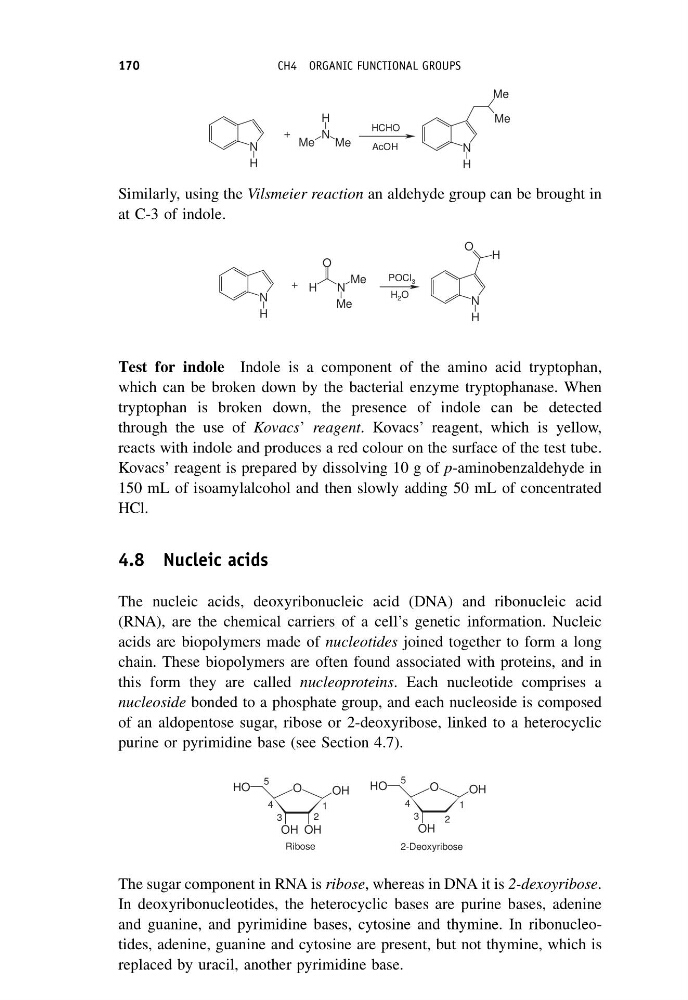
Similarly, using the Vilsmeier reaction an aldehyde group can be brought in
at C-3 of indole.
N
H
N
H
H
O
H
N
O
Me
Me
POCl 3
H 2 O
+
Test for indole Indole is a component of the amino acid tryptophan,
which can be broken down by the bacterial enzyme tryptophanase. When
tryptophan is broken down, the presence of indole can be detected
through the use of Kovacs’ reagent. Kovacs’ reagent, which is yellow,
reacts with indole and produces a red colour on the surface of the test tube.
Kovacs’ reagent is prepared by dissolving 10 g of p-aminobenzaldehyde in
150 mL of isoamylalcohol and then slowly adding 50 mL of concentrated
HCl.
4.8 Nucleic acids
The nucleic acids, deoxyribonucleic acid (DNA) and ribonucleic acid
(RNA), are the chemical carriers of a cell’s genetic information. Nucleic
acids are biopolymers made of nucleotides joined together to form a long
chain. These biopolymers are often found associated with proteins, and in
this form they are called nucleoproteins. Each nucleotide comprises a
nucleoside bonded to a phosphate group, and each nucleoside is composed
of an aldopentose sugar, ribose or 2-deoxyribose, linked to a heterocyclic
purine or pyrimidine base (see Section 4.7).
O
OH
OH
OH
O
H
O
OH
OH
O
H
1
2
3
4
5
Ribose
1
2
3
4
5
2-Deoxyribose
The sugar component in RNA is ribose, whereas in DNA it is 2-dexoyribose.
In deoxyribonucleotides, the heterocyclic bases are purine bases, adenine
and guanine, and pyrimidine bases, cytosine and thymine. In ribonucleotides, adenine, guanine and cytosine are present, but not thymine, which is
replaced by uracil, another pyrimidine base.
170
CH4 ORGANIC FUNCTIONAL GROUPS
H
N
H
Me
Me
N
Me
Me
H
HCHO
AcOH
+
Similarly, using the Vilsmeier reaction an aldehyde group can be brought in
at C-3 of indole.
N
H
N
H
H
O
H
N
O
Me
Me
POCl 3
H 2 O
+
Test for indole Indole is a component of the amino acid tryptophan,
which can be broken down by the bacterial enzyme tryptophanase. When
tryptophan is broken down, the presence of indole can be detected
through the use of Kovacs’ reagent. Kovacs’ reagent, which is yellow,
reacts with indole and produces a red colour on the surface of the test tube.
Kovacs’ reagent is prepared by dissolving 10 g of p-aminobenzaldehyde in
150 mL of isoamylalcohol and then slowly adding 50 mL of concentrated
HCl.
4.8 Nucleic acids
The nucleic acids, deoxyribonucleic acid (DNA) and ribonucleic acid
(RNA), are the chemical carriers of a cell’s genetic information. Nucleic
acids are biopolymers made of nucleotides joined together to form a long
chain. These biopolymers are often found associated with proteins, and in
this form they are called nucleoproteins. Each nucleotide comprises a
nucleoside bonded to a phosphate group, and each nucleoside is composed
of an aldopentose sugar, ribose or 2-deoxyribose, linked to a heterocyclic
purine or pyrimidine base (see Section 4.7).
O
OH
OH
OH
O
H
O
OH
OH
O
H
1
2
3
4
5
Ribose
1
2
3
4
5
2-Deoxyribose
The sugar component in RNA is ribose, whereas in DNA it is 2-dexoyribose.
In deoxyribonucleotides, the heterocyclic bases are purine bases, adenine
and guanine, and pyrimidine bases, cytosine and thymine. In ribonucleotides, adenine, guanine and cytosine are present, but not thymine, which is
replaced by uracil, another pyrimidine base.
170
CH4 ORGANIC FUNCTIONAL GROUPS