

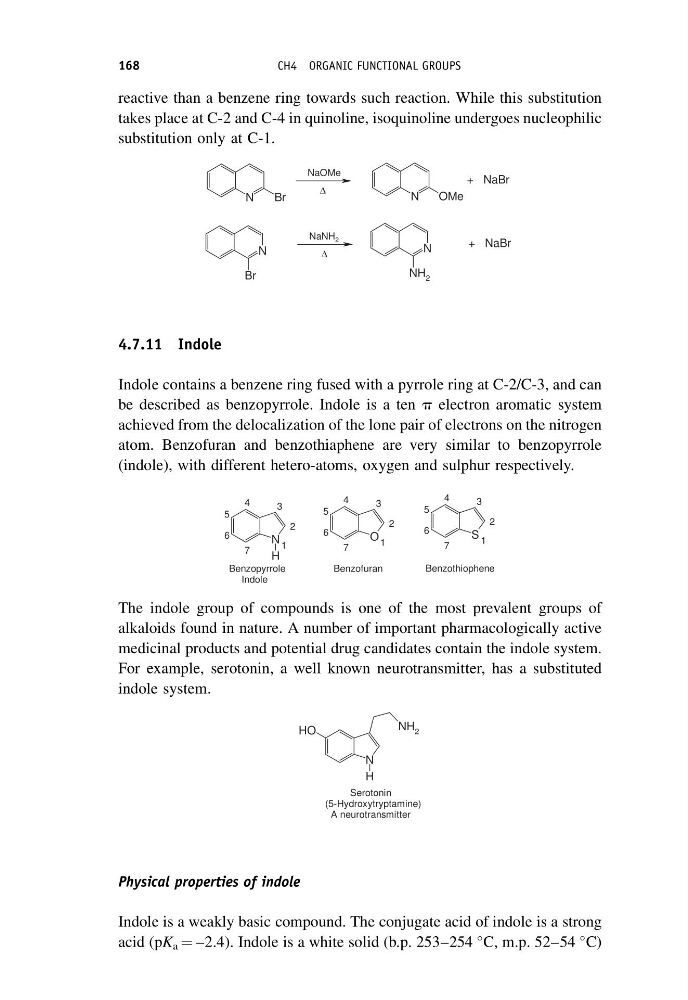
reactive than a benzene ring towards such reaction. While this substitution
takes place at C-2 and C-4 in quinoline, isoquinoline undergoes nucleophilic
substitution only at C-1.
N
Br
N
Br
N
OMe
N
NH 2
∆
NaOMe
+ NaBr
+ NaBr
∆
NaNH 2
4.7.11 Indole
Indole contains a benzene ring fused with a pyrrole ring at C-2/C-3, and can
be described as benzopyrrole. Indole is a ten p electron aromatic system
achieved from the delocalization of the lone pair of electrons on the nitrogen
atom. Benzofuran and benzothiaphene are very similar to benzopyrrole
(indole), with different hetero-atoms, oxygen and sulphur respectively.
N
H
O
S
1
2
3
4
5
6
7
1
2
3
4
5
6
7
1
2
3
4
5
6
7
Benzopyrrole
Indole
Benzofuran
Benzothiophene
The indole group of compounds is one of the most prevalent groups of
alkaloids found in nature. A number of important pharmacologically active
medicinal products and potential drug candidates contain the indole system.
For example, serotonin, a well known neurotransmitter, has a substituted
indole system.
N
H
NH 2
O
H
Serotonin
(5-Hydroxytryptamine)
A neurotransmitter
Physical properties of indole
Indole is a weakly basic compound. The conjugate acid of indole is a strong
acid (pK a ¼ –2.4). Indole is a white solid (b.p. 253–254
C, m.p. 52–54
C)
168
CH4 ORGANIC FUNCTIONAL GROUPS
takes place at C-2 and C-4 in quinoline, isoquinoline undergoes nucleophilic
substitution only at C-1.
N
Br
N
Br
N
OMe
N
NH 2
∆
NaOMe
+ NaBr
+ NaBr
∆
NaNH 2
4.7.11 Indole
Indole contains a benzene ring fused with a pyrrole ring at C-2/C-3, and can
be described as benzopyrrole. Indole is a ten p electron aromatic system
achieved from the delocalization of the lone pair of electrons on the nitrogen
atom. Benzofuran and benzothiaphene are very similar to benzopyrrole
(indole), with different hetero-atoms, oxygen and sulphur respectively.
N
H
O
S
1
2
3
4
5
6
7
1
2
3
4
5
6
7
1
2
3
4
5
6
7
Benzopyrrole
Indole
Benzofuran
Benzothiophene
The indole group of compounds is one of the most prevalent groups of
alkaloids found in nature. A number of important pharmacologically active
medicinal products and potential drug candidates contain the indole system.
For example, serotonin, a well known neurotransmitter, has a substituted
indole system.
N
H
NH 2
O
H
Serotonin
(5-Hydroxytryptamine)
A neurotransmitter
Physical properties of indole
Indole is a weakly basic compound. The conjugate acid of indole is a strong
acid (pK a ¼ –2.4). Indole is a white solid (b.p. 253–254
C, m.p. 52–54
C)
168
CH4 ORGANIC FUNCTIONAL GROUPS