

MeO
MeO
NH 2
MeO
MeO
N
OMe
OMe
O
H
N
MeO
MeO
OMe
OMe
N
MeO
MeO
OMe
OMe
Pd
N-acylation or
amide formation
Cyclodehydration POCl 3
Aromatization
Papaverine
β-Phenylethylamine
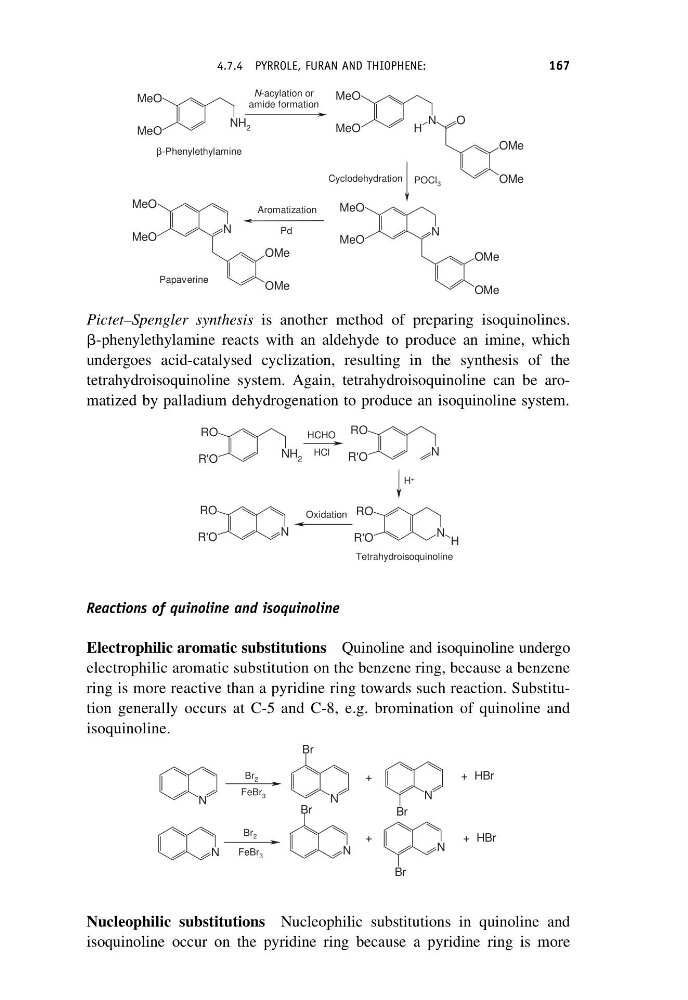
Pictet–Spengler synthesis is another method of preparing isoquinolines.
b-phenylethylamine reacts with an aldehyde to produce an imine, which
undergoes acid-catalysed cyclization, resulting in the synthesis of the
tetrahydroisoquinoline system. Again, tetrahydroisoquinoline can be aromatized by palladium dehydrogenation to produce an isoquinoline system.
RO
R'O
NH 2
RO
R'O
N
RO
R'O
N H
N
RO
R'O
HCHO
HCl
H +
Tetrahydroisoquinoline
Oxidation
Reactions of quinoline and isoquinoline
Electrophilic aromatic substitutions Quinoline and isoquinoline undergo
electrophilic aromatic substitution on the benzene ring, because a benzene
ring is more reactive than a pyridine ring towards such reaction. Substitution generally occurs at C-5 and C-8, e.g. bromination of quinoline and
isoquinoline.
N
N
N
Br
N
Br
N
Br
N
Br
Br 2
FeBr 3
Br 2
FeBr 3
+
+
+ HBr
+ HBr
Nucleophilic substitutions Nucleophilic substitutions in quinoline and
isoquinoline occur on the pyridine ring because a pyridine ring is more
4.7.4 PYRROLE, FURAN AND THIOPHENE:
167
MeO
NH 2
MeO
MeO
N
OMe
OMe
O
H
N
MeO
MeO
OMe
OMe
N
MeO
MeO
OMe
OMe
Pd
N-acylation or
amide formation
Cyclodehydration POCl 3
Aromatization
Papaverine
β-Phenylethylamine
Pictet–Spengler synthesis is another method of preparing isoquinolines.
b-phenylethylamine reacts with an aldehyde to produce an imine, which
undergoes acid-catalysed cyclization, resulting in the synthesis of the
tetrahydroisoquinoline system. Again, tetrahydroisoquinoline can be aromatized by palladium dehydrogenation to produce an isoquinoline system.
RO
R'O
NH 2
RO
R'O
N
RO
R'O
N H
N
RO
R'O
HCHO
HCl
H +
Tetrahydroisoquinoline
Oxidation
Reactions of quinoline and isoquinoline
Electrophilic aromatic substitutions Quinoline and isoquinoline undergo
electrophilic aromatic substitution on the benzene ring, because a benzene
ring is more reactive than a pyridine ring towards such reaction. Substitution generally occurs at C-5 and C-8, e.g. bromination of quinoline and
isoquinoline.
N
N
N
Br
N
Br
N
Br
N
Br
Br 2
FeBr 3
Br 2
FeBr 3
+
+
+ HBr
+ HBr
Nucleophilic substitutions Nucleophilic substitutions in quinoline and
isoquinoline occur on the pyridine ring because a pyridine ring is more
4.7.4 PYRROLE, FURAN AND THIOPHENE:
167