

acids as the protonated derivative. Some other physical properties of these
compounds are shown below.
b.p. (
C) m.p. (
C)
Physical state
Quinoline
238
À15.0
A colourless hygroscopic liquid with a strong odour
Isoquinoline
242
26–28
A colourless hygroscopic liquid at room temperature
with a penetrating, unpleasant odour.
Preparation of quinoline and isoquinoline
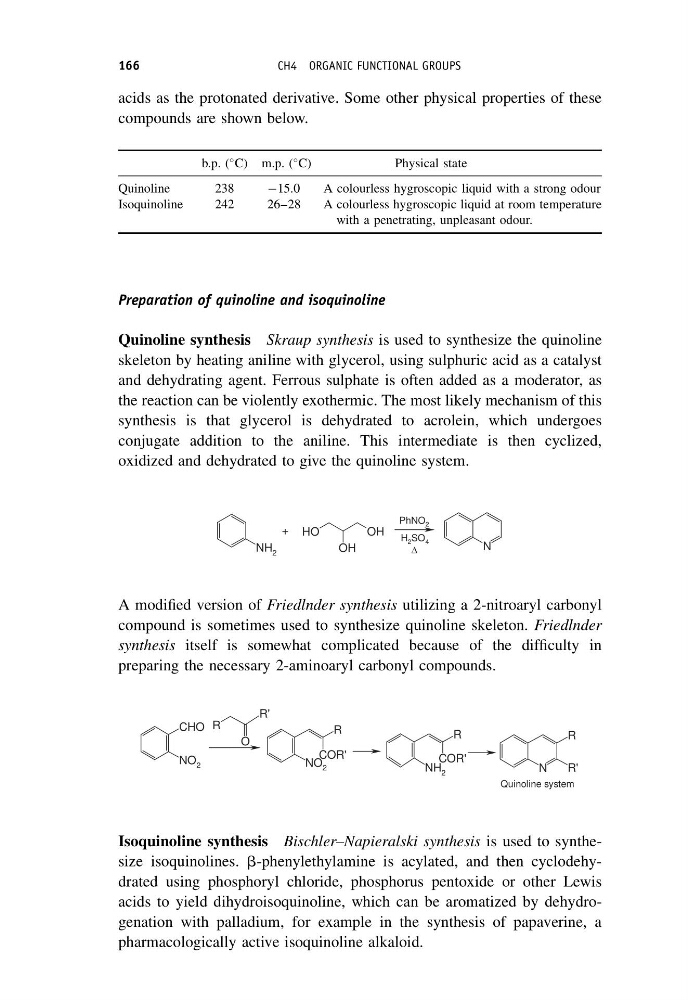
Quinoline synthesis Skraup synthesis is used to synthesize the quinoline
skeleton by heating aniline with glycerol, using sulphuric acid as a catalyst
and dehydrating agent. Ferrous sulphate is often added as a moderator, as
the reaction can be violently exothermic. The most likely mechanism of this
synthesis is that glycerol is dehydrated to acrolein, which undergoes
conjugate addition to the aniline. This intermediate is then cyclized,
oxidized and dehydrated to give the quinoline system.
N
NH 2
O
H
OH
OH
+
PhNO 2
H 2 SO 4
∆
A modified version of Friedlnder synthesis utilizing a 2-nitroaryl carbonyl
compound is sometimes used to synthesize quinoline skeleton. Friedlnder
synthesis itself is somewhat complicated because of the difficulty in
preparing the necessary 2-aminoaryl carbonyl compounds.
NO 2
CHO R
R'
O
R
NO 2
COR'
R
NH 2
COR'
N
R
R'
Quinoline system
Isoquinoline synthesis Bischler–Napieralski synthesis is used to synthesize isoquinolines. b-phenylethylamine is acylated, and then cyclodehydrated using phosphoryl chloride, phosphorus pentoxide or other Lewis
acids to yield dihydroisoquinoline, which can be aromatized by dehydrogenation with palladium, for example in the synthesis of papaverine, a
pharmacologically active isoquinoline alkaloid.
166
CH4 ORGANIC FUNCTIONAL GROUPS
compounds are shown below.
b.p. (
C) m.p. (
C)
Physical state
Quinoline
238
À15.0
A colourless hygroscopic liquid with a strong odour
Isoquinoline
242
26–28
A colourless hygroscopic liquid at room temperature
with a penetrating, unpleasant odour.
Preparation of quinoline and isoquinoline
Quinoline synthesis Skraup synthesis is used to synthesize the quinoline
skeleton by heating aniline with glycerol, using sulphuric acid as a catalyst
and dehydrating agent. Ferrous sulphate is often added as a moderator, as
the reaction can be violently exothermic. The most likely mechanism of this
synthesis is that glycerol is dehydrated to acrolein, which undergoes
conjugate addition to the aniline. This intermediate is then cyclized,
oxidized and dehydrated to give the quinoline system.
N
NH 2
O
H
OH
OH
+
PhNO 2
H 2 SO 4
∆
A modified version of Friedlnder synthesis utilizing a 2-nitroaryl carbonyl
compound is sometimes used to synthesize quinoline skeleton. Friedlnder
synthesis itself is somewhat complicated because of the difficulty in
preparing the necessary 2-aminoaryl carbonyl compounds.
NO 2
CHO R
R'
O
R
NO 2
COR'
R
NH 2
COR'
N
R
R'
Quinoline system
Isoquinoline synthesis Bischler–Napieralski synthesis is used to synthesize isoquinolines. b-phenylethylamine is acylated, and then cyclodehydrated using phosphoryl chloride, phosphorus pentoxide or other Lewis
acids to yield dihydroisoquinoline, which can be aromatized by dehydrogenation with palladium, for example in the synthesis of papaverine, a
pharmacologically active isoquinoline alkaloid.
166
CH4 ORGANIC FUNCTIONAL GROUPS