

4.7.10 Quinoline and isoquinoline
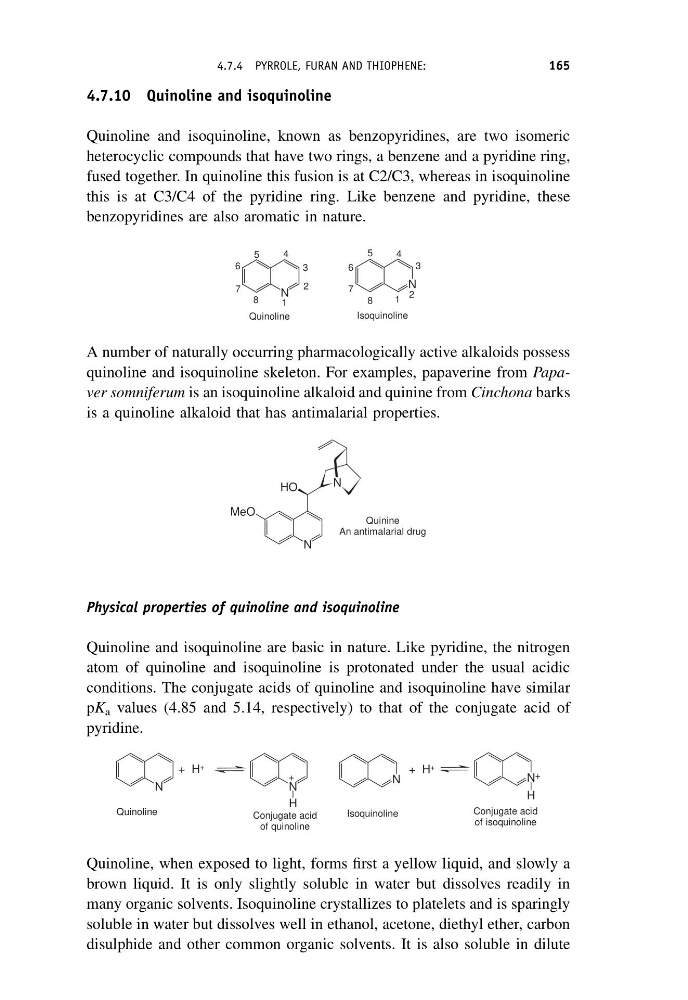
Quinoline and isoquinoline, known as benzopyridines, are two isomeric
heterocyclic compounds that have two rings, a benzene and a pyridine ring,
fused together. In quinoline this fusion is at C2/C3, whereas in isoquinoline
this is at C3/C4 of the pyridine ring. Like benzene and pyridine, these
benzopyridines are also aromatic in nature.
N
N
Quinoline
Isoquinoline
1
2
3
4
5
6
7
8
1 2
3
4
5
6
7
8
A number of naturally occurring pharmacologically active alkaloids possess
quinoline and isoquinoline skeleton. For examples, papaverine from Papaver somniferum is an isoquinoline alkaloid and quinine from Cinchona barks
is a quinoline alkaloid that has antimalarial properties.
N
N
O
H
MeO
Quinine
An antimalarial drug
Physical properties of quinoline and isoquinoline
Quinoline and isoquinoline are basic in nature. Like pyridine, the nitrogen
atom of quinoline and isoquinoline is protonated under the usual acidic
conditions. The conjugate acids of quinoline and isoquinoline have similar
pK a values (4.85 and 5.14, respectively) to that of the conjugate acid of
pyridine.
N
N
H
N
N
H
Quinoline
+ H +
+
Conjugate acid
of quinoline
Isoquinoline
+ H +
+
Conjugate acid
of isoquinoline
Quinoline, when exposed to light, forms first a yellow liquid, and slowly a
brown liquid. It is only slightly soluble in water but dissolves readily in
many organic solvents. Isoquinoline crystallizes to platelets and is sparingly
soluble in water but dissolves well in ethanol, acetone, diethyl ether, carbon
disulphide and other common organic solvents. It is also soluble in dilute
4.7.4 PYRROLE, FURAN AND THIOPHENE:
165
Quinoline and isoquinoline, known as benzopyridines, are two isomeric
heterocyclic compounds that have two rings, a benzene and a pyridine ring,
fused together. In quinoline this fusion is at C2/C3, whereas in isoquinoline
this is at C3/C4 of the pyridine ring. Like benzene and pyridine, these
benzopyridines are also aromatic in nature.
N
N
Quinoline
Isoquinoline
1
2
3
4
5
6
7
8
1 2
3
4
5
6
7
8
A number of naturally occurring pharmacologically active alkaloids possess
quinoline and isoquinoline skeleton. For examples, papaverine from Papaver somniferum is an isoquinoline alkaloid and quinine from Cinchona barks
is a quinoline alkaloid that has antimalarial properties.
N
N
O
H
MeO
Quinine
An antimalarial drug
Physical properties of quinoline and isoquinoline
Quinoline and isoquinoline are basic in nature. Like pyridine, the nitrogen
atom of quinoline and isoquinoline is protonated under the usual acidic
conditions. The conjugate acids of quinoline and isoquinoline have similar
pK a values (4.85 and 5.14, respectively) to that of the conjugate acid of
pyridine.
N
N
H
N
N
H
Quinoline
+ H +
+
Conjugate acid
of quinoline
Isoquinoline
+ H +
+
Conjugate acid
of isoquinoline
Quinoline, when exposed to light, forms first a yellow liquid, and slowly a
brown liquid. It is only slightly soluble in water but dissolves readily in
many organic solvents. Isoquinoline crystallizes to platelets and is sparingly
soluble in water but dissolves well in ethanol, acetone, diethyl ether, carbon
disulphide and other common organic solvents. It is also soluble in dilute
4.7.4 PYRROLE, FURAN AND THIOPHENE:
165