

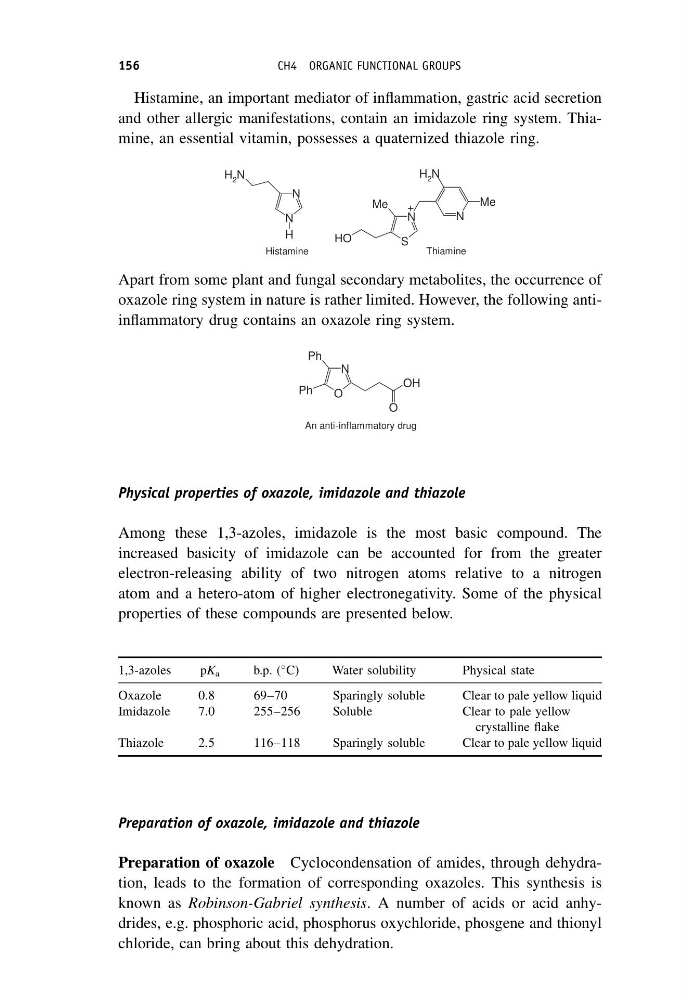
Histamine, an important mediator of inflammation, gastric acid secretion
and other allergic manifestations, contain an imidazole ring system. Thiamine, an essential vitamin, possesses a quaternized thiazole ring.
N
N
H
N
H 2
S
N
N
N
H 2
Me
Me
O
H
Histamine
+
Thiamine
Apart from some plant and fungal secondary metabolites, the occurrence of
oxazole ring system in nature is rather limited. However, the following antiinflammatory drug contains an oxazole ring system.
O
N
O
OH
Ph
Ph
An anti-inflammatory drug
Physical properties of oxazole, imidazole and thiazole
Among these 1,3-azoles, imidazole is the most basic compound. The
increased basicity of imidazole can be accounted for from the greater
electron-releasing ability of two nitrogen atoms relative to a nitrogen
atom and a hetero-atom of higher electronegativity. Some of the physical
properties of these compounds are presented below.
1,3-azoles
pK a
b.p. (
C)
Water solubility
Physical state
Oxazole
0.8
69–70
Sparingly soluble
Clear to pale yellow liquid
Imidazole
7.0
255–256
Soluble
Clear to pale yellow
crystalline flake
Thiazole
2.5
116–118
Sparingly soluble
Clear to pale yellow liquid
Preparation of oxazole, imidazole and thiazole
Preparation of oxazole Cyclocondensation of amides, through dehydration, leads to the formation of corresponding oxazoles. This synthesis is
known as Robinson-Gabriel synthesis. A number of acids or acid anhydrides, e.g. phosphoric acid, phosphorus oxychloride, phosgene and thionyl
chloride, can bring about this dehydration.
156
CH4 ORGANIC FUNCTIONAL GROUPS
and other allergic manifestations, contain an imidazole ring system. Thiamine, an essential vitamin, possesses a quaternized thiazole ring.
N
N
H
N
H 2
S
N
N
N
H 2
Me
Me
O
H
Histamine
+
Thiamine
Apart from some plant and fungal secondary metabolites, the occurrence of
oxazole ring system in nature is rather limited. However, the following antiinflammatory drug contains an oxazole ring system.
O
N
O
OH
Ph
Ph
An anti-inflammatory drug
Physical properties of oxazole, imidazole and thiazole
Among these 1,3-azoles, imidazole is the most basic compound. The
increased basicity of imidazole can be accounted for from the greater
electron-releasing ability of two nitrogen atoms relative to a nitrogen
atom and a hetero-atom of higher electronegativity. Some of the physical
properties of these compounds are presented below.
1,3-azoles
pK a
b.p. (
C)
Water solubility
Physical state
Oxazole
0.8
69–70
Sparingly soluble
Clear to pale yellow liquid
Imidazole
7.0
255–256
Soluble
Clear to pale yellow
crystalline flake
Thiazole
2.5
116–118
Sparingly soluble
Clear to pale yellow liquid
Preparation of oxazole, imidazole and thiazole
Preparation of oxazole Cyclocondensation of amides, through dehydration, leads to the formation of corresponding oxazoles. This synthesis is
known as Robinson-Gabriel synthesis. A number of acids or acid anhydrides, e.g. phosphoric acid, phosphorus oxychloride, phosgene and thionyl
chloride, can bring about this dehydration.
156
CH4 ORGANIC FUNCTIONAL GROUPS