

N
Cl
N
OMe
N
NH 2
2-Chloropyridine
NH 3
NaOMe
2-Aminopyridine
2-Methoxypyridine
N
Br
OMe
N
NH 2
OMe
4-Bromo-2-methoxypyridine
4-Amino-2-methoxypyridine
NaNH 2
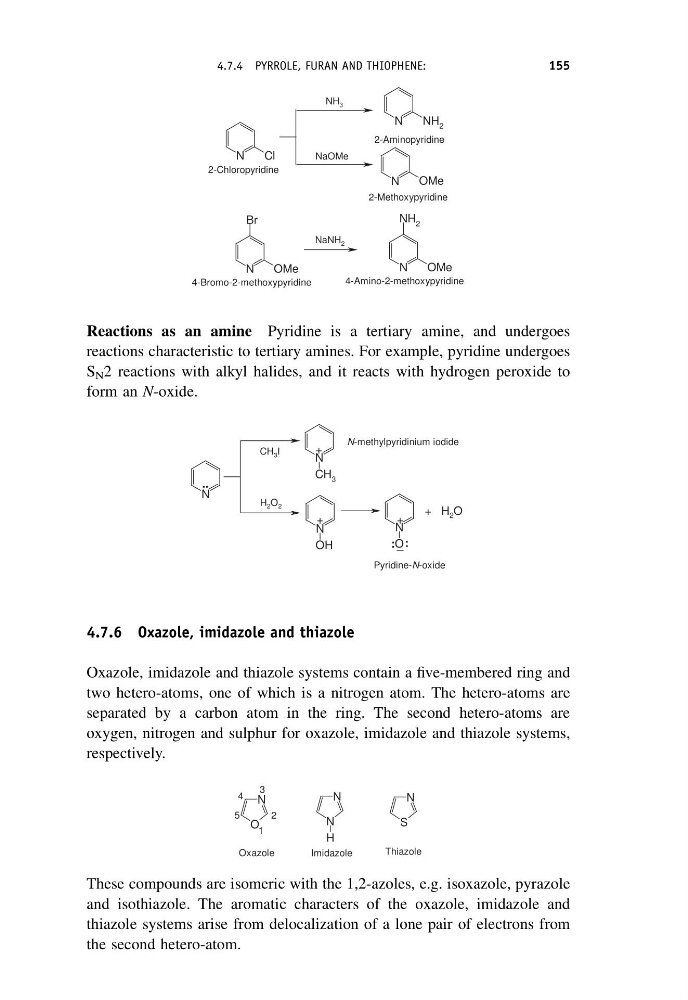
Reactions as an amine Pyridine is a tertiary amine, and undergoes
reactions characteristic to tertiary amines. For example, pyridine undergoes
S N 2 reactions with alkyl halides, and it reacts with hydrogen peroxide to
form an N-oxide.
N
N
CH 3
N
OH
N
O
..
CH 3 I
H 2 O 2
+
+
N-methylpyridinium iodide
_
+
+ H 2 O
Pyridine-N-oxide
: :
4.7.6 Oxazole, imidazole and thiazole
Oxazole, imidazole and thiazole systems contain a five-membered ring and
two hetero-atoms, one of which is a nitrogen atom. The hetero-atoms are
separated by a carbon atom in the ring. The second hetero-atoms are
oxygen, nitrogen and sulphur for oxazole, imidazole and thiazole systems,
respectively.
O
N
N
N
H
S
N
1
2
3
4
5
Oxazole
Imidazole
Thiazole
These compounds are isomeric with the 1,2-azoles, e.g. isoxazole, pyrazole
and isothiazole. The aromatic characters of the oxazole, imidazole and
thiazole systems arise from delocalization of a lone pair of electrons from
the second hetero-atom.
4.7.4 PYRROLE, FURAN AND THIOPHENE:
155
Cl
N
OMe
N
NH 2
2-Chloropyridine
NH 3
NaOMe
2-Aminopyridine
2-Methoxypyridine
N
Br
OMe
N
NH 2
OMe
4-Bromo-2-methoxypyridine
4-Amino-2-methoxypyridine
NaNH 2
Reactions as an amine Pyridine is a tertiary amine, and undergoes
reactions characteristic to tertiary amines. For example, pyridine undergoes
S N 2 reactions with alkyl halides, and it reacts with hydrogen peroxide to
form an N-oxide.
N
N
CH 3
N
OH
N
O
..
CH 3 I
H 2 O 2
+
+
N-methylpyridinium iodide
_
+
+ H 2 O
Pyridine-N-oxide
: :
4.7.6 Oxazole, imidazole and thiazole
Oxazole, imidazole and thiazole systems contain a five-membered ring and
two hetero-atoms, one of which is a nitrogen atom. The hetero-atoms are
separated by a carbon atom in the ring. The second hetero-atoms are
oxygen, nitrogen and sulphur for oxazole, imidazole and thiazole systems,
respectively.
O
N
N
N
H
S
N
1
2
3
4
5
Oxazole
Imidazole
Thiazole
These compounds are isomeric with the 1,2-azoles, e.g. isoxazole, pyrazole
and isothiazole. The aromatic characters of the oxazole, imidazole and
thiazole systems arise from delocalization of a lone pair of electrons from
the second hetero-atom.
4.7.4 PYRROLE, FURAN AND THIOPHENE:
155