

O
R
O
R'
N
H
R
R'
N
R
R'
1,5-Diketone
Dihydropyridine system
+ NH 3
−H 2 O
−2H
[O]
Pyridine system
Reactions of pyridine
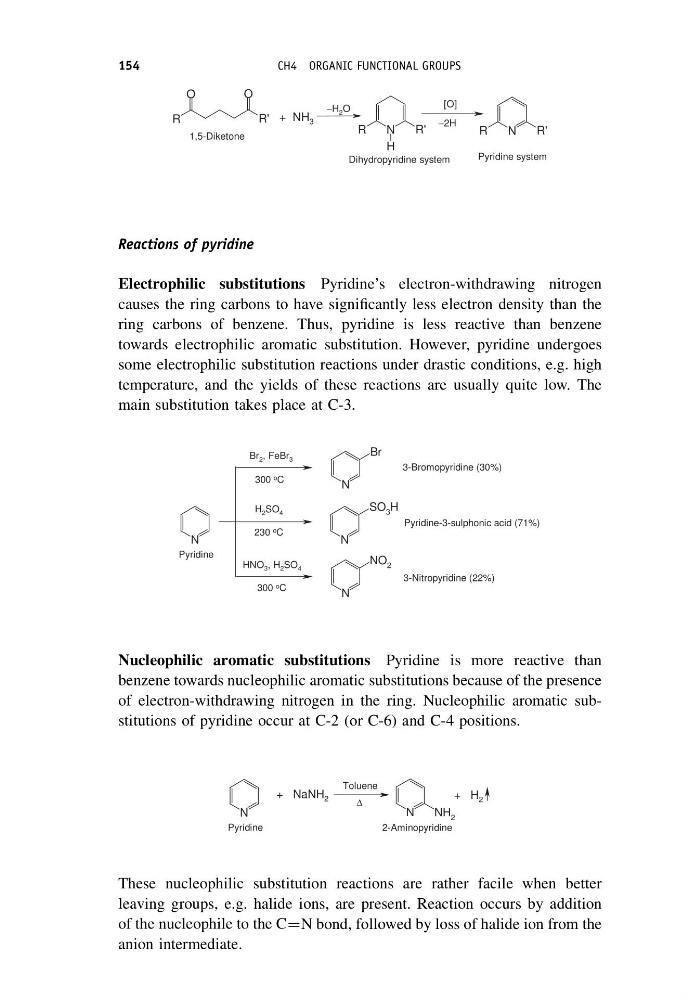
Electrophilic substitutions Pyridine’s electron-withdrawing nitrogen
causes the ring carbons to have significantly less electron density than the
ring carbons of benzene. Thus, pyridine is less reactive than benzene
towards electrophilic aromatic substitution. However, pyridine undergoes
some electrophilic substitution reactions under drastic conditions, e.g. high
temperature, and the yields of these reactions are usually quite low. The
main substitution takes place at C-3.
N
N
Br
N
SO 3 H
N
NO 2
Pyridine
Br 2 , FeBr 3
300 o C
H 2 SO 4
230 o C
HNO 3 , H 2 SO 4
300 o C
3-Bromopyridine (30%)
Pyridine-3-sulphonic acid (71%)
3-Nitropyridine (22%)
Nucleophilic aromatic substitutions Pyridine is more reactive than
benzene towards nucleophilic aromatic substitutions because of the presence
of electron-withdrawing nitrogen in the ring. Nucleophilic aromatic substitutions of pyridine occur at C-2 (or C-6) and C-4 positions.
N
N
NH 2
Pyridine
+ NaNH 2
2-Aminopyridine
Toluene
∆
+ H 2
These nucleophilic substitution reactions are rather facile when better
leaving groups, e.g. halide ions, are present. Reaction occurs by addition
of the nucleophile to the C À À
À À N bond, followed by loss of halide ion from the
anion intermediate.
154
CH4 ORGANIC FUNCTIONAL GROUPS
R
O
R'
N
H
R
R'
N
R
R'
1,5-Diketone
Dihydropyridine system
+ NH 3
−H 2 O
−2H
[O]
Pyridine system
Reactions of pyridine
Electrophilic substitutions Pyridine’s electron-withdrawing nitrogen
causes the ring carbons to have significantly less electron density than the
ring carbons of benzene. Thus, pyridine is less reactive than benzene
towards electrophilic aromatic substitution. However, pyridine undergoes
some electrophilic substitution reactions under drastic conditions, e.g. high
temperature, and the yields of these reactions are usually quite low. The
main substitution takes place at C-3.
N
N
Br
N
SO 3 H
N
NO 2
Pyridine
Br 2 , FeBr 3
300 o C
H 2 SO 4
230 o C
HNO 3 , H 2 SO 4
300 o C
3-Bromopyridine (30%)
Pyridine-3-sulphonic acid (71%)
3-Nitropyridine (22%)
Nucleophilic aromatic substitutions Pyridine is more reactive than
benzene towards nucleophilic aromatic substitutions because of the presence
of electron-withdrawing nitrogen in the ring. Nucleophilic aromatic substitutions of pyridine occur at C-2 (or C-6) and C-4 positions.
N
N
NH 2
Pyridine
+ NaNH 2
2-Aminopyridine
Toluene
∆
+ H 2
These nucleophilic substitution reactions are rather facile when better
leaving groups, e.g. halide ions, are present. Reaction occurs by addition
of the nucleophile to the C À À
À À N bond, followed by loss of halide ion from the
anion intermediate.
154
CH4 ORGANIC FUNCTIONAL GROUPS