

dipole moment of pyridine is 1.57 D. Pyridine is an excellent donor ligand
in metal complexes. It is highly aromatic and moderately basic in nature,
with a pK a 5.23, i.e. a stronger base than pyrrole but weaker than
alkylamines. The lone pair of electrons on the nitrogen atom in pyridine
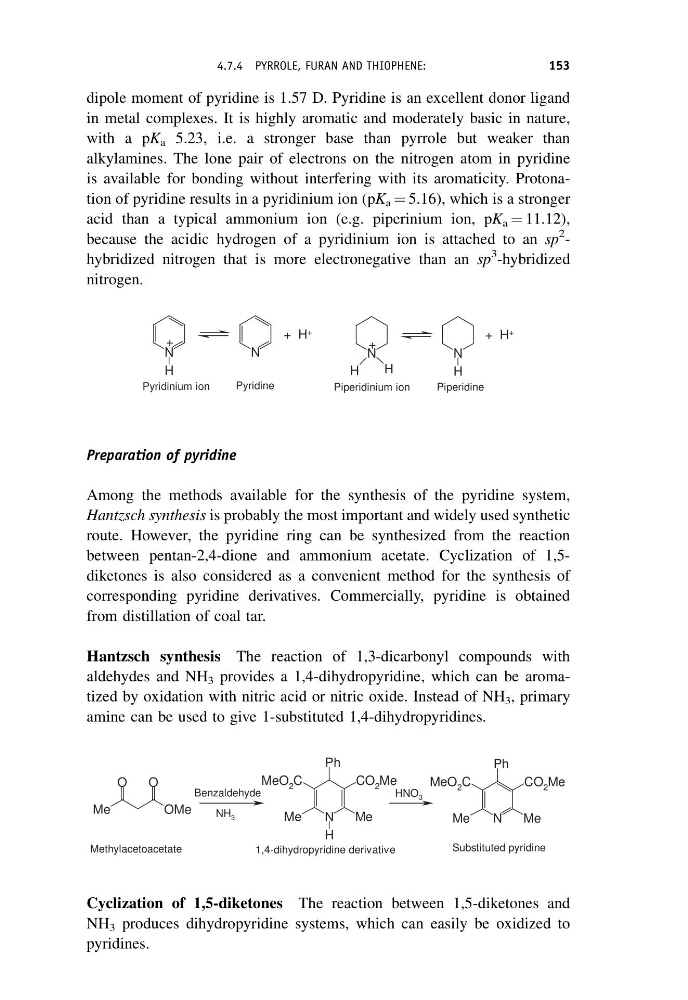
is available for bonding without interfering with its aromaticity. Protonation of pyridine results in a pyridinium ion (pK a ¼ 5.16), which is a stronger
acid than a typical ammonium ion (e.g. piperinium ion, pK a ¼ 11.12),
because the acidic hydrogen of a pyridinium ion is attached to an sp
2 -
hybridized nitrogen that is more electronegative than an sp
3
-hybridized
nitrogen.
N
H
N
N
H
H
N
H
+
Pyridinium ion
+ H +
+
Piperidinium ion
+ H +
Pyridine
Piperidine
Preparation of pyridine
Among the methods available for the synthesis of the pyridine system,
Hantzsch synthesis is probably the most important and widely used synthetic
route. However, the pyridine ring can be synthesized from the reaction
between pentan-2,4-dione and ammonium acetate. Cyclization of 1,5diketones is also considered as a convenient method for the synthesis of
corresponding pyridine derivatives. Commercially, pyridine is obtained
from distillation of coal tar.
Hantzsch synthesis The reaction of 1,3-dicarbonyl compounds with
aldehydes and NH 3 provides a 1,4-dihydropyridine, which can be aromatized by oxidation with nitric acid or nitric oxide. Instead of NH 3 , primary
amine can be used to give 1-substituted 1,4-dihydropyridines.
N
Me
Me
MeO 2 C
C O 2 Me
H
Ph
Me
O
O
OMe
N
Me
Me
CO 2 Me
MeO 2 C
Ph
NH 3
1,4-dihydropyridine derivative
HNO 3
Substituted pyridine
Benzaldehyde
Methylacetoacetate
Cyclization of 1,5-diketones The reaction between 1,5-diketones and
NH 3 produces dihydropyridine systems, which can easily be oxidized to
pyridines.
4.7.4 PYRROLE, FURAN AND THIOPHENE:
153
in metal complexes. It is highly aromatic and moderately basic in nature,
with a pK a 5.23, i.e. a stronger base than pyrrole but weaker than
alkylamines. The lone pair of electrons on the nitrogen atom in pyridine
is available for bonding without interfering with its aromaticity. Protonation of pyridine results in a pyridinium ion (pK a ¼ 5.16), which is a stronger
acid than a typical ammonium ion (e.g. piperinium ion, pK a ¼ 11.12),
because the acidic hydrogen of a pyridinium ion is attached to an sp
2 -
hybridized nitrogen that is more electronegative than an sp
3
-hybridized
nitrogen.
N
H
N
N
H
H
N
H
+
Pyridinium ion
+ H +
+
Piperidinium ion
+ H +
Pyridine
Piperidine
Preparation of pyridine
Among the methods available for the synthesis of the pyridine system,
Hantzsch synthesis is probably the most important and widely used synthetic
route. However, the pyridine ring can be synthesized from the reaction
between pentan-2,4-dione and ammonium acetate. Cyclization of 1,5diketones is also considered as a convenient method for the synthesis of
corresponding pyridine derivatives. Commercially, pyridine is obtained
from distillation of coal tar.
Hantzsch synthesis The reaction of 1,3-dicarbonyl compounds with
aldehydes and NH 3 provides a 1,4-dihydropyridine, which can be aromatized by oxidation with nitric acid or nitric oxide. Instead of NH 3 , primary
amine can be used to give 1-substituted 1,4-dihydropyridines.
N
Me
Me
MeO 2 C
C O 2 Me
H
Ph
Me
O
O
OMe
N
Me
Me
CO 2 Me
MeO 2 C
Ph
NH 3
1,4-dihydropyridine derivative
HNO 3
Substituted pyridine
Benzaldehyde
Methylacetoacetate
Cyclization of 1,5-diketones The reaction between 1,5-diketones and
NH 3 produces dihydropyridine systems, which can easily be oxidized to
pyridines.
4.7.4 PYRROLE, FURAN AND THIOPHENE:
153