

O
CH 3
C
H 3
C
H 3
O
O
CH 3
2,5-Hexanedione (86%)
2,5-Dimethylfuran
H 2 SO 4 , CH 3 CO 2 H
+ H 2 O
∆
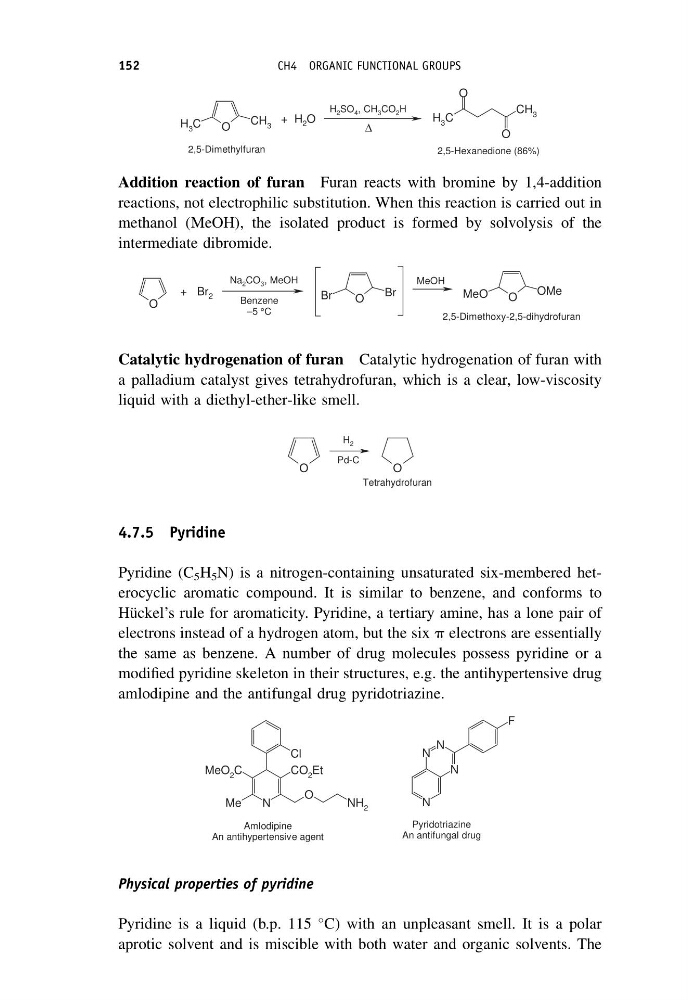
Addition reaction of furan Furan reacts with bromine by 1,4-addition
reactions, not electrophilic substitution. When this reaction is carried out in
methanol (MeOH), the isolated product is formed by solvolysis of the
intermediate dibromide.
O
O
Br
Br
O
OMe
MeO
2,5-Dimethoxy-2,5-dihydrofuran
Na 2 CO 3 , MeOH
+ Br 2
Benzene
–5 °C
MeOH
Catalytic hydrogenation of furan Catalytic hydrogenation of furan with
a palladium catalyst gives tetrahydrofuran, which is a clear, low-viscosity
liquid with a diethyl-ether-like smell.
O
O
Pd-C
H 2
Tetrahydrofuran
4.7.5 Pyridine
Pyridine (C 5 H 5 N) is a nitrogen-containing unsaturated six-membered heterocyclic aromatic compound. It is similar to benzene, and conforms to
Hu ¨ckel’s rule for aromaticity. Pyridine, a tertiary amine, has a lone pair of
electrons instead of a hydrogen atom, but the six p electrons are essentially
the same as benzene. A number of drug molecules possess pyridine or a
modified pyridine skeleton in their structures, e.g. the antihypertensive drug
amlodipine and the antifungal drug pyridotriazine.
N
Cl
Me
CO 2 Et
MeO 2 C
O
NH 2
N
N
N
N
F
Amlodipine
An antihypertensive agent
Pyridotriazine
An antifungal drug
Physical properties of pyridine
Pyridine is a liquid (b.p. 115
C) with an unpleasant smell. It is a polar
aprotic solvent and is miscible with both water and organic solvents. The
152
CH4 ORGANIC FUNCTIONAL GROUPS
CH 3
C
H 3
C
H 3
O
O
CH 3
2,5-Hexanedione (86%)
2,5-Dimethylfuran
H 2 SO 4 , CH 3 CO 2 H
+ H 2 O
∆
Addition reaction of furan Furan reacts with bromine by 1,4-addition
reactions, not electrophilic substitution. When this reaction is carried out in
methanol (MeOH), the isolated product is formed by solvolysis of the
intermediate dibromide.
O
O
Br
Br
O
OMe
MeO
2,5-Dimethoxy-2,5-dihydrofuran
Na 2 CO 3 , MeOH
+ Br 2
Benzene
–5 °C
MeOH
Catalytic hydrogenation of furan Catalytic hydrogenation of furan with
a palladium catalyst gives tetrahydrofuran, which is a clear, low-viscosity
liquid with a diethyl-ether-like smell.
O
O
Pd-C
H 2
Tetrahydrofuran
4.7.5 Pyridine
Pyridine (C 5 H 5 N) is a nitrogen-containing unsaturated six-membered heterocyclic aromatic compound. It is similar to benzene, and conforms to
Hu ¨ckel’s rule for aromaticity. Pyridine, a tertiary amine, has a lone pair of
electrons instead of a hydrogen atom, but the six p electrons are essentially
the same as benzene. A number of drug molecules possess pyridine or a
modified pyridine skeleton in their structures, e.g. the antihypertensive drug
amlodipine and the antifungal drug pyridotriazine.
N
Cl
Me
CO 2 Et
MeO 2 C
O
NH 2
N
N
N
N
F
Amlodipine
An antihypertensive agent
Pyridotriazine
An antifungal drug
Physical properties of pyridine
Pyridine is a liquid (b.p. 115
C) with an unpleasant smell. It is a polar
aprotic solvent and is miscible with both water and organic solvents. The
152
CH4 ORGANIC FUNCTIONAL GROUPS